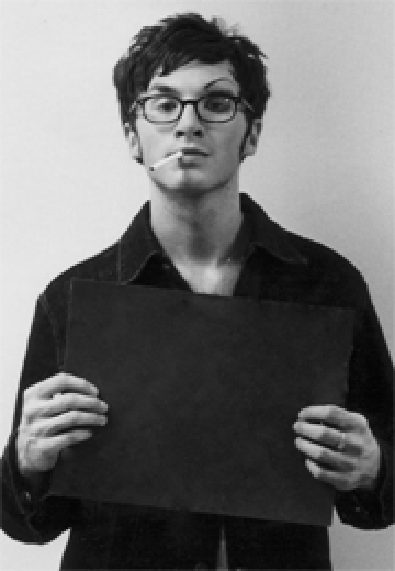
Although Bradford Louryk lip-synchs the words of Christine Jorgensen--who in 1952 became one of the world's best-known transsexuals--Christine Jorgensen Reveals is not another drag show. For one thing, it isn't campy. "I want to subvert camp and make Christine authentic and human," Louryk says.
Since his first solo play, Klytaemnestra's Unmentionables, which centers on five women of Greek tragedy, Louryk's goal has been authenticity. It has not always been an easy task, considering the iconic, larger-than-life women he has tackled-from Elektra (in Klytaemnestra and another piece, Elektra) to Judith (of Old Testament fame, in the whimsically titled Jewish Mothers) to the Virgin Mary (in his latest play, Version Mary, which he is developing with writers Lisa Kron, Bryony Lavery, Mike Albo, Theresa Rebeck, and others).
Things are happening for Louryk, a 27-year-old native of Dickson City, Penn., thanks in part to the public and critical response to Christine Jorgensen Reveals. The day after receiving a glowing New York Times review, he was invited to perform the play this summer at the Sundance Institute's Theatre Lab--where Doug Wright developed his Pulitzer Prize-winning I Am My Own Wife, a work with certain similarities. Louryk has been nominated for a Media Award from the Gay & Lesbian Alliance Against Defamation, and the show, which played a four-week engagement at Dodger Stages last month, will reopen Off-Broadway at the Studio Theatre at Theatre Row on Feb. 16 and run through April 1. Then he plays the Boston Center for the Arts (April 6-29) and the Dublin Gay Theatre Festival (May).
The genial, enthusiastic Louryk, sporting a colorful bandana across his forehead, is delighted by the upturn his career is taking. He emphasizes that he hasn't been creating solo shows as vehicles for self-advancement but to do the kind of work that most interests him. "For me, the most exciting work is new work, and that's what I'm doing," he says. "I have specific ideas of what I want theatre to be. It's theatrical and filled with roadblocks for me, the actor. That's the way I challenge myself." He calls himself an "actor and creator, but never a writer. I can come up with the idea and create the structure and arc, but then I have to bring in a writer to work with me."
Christine Jorgensen Reveals posed editing challenges, as it re-creates an actual recorded interview--the only one of its kind--between Jorgensen and African-American actor Nipsey Russell. Rob Grace, the play's co-creator, restructured the interview for drama and clarity. "Large sections were transposed to make the piece more accessible," says Louryk. "But Christine's answers to each question remain the same."
Grace also plays the condescending and supercilious Russell, but his prerecorded performance is played on a television monitor. Like Louryk, Grace doesn't actually speak but lip-synchs Russell's words. "Rob and I planned to be onstage together, but when he had to go to Los Angeles to work, we decided to do it this way," says Louryk. "So why not a black actor? Because there is so much going on here in terms of gender politics, we didn't want to add race to the mix. It would have taken away from Christine's story."
Perhaps the most striking thing about the 70-minute intermissionless piece is that there is never any doubt that Louryk's Jorgensen is a man. "She had a biological memory of being a man," he explains. "You see that in the tapes." He pauses. "If we didn't know she had been a man, would we look at her and suspect it? I don't know. Gender identity is fluid--and changes with culture, place, and era."
Nailing the Spirit
Four years ago Louryk discovered the Jorgensen interview while flipping through old LPs at the now-closed Footlight Records in the East Village. The $100 cost of the record stunned him, but it didn't keep him from purchasing it.
"Christine was so intelligent and articulate. I was especially drawn by how collected she was in the face of those idiotic questions," he says. "The interview represents the tension between conservatives and liberals in the '50s...and now. We haven't changed all that much. The interview is especially relevant with the Bush administration trying to take away the rights of women, gays, and lesbians...and everyone else. That's why Christine's story is so important, forward-thinking, ahead of her time."
Jorgensen was also generous to a fault and an enigma, he says. To some, she was a woman; to others, nothing more than a mutilated man. There were those who viewed her as progressive and those who saw her only as an exhibitionist hungry for the limelight. In Louryk's spin, she is all of the above and more.
Louryk admits he is interpreting Jorgensen, not imitating her, but there are elements of impersonation in his performance. To capture her voice-so the lip-synching would appear seamless--he listened to the record repeatedly and to whatever other footage he could uncover. Vocally, he says, "Christine cultivated a '50s notion of femininity. She sounded like any contract player at Metro during that period."
Nailing Jorgensen's voice--her rhythms, her cadences, how her lips moved--helped Louryk with her body language: how she sat and held herself. Sporting "three layers of pantyhose and a corset" affects his posture and manner. So do "the shaved arms and face, the waxed eyebrows, and the heavy makeup. It's an hour and a half of preparation," he says.
"I have to convince an audience that I'm not a 5-foot-11 man weighing 155 pounds, but 5-foot-61⁄2-inches tall, weighing 120 pounds," he says. "But my biggest challenge is specificity, articulation, and precision. It's one shot, straight through. I have to be Christine before I go on and not stop until the end, without taking a break."
A Fundraiser, Too
Louryk majored in drama at Vassar College, where he created Klytaemnestra's Unmentionables as his thesis project. The play went on to a run at Here Arts Center in 2001, and other solo shows in which he played women followed. "The greatest characters in theatre are women," he explains. "They experience the most, lose the most, and have the greatest depths. I gave myself the chance to play them." He cites the Elizabethan viewpoint that a male actor is better suited to play a woman than a woman: "During Shakespeare's era, it was believed that women were too close to femininity to portray it onstage."
In addition to acting and holding various day jobs--he currently works at the Publicity Office, a theatrical public relations firm--Louryk is a founding member of Studio 42, a theatre company with a mission to "support emerging artists who will positively affect the cultural landscape." He served as its artistic director from 2001 to 2005 and remains on its board of directors. He is also a founding member of the 5-year-old Starving Artist Award Fund, which awards $8,000 annually to needy, worthy artists across disciplinary lines.
Louryk is looking forward to continuing work on Version Mary and the new versions his round robin of writers will produce. "The Virgin Mary is the most underwritten woman, yet the most pivotal woman," he says. "She gave birth to God. We should hear different representations. A feminist, gay, lapsed Catholic, and Jewish view will be represented." He adds, "Nothing sells tickets like controversy."
For now, however, Louryk's thoughts are on Jorgensen. He says the greatest tribute he has received came from her family when they saw the show. "I was more terrified [of them] than I was of The New York Times or Doug Wright in the audience," Louryk says. "But the family said I really got her. One cousin, who has come twice, started to cry and said, 'I loved Aunty Chris so much, and tonight I got to be with her again.' "