
Want to hear the Hollywood experience in a nutshell? One week you’re making Emmys history, the next you’re getting a firm “no.” Just ask Seth Rogen.
“The Studio,” the Apple TV+ series he co-created and stars in, notched a mighty 23 Emmy nominations last month, an all-time record for a freshman comedy. It feels like Tinseltown’s stamp of approval for a show about Tinseltown. Rogen might play flailing production head Matt Remick, overseer of the fictional Continental Studios, but the cast is populated by half the town portraying themselves. Martin Scorsese signs on to direct a Kool-Aid movie; Ron Howard explodes over a studio note; and A-listers like Charlize Theron, Anthony Mackie, and Zoë Kravitz get pulled into Matt’s increasingly cringe-inducing orbit.
But if you think all those Emmy nods have made it any easier to repeat the parade of famous faces for Season 2, well…
“I was literally just told today that one of the cameos we really want will likely have no interest in doing our show,” Rogen tells us, unleashing his stuttering V8 engine of a laugh.
“We’re trying to fill these roles with very specific people that occupy very specific roles within our industry, and many of them are not people who traditionally make fun of themselves or even perform in any capacity,” he says. “We’ve once again made the smallest possible bull’s-eyes for us to be aiming at. Hypothetically, it should be easier. But so far, I’ve seen no actual evidence of that.”
What he does have evidence of (23 pieces of it, actually) is the fact he created a high-quality TV show. “The Studio,” beyond just being a slapstick workplace comedy, is a technical marvel. Each episode is constructed as a series of long, unending “oners,” giving the viewer no chance to breathe as they follow Matt from one possible film fuckup to the next. Rogen himself is nominated four times: as producer in the outstanding comedy category; for his lead performance; as co-writer of the premiere with co-creators Peter Huyck, Alex Gregory, Frida Perez, and longtime collaborator Evan Goldberg; and as co-director of the episode “The Oner”—itself a meta commentary on the one-take technique—with Goldberg.
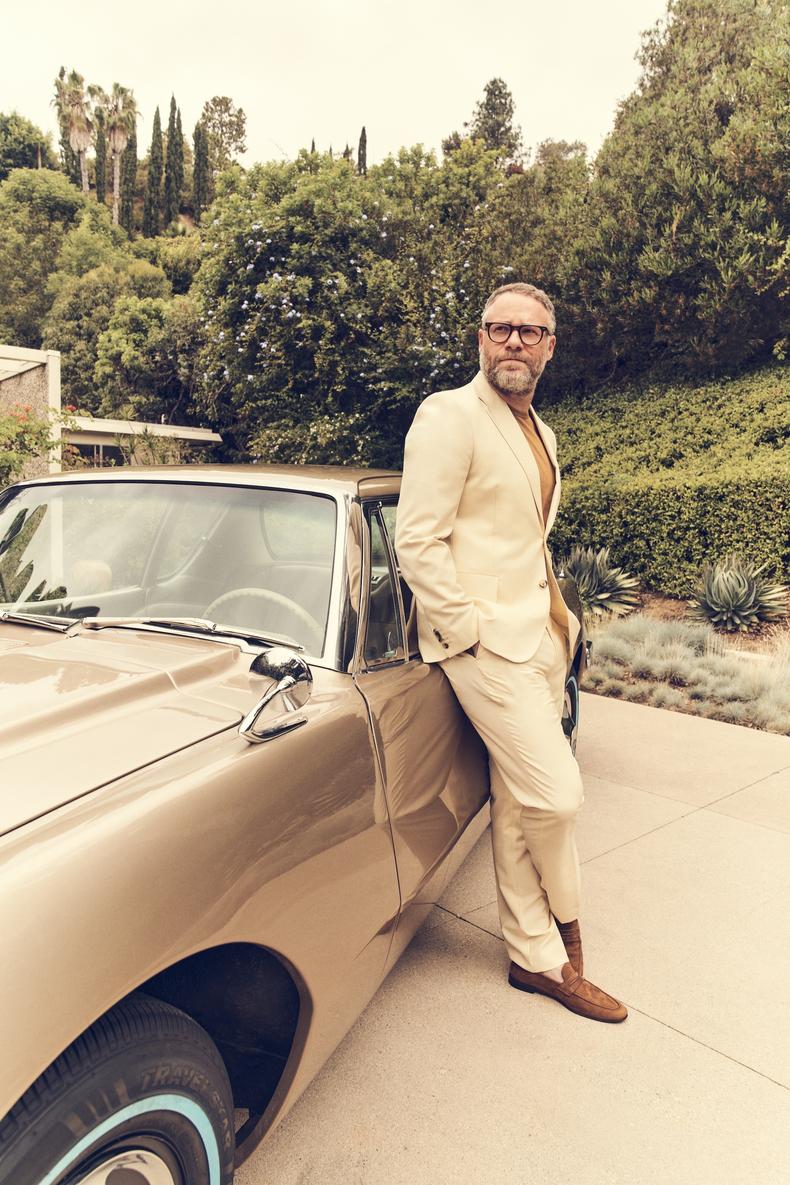
The rest of the show’s nominations landed in nearly every other comedy category, most notably the guest-actor group, where “The Studio” holds five of the six available slots: for Scorsese, Howard, Mackie, and Dave Franco as themselves, along with Bryan Cranston as profit-hungry exec Griffin Mill. (Yes, Rogen has seen the photo of Scorsese’s emotional, hands-over-his-face reaction to the news; the director’s daughter, Francesca Scorsese, texted him right away.)
“It’s all so wonderful and lovely and really outside the realm of anything I expected. And it’s new to me, in many ways, to be involved in any awards conversation,” Rogen says. “It mostly just puts immense pressure on me to continue doing a show that people like.… I have 20 minutes of happiness, and then a week and a half of excruciating fear that what we’re doing isn’t good enough.”
That’s part of the reason why he’s already hunkered down writing Season 2. When we connect, Rogen’s calling on a brainstorming break from the Sunset Boulevard workspace he shares with Goldberg that, I can’t help but point out, looks a lot like a padded cell. “It’s good for sound and it makes us feel insane, so it’s perfect,” Rogen explains.
“You hope that taste prevails, because there is no formula. People said no to ‘Superbad’ for years and years, and then it came out and made hundreds of millions of dollars. No one knows.”
He wants the sophomore season to dive even more philosophically into the gray area between art and commerce, where execs like his character often have to decide between good taste and good ticket sales. “It’s an interesting debate: When does someone become an artist? When does giving notes translate into actually being a part of the creative process?” Rogen muses. There’s also the matter of accurately satirizing an industry that seems to self-satirize daily, where real-life Imax movie theaters will host an AI festival and HBO Max becomes Max and then HBO Max again.
And then, once the team does have all these ideas in place, they still need the cameos they’re penciling in to actually say yes. “It’s quite hard. There’s one episode that actually is, in many ways, my favorite idea that we’ve had for the second season, and it is 100% contingent on one specific person agreeing to do it,” Rogen says. “And if they say no, we literally can’t do the episode and it won’t exist anymore.”
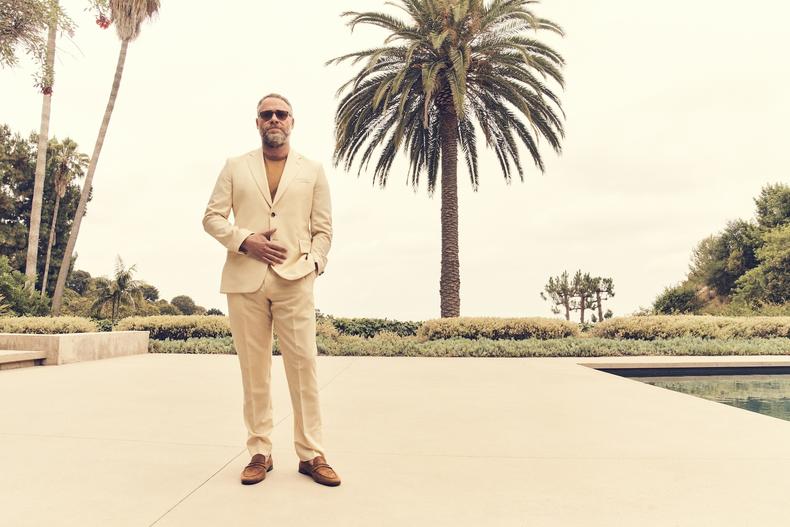
He remains tight-lipped about who the show has reached out to so far. “I know I shouldn’t talk about them publicly because I’m worried that it’s actually going to ruin my chances of getting them,” he says. The speculation around potential guests has already begun. Rogen recently shared a selfie with Vin Diesel on Instagram (caption: “Family”), sparking rumors that the chrome-domed “Fast & Furious” star had been recruited for Season 2. In reality, the two actors just happened to be at the opening of Universal Studios’ Steven Spielberg Theater—Diesel had a role in Spielberg’s “Saving Private Ryan,” Rogen in “The Fabelmans.” But the idea is out there.
“I went up and talked to him for quite a while,” Rogen says, “and he was very lovely. I had joked [on ‘Jimmy Kimmel Live!’] about how I wanted him on the show, and then, a week later, to meet him for the first time I’ve ever met him in my entire life, it felt very fortuitous.”
If you haven’t been paying attention for the past, say, 15 years, you might be wondering when exactly Rogen graduated from court jester to the new king of Hollywood—a guy with the power to get the director of “Taxi Driver” his first acting nomination. That influence has extended beyond just star wrangling; Rogen’s become a production powerhouse in his own right. His Point Grey Pictures, founded alongside Goldberg in 2011, has grossed more than a billion dollars backing a diverse slate of crass comedies like “This Is the End” and “Neighbors” alongside tentpole projects like Prime Video’s “The Boys” and the animated feature “Teenage Mutant Ninja Turtles: Mutant Mayhem.”
“Honestly, acting is a very weird job and a very weird art form. I’ve acted with children who literally don’t know what the scene is about and they’re incredible. And I always leave those days not knowing what to do with that information.”
It’s all a far cry from when Rogen first emerged, playing a fresh-faced 16-year-old on Paul Feig’s short-lived “Freaks and Geeks”; soon afterward, he was a wunderkind writer on the staff of Sacha Baron Cohen’s “Da Ali G Show” (for which he earned his first Emmy nomination). The powers that be did not know what to make of this pot-smoking, gravel-voiced newcomer, especially as he proved to be a draw both behind and in front of the camera. In 2007, Rogen led a film for the first time, Judd Apatow’s “Knocked Up” (which grossed $220 million on a $25 million budget); that same year, Sony Pictures released Greg Mottola’s “Superbad” ($170 million on a $20 million budget), from a script Rogen and Goldberg wrote in high school.
“If things go well for him at the box office, Los Angeles restaurants may have to deal with an infestation of waiters who are dumpy Canadians with Jewfros,” reads a Time magazine interview published right before “Knocked Up” hit theaters. I mention to Rogen how surprising it is that so many of these early profiles had that same tone of—
“ ‘Can you believe this idiot did this?’ ” he says, finishing the sentence with a guffaw. It was a public perception he was (and still is) well aware of. “I was playing the role more than actually being myself in a lot of interviews and appearances, because it was all very new to me.
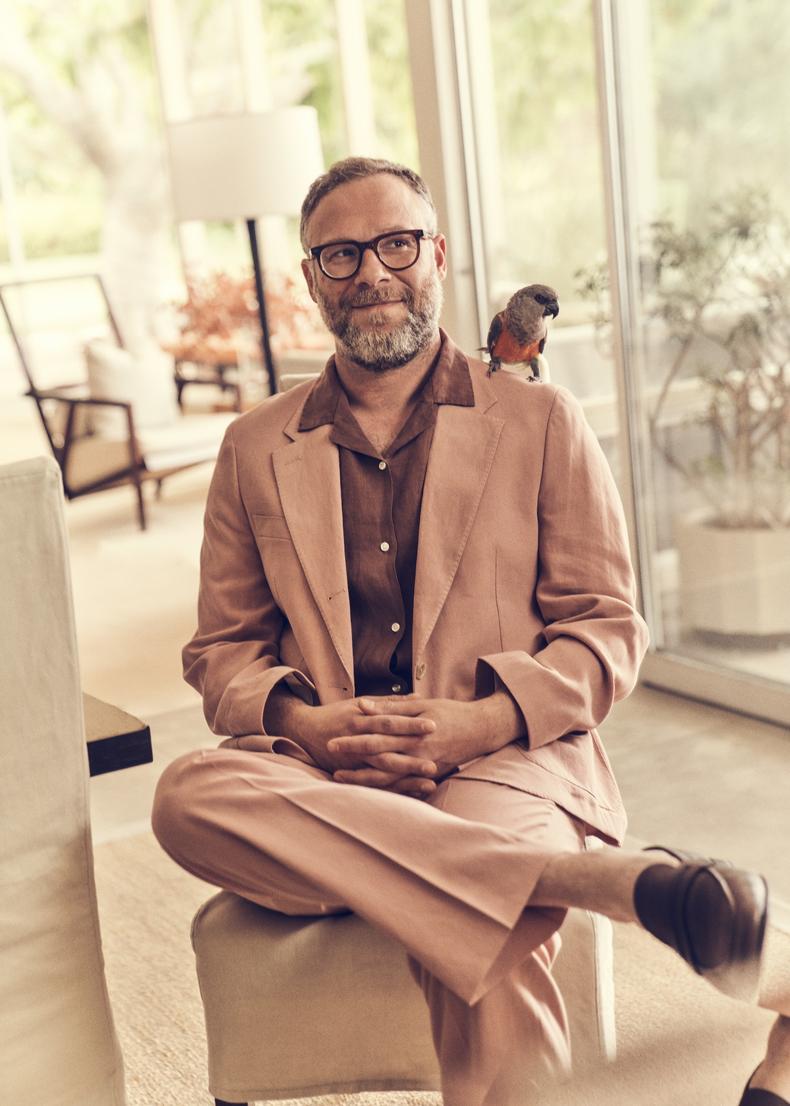
“If it was actually hurting my career, I would’ve felt differently about it,” Rogen continues. “But as all this was happening, major corporations were entrusting me with tens of millions of dollars over and over again to essentially do whatever we wanted, so I wasn’t really seeing being painted as a stoner idiot really negatively affecting the things I wanted to do, necessarily.”
The real Rogen, he insists, has less of a headliney hook. “I’m a guy who does smoke weed, but I also work all day, every single day. I watch a lot of movies, I read about movies, and I try to learn about filmmaking as much as I can,” he says. He’s worked with collaborators like Goldberg and Apatow since before he could legally buy beer; he met his wife, actor and writer Lauren Miller, before cameras rolled on “Knocked Up.” “I understand,” he says, “when you’re looking for something and ‘stoner boy hits it big’ is a more interesting narrative than ‘a guy who works really hard and then tries to do his job well.’ ”
The part of filmmaking that still mystifies him is acting. With writing and directing, he explains, “Evan and I always had a very specific and clear and distinct voice and tone that we were actively pursuing, and we had parameters for it.” But despite clearly growing beyond the improv-heavy Apatow house style over the years—just look at his stellar work in “The Fabelmans” or Danny Boyle’s “Steve Jobs”—the particulars of performing are still harder for him to pin down.
“Honestly, acting is a very weird job and a very weird art form,” he says. “I’ve acted with children who literally don’t know what the scene is about and they’re incredible. And I always leave those days not knowing what to do with that information. What does it say about the art of acting that I can be doing it with an 11-year-old, no one’s even told him what the movie is and he doesn’t care, and he’s a better actor than anyone else in the scene?”
The takeaway, in hindsight, is that “I don’t know if the more thought you put into [acting], the better you are at it, necessarily,” Rogen says. “Writing and directing, the more parameters you lay out for yourself and the more articulable creative goals you have, the better it is. That’s what’s cool about acting: It’s a lot scarier, in a way, in that it’s a little bit more mysterious.”
That’s also part of the reasoning behind shooting “The Studio” in as many long takes as possible—a way to do less thinking as an actor and more doing.
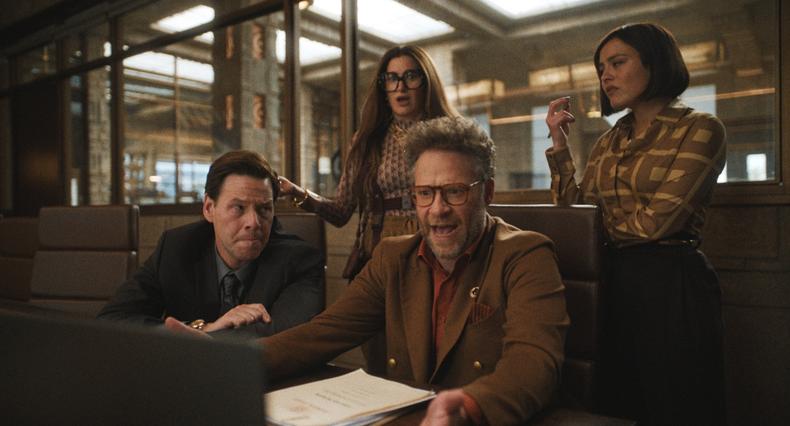
“I was like, what if you’re never off camera?” Rogen says. “What if you’re never sitting on an apple box as you’re getting coverage? What if you’re never getting coverage? What if there’s never that day on set where I’m holding a telephone and they’re just shooting my hand holding the phone? Or what if there’s never a day where it’s just a shot of the outside of a building and they shoot me coming and going 15 times in 15 outfits? Because I don’t like those days.”
The design of “The Studio” also came from Rogen’s love of great blocking and choreography, something you often have to look outside the comedy realm to find. “What’s funny is, action movies are my favorite genre. That’s actually where a lot of the physicality in the show comes from,” he says. The talk naturally turned to James Cameron’s “Terminator 2: Judgment Day,” a movie Rogen recently told Letterboxd “is probably actually my favorite movie ever made.” And from there, it’s almost impossible not to note how incredible a James Cameron cameo would be for Season 2.
“I did meet him at a restaurant recently, so I feel like maybe I have a shot,” Rogen says, before remembering: “I actually saw him at a restaurant with Kathryn Bigelow; it was fucking crazy.”
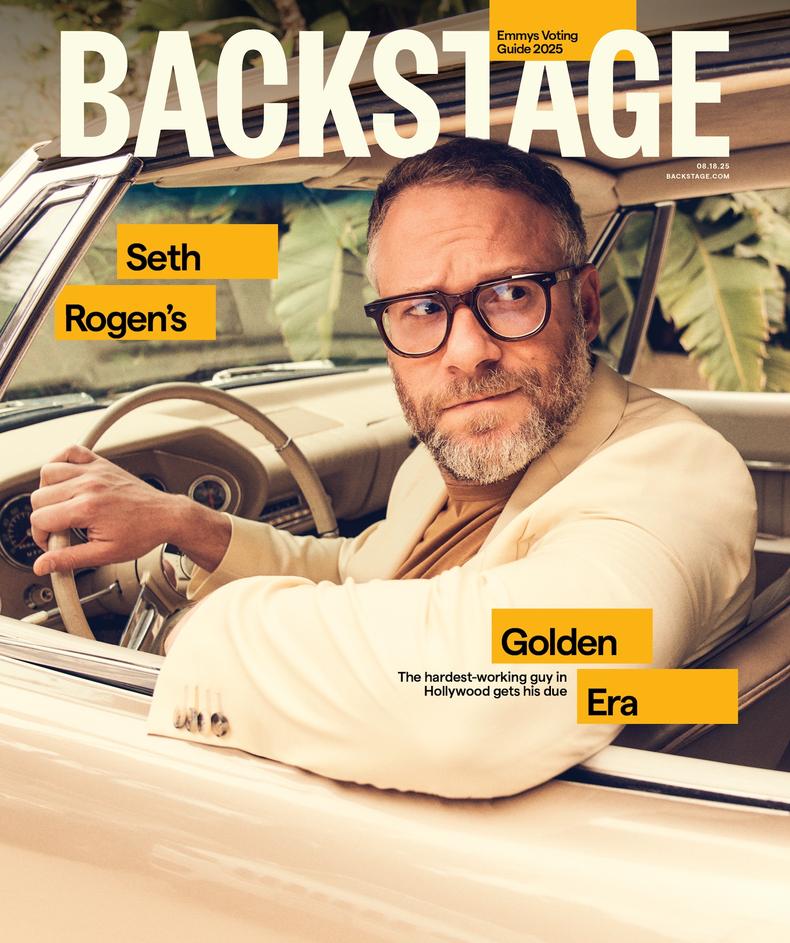 And if bumping into the highest-grossing filmmaker of all time with his history-making, Oscar-winning ex-wife sounds like something that might happen to Matt Remick, well, it’s hard to be this immersed in Hollywood without life occasionally imitating art. If anything, the careers of Cameron and Bigelow perfectly epitomize the question at the heart of “The Studio”—what does it take to create groundbreaking, personal work that also makes a shit ton of money?
Rogen’s path to the place he’s at now has made him better equipped to explore that question than almost anyone else working today. And the conclusion he’s found mostly echoes the enduring quote from Oscar-winning screenwriter William Goldman: “Nobody knows anything.”
“You hope that taste prevails, because there is no formula,” Rogen says. “People said no to ‘Superbad’ for years and years, and then it came out and made hundreds of millions of dollars. No one knows.”
It’s a paradox he’s made peace with. “I understand [the industry] better now,” he says, the irony sparking his trademark laugh. “I don’t know if that makes it more or less frustrating, but it is something that is less confounding to me.”
This story originally appeared in the August 18 issue of Backstage Magazine. To hear our full conversation with Rogen, listen and subscribe to In the Envelope: The Actor's Podcast.
Photographed by Shayan Asgharnia. Groomed by Kristen Shaw. Styled by Wendi & Nicole, and Grant Grosch. Cover desgined by Andrew Turnbull.