Sofia Coppola's toughest profession hurdle is her last name. Indeed the director faces all the blessings and burdens of being Francis Ford Coppola's daughter. Most infamous among her credits may be her portrayal of Mary Corleone in her father's third installment of the Godfather series.
"I remember seeing a magazine that I posed for in some different context with the caption, 'Did She Ruin Her Father's Film?'" she recalled. "I wasn't devastated. Although I can't say it was easy being 18 and insecure, it sort of toughens you up. I really wanted to go to art school, and I was always interested in photography. [Acting] was just a detour, really."
Aside from that one detour, Coppola has made a name for herself doing what her father does best: directing. For her spot-on adaptation and first-time feature, The Virgin Suicides, Coppola received the Young Hollywood Award for Best Director, as well as the Best New Filmmaker Award at the MTV Movie Awards in 2001. The film about first love and the loss of innocence was well-received by critics and audiences alike, in part thanks to the superb cast she lured in: James Woods, Kathleen Turner, and Kirsten Dunst, plus cameos from Danny DeVito and Scott Glenn.
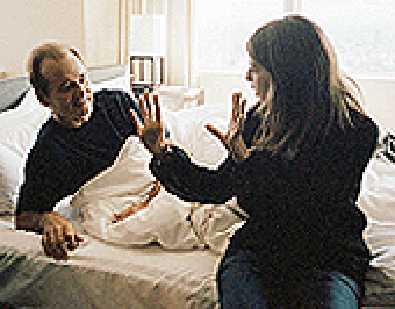
For her second feature, Lost in Translation, she wrote an original script based on her own experiences working in Tokyo's fashion world. This reflective, moving piece centers on an unlikely pair (Scarlett Johansson and Bill Murray), who feel like tourists in their own lives and who find comfort and unexpected friendship in a strange city, if only for a moment. Coppola has already established herself as one of the most exciting new filmmakers, and this film cements her storytelling style as nostalgic, bittersweet, and dreamy.
"I like personal films. I like personal stories," the director explained. "I just wanted to do something in Tokyo because I spent a bunch of time there. I love the way it looks, and it's exciting to me. I thought it would be fun to shoot a movie in Tokyo. Also, I hadn't seen that in an American movie recently. So I thought it would be visually interesting."
Coppola said she loved growing up on her father's sets, hanging around after school. Now of course she feels no intimidation being on-set. "I'm sure I must have picked stuff up by osmosis just from being around it," she said. And her father has served as executive producer on her films.
"You know, with parents giving advice, you take some or leave some, but with directing he's given me really good advice about acting," she said. "[He feels that] acting and writing is the most important part." Her father also advised her to always sit by the camera so that she could remain fully involved with the actors. But, she confessed, the most important advice he has ever given her was to be tenacious about seeing a film through. "He always told me that even if your financing is falling apart, you just have to keep acting like you're doing a movie, and it'll all sort of fall into place. I remember the week before The Virgin Suicides started, one of our main financers fell through, and [my father] was like, 'Just keep going ahead, and we'll figure something out.'"
Lost in Translation was shot entirely on location in Japan over 27 days, and 90 percent of the crew was Japanese and non-English-speaking, so Coppola hired a bilingual AD. She also hired a Japanese casting director to fill in touches of authenticity. Coppola's childhood friend Stephanie Hayman also helped to cast. "She just knows my taste," said Coppola. Much of the film's humor comes from the colorful characters to whom Murray and Johansson react. For example, the campy lounge singer Sorcelina worked in real life at the Park Hyatt Tokyo's New York bar. Another character was played by Coppola's old friend Charlie Brown, aka Fumihiro Hayashi, who runs a fashion magazine and is not an actor. "Also the talk show host was a real talk show host, and that was his real set, because we couldn't afford to build a set," said Coppola.
She wrote the film with Murray and Johansson in mind. She chose Murray because she loved the sensitive side director Wes Anderson brought out of him in Rushmore. She also loved that Murray was great with improvisation, but she didn't let him take over her words. "He was really respectful and understood that I had something in mind for this. The best is when an actor wants to work with you to get what you see in your head. We collaborated. I was really open to him improvising because he comes up with great stuff, and I knew that he would add a lot to it," she said.
She also wanted to work with Giovanni Ribisi on-camera since his haunting narration for The Virgin Suicides. "To me he's fun in this part because usually he plays more serious roles." She enlisted producer Fred Roos, a longtime collaborator with her father, to cast shallow starlet Kelly. "He's kind of the casting genius of all time. He helped me with The Virgin Suicides, finding Josh Hartnett, and he cast The Outsiders. He suggested Anna Faris. I'd never seen Scary Movie, so I never would've thought of her. She's totally up for anything," Coppola said.
She has great taste in actors, but when it comes to describing what she likes, Coppola quoted that famous line from Gypsy: "You either got it or you don't." "I like more subtle performances, but it would be different if you were doing a slapstick comedy," she explained. She lists Dunst, Hartnett, Angelica Houston, and Isabelle Huppert as actors she gets excited about.
As far as upcoming projects, she said, "I have to sit down and write, and I'm kind of procrastinating. I don't know what I'll do next, but it'll be fun to do something different." BSW