In developing her now-famous Grief Cycle, Swiss physician Elizabeth K端bler-Ross constructed a seven-level model demonstrating the human mind's capacity for dealing with bad news. In particular, death, whether suffered as a personal event or on a grander scale, elicits a series of reactions ranging from initial shock to eventual acceptance.
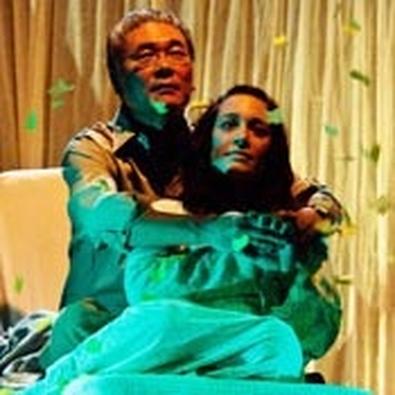
Playwright E.M. Lewis' world premiere evenhandedly focuses on the human psyche's ability to cope — from a single terminal illness to mass genocide. Director Heidi Helen Davis has, for the most part, concocted a solidly beautiful staging of Lewis' almost-screenplaylike script. A rapid-fire succession of short scenes sets up the various plot lines. Cancer patient Lily Forrestal, empathetically played by Lori Yeghiayan, has one week to live. Her husband, played with the perfect amount of angst by Michael Shutt, is a neurotically self-absorbed biologist. He seems more concerned with the potential extinction of a subspecies of Bolivian beetles than with his wife's impending death or its effect on their obviously disturbed teenage son, Max. Portrayed by Will Faught, Max, continually clutching his viola, is a bundle of dynamitelike nerves just waiting for a place to explode. Fortunately, playwright Lewis provides a calming voice of reason in the character of Khim Phan, Max's biology teacher. Phan, a Cambodian refugee, is his family's sole survivor of the Khmer Rouge genocide. Turning in the production's finest performance, Darrell Kunitomi is remarkable as Phan. His understated subtlety is thoughtful and caring at times while dryly sardonic at others. Kunitomi's scene with Yeghiayan as Lily dies is truly heart-wrenching.
Nicely conceived design elements elevate this production above the ordinary. Stephanie Kerley Schwartz's Asian-influenced scenic design includes an overhead screen allowing multimedia images to represent location changes. Composer Geoffrey Pope's original viola composition, rendered by Renata van der Vyver, haunts the stage. Jason Duplissea's otherwise seamless sound design, including a foreign-language version of "Both Sides Now," could have been further expanded by director Davis as underscoring for the countless scene changes, especially in the early half of the show. Instead, those blackouts stymied the story's progress.
Presented by Moving Arts at [Inside] the Ford, 2580 Cahuenga Blvd. East, Hollywood. Nov. 7-Dec. 14. Thu.-Sat., 8 p.m.; Sun., 3 and 7 p.m. (323) 461-3673 or www.fordtheatres.org.