If you're even vaguely familiar with show biz, you understand something about the need to study, have an agent, make contacts, learn from those who are further along in their careers.
So if you know Tara Clark, it's easy to understand why she's a little frustrated. She's an accomplished stunt woman, and finds that in her field, it's difficult for newbies to study, make contacts, learn from others. And forget about having an agent. A stunt person gets his own work.
"It's a very tough business," the Pioche, NV. resident says, "much more so than acting."
Clark isn't talking about the skills involved. She's concerned with the process one has to go through to learn the ins and outs of getting work.
To help cushion the odds, Clark is joining with Women in Film Las Vegas chapter founder Phyllis Cesare-Taie in producing a stunt clinic Aug. 26-28 at the Dream Vision International Studios. It's three days of training--under the guidance of some of the industry's top professionals--to do the sort of feats that get people jobs. The two say this is among the first event of its kind in the world.
"In most professions, the better people teach the lesser people, and it's good for everyone," Clark says. "The new person gets to learn the craft, and the teacher--well, you learn more about yourself by teaching, and it's a way of [giving back]. But in the stunt world, everything is closed, no one wants to share information. The older stunt people don't want to share their knowledge because they figure younger guys will get the work. So, it's not like if you're an actor you can simply go to an acting school. There's only one school in the world for stunt training [in the state of Washington], but our clinic is the only one that's being taught by working Hollywood stunt coordinators."
Clark points out that since there are no agents for stunt people, a hopeful must figure out a way to "schmooze his way onto a set, go after a stunt coordinator and try to connect with him when he's not busy to give him a pic and resume. There's no organized ANYTHING for stunt people! So this clinic is at least a chance to get to know people."
Cesare-Taie says the clinic is one of the major reasons she formed the Vegas chapter of Women in Film, whose parent organization was founded in Los Angeles in 1973 by former Hollywood Reporter publisher Tichi Wilkerson Kassel. "There was no place for people to be trained by professionals--people who could get the beginner jobs."
Cesare-Taie says the event is designed to help the beginner as well as the seasoned pro.
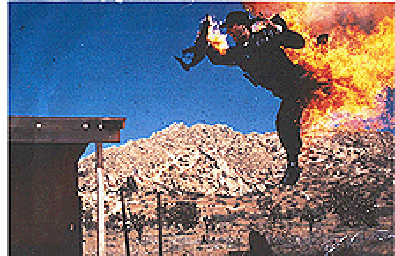
"Have you ever seen an explosion in the movies and you see someone flying through the air?" she says. "Okay, well, there's a piece of equipment that you step on that capitulates you through the air, and that's an air ram. Ratchets are the exact opposite. They pull you backwards, like if you're going through a plate glass window. It's very difficult to get a job if you don't have experience on these types of equipment. We're going to give the beginner training from professionals that will give them the opportunity to learn how to do a high fall, or a horse fall, fire burns, weapons. We'll be taping these people so that they can add this to their reel."
Clark says the clinic will give those already in the stunt biz a chance to expand their expertise.
"For instance," she says, "I've been doing stunts for years, but I had never used one particular piece of equipment, so I included it, because I wanted to learn it. There's always something new to learn."
Cesare-Taie is also hoping the clinic will help convince independent film makers that stunts can be well within their limited budgets. "A lot of them don't understand what it takes to put a stunt together, so they [shy away from stunts] altogether."
She feels the clinic should interest even the movie lover who has no interest in a film career.
"What could be better than to be able to look at a movie and say, 'I know how they did that!'"
Being proficient at stunts can only help an actor's career, Cesaire-Taie says.
"If you can accommodate a producer or director, it's very much an 'in' for an actor. I would want to hire someone like Tara because I know she's saving me money. I know Tara can fall off the horse. I don't have to go to the expense of hiring a double that looks like her to do it."
Clark says there are some major misconceptions about stunt work.
"I don't like to see actors pretending they are able to do something they can't, and that's the misconception. They THINK they can. We don't like to see arrogance in stunt work. That's when people get injured. This stunt clinic is giving them the true experience of it."
"Anyone can jump off a building," Cesaire-Taie interjects. "It's how you land that matters."
Isn't there some sort of certification that verifies a person's qualifications for stunts?
"There's nothing," Clark says. And it would be difficult to have certifications. On a lot of films, stunt coordinators take pride in designing their own kinds of stunts, and how would you verify who's qualified to do them?"
Another misconception, Clark says, is that stunt people don't need acting skills.
"When I'm doubling someone," she explains, "I follow her around the set before I'm actually going to do the stunt itself. I watch how she does things, how she laughs, how she talks, how she moves. I try to emulate that. It's my job to BECOME her. If you can't act, how can you do that? Your body language is acting. Just because you're not speaking doesn't mean you're not acting."
Clark says it works the other way as well.
"I was falling out of a window, and the actress I was doubling for had to watch how I did it so that she could play the scene that led up to it."
Cesaire-Taie adds, "An actor needs to learn something about stunts. If you're doing a scene and you're on a horse and we're going to cut to someone else falling off the horse, you still have to sit on that horse and ride to an extent. You're going to have to [lead up] to the fall. Whether you're supposed to look like you're about to jump off a 7-story building, or a horse, or about to be set on fire, or shot through the air--it's good to understand and have the education and knowledge about what's going on. Knowledge is power."
Are working stuntmen enthusiastic about the clinic, or do they see it as a threat to their jobs?
"In the beginning it was rough, but we're getting support," Cesaire-Taie says.
"We'll have to see what impact this has five years from now. We're either going to be praised, or we're going to be hated by all the 50-year-old stunt men."
(The Women in Film Las Vegas stunt clinic will be held Aug. 26-28 at Dream Vision International Studios, 3111 S Valley View, Bldg. T. Cost is $450-$600. Info:
www.wiflasvegas.org or 702-737-7337)