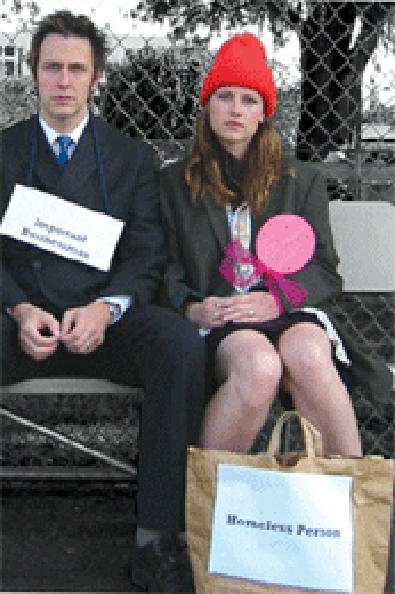
To most viewers of NBC's offbeat comedy The Office, Jenna Fischer is known as the sweet-faced, infinitely patient secretary with a sharply concealed sense of humor. With her angelic features and quiet nature, Fischer's put-upon Pam Beesley wields her wit at unexpected times, perfectly the dry deadpan that has become the show's trademark. So it should come as no surprise that her feature directing debut, LolliLove, would be a fitfully funny and frequently twisted tale that doesn't hesitate to poke good-natured fun at charity work, the plight of the homeless, and Fischer herself.
The script, co-written with Peter Alton, centers on a self-absorbed Hollywood couple whose names happen to be James and Jenna Gunn--played by Fischer and her real-life husband, writer-director James Gunn. Filmed in a mock documentary style, LolliLove follows the couple as they embark on charity work, choosing the homeless as their personal cause. Other charities are considered but discarded; bulimia, for example, is passed on as "not a real disease." The filmic Jenna decides to name her charity "LolliLove" and pass out lollipops with original artwork by James on the wrappers and inspirational quotes inside, and she begins a lengthy process of enlisting benefactors and volunteers to help with her well-intentioned, if slightly warped, generosity.
While comparisons to the faux doc style of The Office are inevitable, LolliLove originated four years ago, when Fischer was still struggling as an actor. "I wasn't working much, getting little guest-star roles months away from each other," she notes. "James convinced me to quit my part-time job so I could concentrate full-time on acting. I was really feeling kind of down and out and discouraged." Julia Cameron's self-help book The Artist's Way inspired Fischer to make her own short film-regardless of the quality. "My goal when I was making LolliLove was to finish it," she says. "I didn't care if I made a crappy movie, as long as I finished a crappy movie."
Using a camera she had given Gunn as a wedding gift, she began conducting interviews with friends in characters she had sketched out. "People were so funny being interviewed and just talking to us, I started to realize we could really edit this into something," she recalls. She called her friend, producer Stephen Blackehart, and asked him to look at the tapes and give his opinion. Though the picture and sound quality were low, Blackehart was impressed with what he saw. "So I took those tapes and considered them a rehearsal," says Fischer. "And I took the characters people had created and wrote a 30-page script based on a lot of that material." Fischer rented a basic lighting package and shot over the course of four weekends. "Whenever we rented a lens or lights, we rented it on Friday, so we paid for only one day and returned it on Monday," she says. She also borrowed a friend's Canon XL-1 camera for the shoot-although one weekend he couldn't lend it out, so she rented a Panasonic DVX-100A, on which they shot the opening and closing sequences, which were edited seamlessly into the film.
On the Fly
Fischer also convinced her friend Alton, whom she met through L.A. theatre group Zoo District, to shoot and edit the film. It was Alton's idea to incorporate home movies and photographs from the real Jenna and James' life into the film. "He said, 'The greatest thing you did in this movie was use your real names, because we can use anything of you from anywhere,'" Fischer notes. "It totally ups the production value to have a wedding scene with 200 guests." Some scenes were shot guerrilla-style: For a sequence in which Jenna goes to Kinko's, Alton sat on an electrical box on Ventura Boulevard and zoomed in through the shop's window.
Alton also received a co-writer credit, because, when it came to editing the film, the story began to take on a different shape. "We shot it according to script, but, when he edited it, he approached it like real documentary footage," says Fischer. "In order to cover certain transitions, we would use narration and video clips and voiceover. The movie became such a collaboration. In a lot of ways the creative force behind the movie was me, Peter, James, and Steve. And without any one of us, this movie would not have existed. We took titles, but they're kind of arbitrary." And because she was spending so much time in front of the camera, Fischer frequently relied on Blackehart and Alton for guidance. "It's not like I walked in and said, 'Here's what to do: I want a two-shot, then drop back and swing over for the reaction,'" she notes. "That's what I would do today. But I had no idea what I was doing, so my direction was, 'Okay, we're going to sit at this table, and just try to get us all in.'"
Because of Alton's busy schedule, Fischer hired another editor to look at the footage but found it hard to keep the running time down as originally intended. "We were really trying to make it a short film, but it just didn't work," she recalls. "Watching the raw footage made me laugh so hard, and when I saw it edited together, it just didn't translate." She asked Alton to come back on board to edit the film, which he did in January 2004. "He asked if he could just make it a feature, and I said to go ahead," says Fischer. At that point, they decided to shoot about five additional days of footage to balance out some of the new ideas. The film was edited on a Mac G4 using Final Cut Pro with sound mixing done with Pro Tools; it was completed between July and November 2004.
Office Space
Fischer's intention with the film was to avoid making what she calls "a wink-wink mockumentary." "I wanted to make something you might think was a real documentary while you were watching it," she explains. "I had never seen anything like that before." Two years after shooting LolliLove, she caught an episode of the original British series The Office. "I was furious," she says with a laugh. "I was, like, 'This is what I was trying to do. This is what I meant.' This idea of how people react when they think the camera's on and how they react when they think it's not--that was the piece I had been missing. I was afraid people would think I stole the style from The Office and they did it so much better than me."
On the upside, two weeks later, Fischer was called in to audition for the American version of The Office. She went in possibly more prepared than any other candidate, having worked in the milieu for so long. "I really feel it was divine intervention that I chose to work in this medium for a year," she nods. "It was the best practice I could have ever gotten for the possibility of being on the show. I had done these long interviews, and I knew that what was funny was not helping the documentary crew. Allison Jones, the casting director, even said that when I came in, I shouldn't try to be funny. She said, 'I dare you to bore me.'" Fischer had also learned quite a bit about playing the straight man, courtesy of her husband's antics in LolliLove. "My problem with the movie is that James is so funny, I couldn't figure out what my role was going to be," she notes. "I wasn't going to be more clever or funnier. So I came to understand what a good straight man does. They stay out of the way of the funny man and give reactions that make the funny man funnier." Fischer left the audition feeling remarkably confident.
It's a Wrap
LolliLove will be released on DVD in early 2006 by Troma Films, which has a long relationship with Gunn and Blackehart; Gunn has written several films for the company, including Tromeo and Juliet, which starred Blackehart. Troma President Lloyd Kaufman even has a cameo in that film as a priest trying to counsel the fracturing couple. Still, it wasn't a forgone conclusion that Troma would be involved. "The person who really loved it was Lloyd Kaufman's wife," says Fischer. "They joke that she doesn't like anything he does, but she loved LolliLove and kept saying, 'Lloyd, you need to buy and distribute this.'" Fischer couldn't be more thrilled, noting, "Troma is the only truly independent film studio. Troma owns Troma." Troma also owns a library of cult films, and Fischer's dream was to have LolliLove be the kind of movie that would be an underground movie, passed from friend to friend. "The Artist's Way asks you, 'What's your goal, what's the best-case scenario, and what's your wildest dream come true?'" says Fischer. "My goal was to finish the movie. My best-case scenario was for it to show at a film festival. My wildest dream come true was that people would like it enough to pass it around to each other." Fischer got all her wishes, and then some. When the film screened in her hometown of St. Louis at last year's St. Louis International Film Festival, it played at the historic Tivoli Theatre. "As a little girl I would sit in the Tivoli and think, 'Maybe one day I'll make a movie that plays here,'" Fischer recalls. "And here I was, in a movie I had written, directed, and starred in. And it was even better."
------------------------------------------
This article was first published in ACTion, Back Stage's quarterly magazine on performers creating their own film and video projects. ACTion is a free supplement to Back Stage