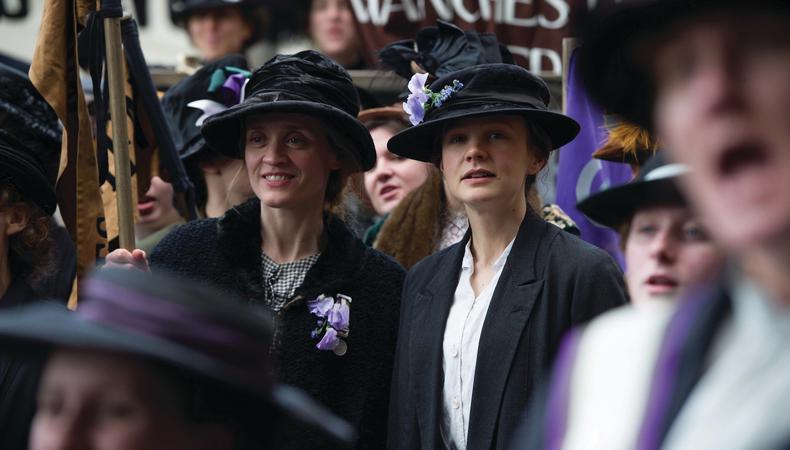
Don’t underestimate the historical accuracy of “Suffragette,” the powerful new awards contender about the fight for women’s rights in early 20th-century England. Made by a fleet of female filmmakers led by director Sarah Gavron, the creative team spent six years researching the period—and the result is a film unlike those we’re used to seeing.
“Carey Mulligan didn’t wash her hair for weeks,” Gavron says with a laugh. “Often with period dramas, you can sometimes feel at a distance admiring the look, and we wanted to make something very real.”
Gavron and screenwriter Abi Morgan were aided by the then-nascent world of cinema, which left crisp documentary images of what men and women looked like both in everyday life and in the suffragette movement in particular. The result is one of the few movies that feels almost uncomfortably lived in; a historical film about women that is as grimy and sweaty as any Western. Rather than putting the focus on any well-known, real-life figure—though many do make an appearance—Gavron and Morgan created Maude, a wife and mother who finds herself drawn into the fight for equal rights against her will before sacrificing almost everything for the cause.
Working in a laundry alongside her husband (Ben Whishaw), Maude first witnesses a shocking display of coordinated violence when a group of women abruptly open baby carriages to display a collection of stones that they then throw to shatter windows. Eventually, she becomes an integral foot soldier in the movement, working alongside Emmeline Pankhurst and Emily Davison. Likewise, the film surrounds Mulligan with a who’s who of fabulous, individual women who bring their sui generis personas to the proceedings.
“We had Carey in mind for a long time because she felt like a female actor who could carry this movie,” Gavron says. “And she said yes very quickly. And then we built the cast around her because we wanted to have a range of women who represented the incredible range of women who joined this movement. We wanted to put her with women you haven’t seen her with, like Helena Bonham Carter and Anne-Marie Duff and Meryl Streep.”
Streep has garnered an inordinate amount of publicity for her one four-minute sequence as Emmeline Pankhurst, but it’s the lesser-known supporting cast whom audiences will remember afterward—all of whom benefitted from Gavron’s years of research. “We had a lot to feed them,” Gavron says. “The suffragettes were quite strategic about documenting their events, and there were some good photos. And we developed a roll of film that had never been developed before!” In addition to unearthing brand-new images, Gavron was also able to re-create the medals awarded for hunger strikes in prison from the original molds at the company that first forged them.
All of that research and period detail added up to an excess of footage, leaving Gavron to spend quite a bit of time on the editing process. “We ran two cameras at a time, and rather than stage it and make it feel composed, we tried to catch them in cinema verité style,” Gavron says. “Ultimately, things shift as you go in the edit. There are some moments you want to build up or compress or expand. But it was really realizing that what was so important was Maude’s journey to empowerment and becoming an activist. We had to make sure that each shift in that was marked. We wanted to tell the story of unsung women.”
Inspired by this post? Check out our film audition listings!