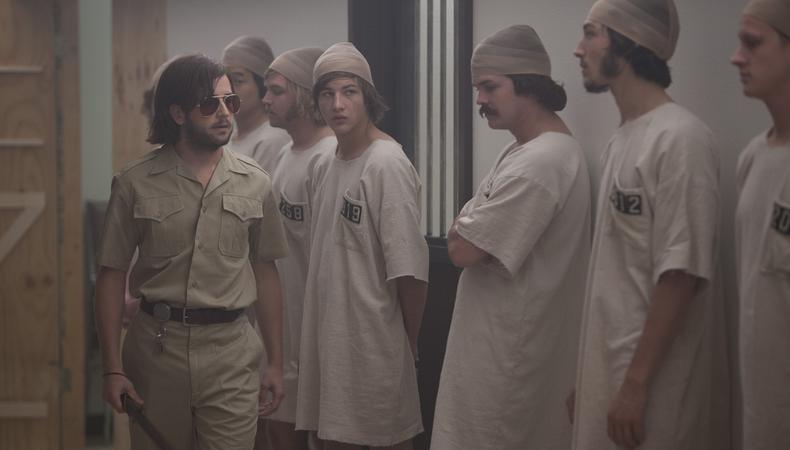
The last line of “The Stanford Prison Experiment” is nothing less than bone-chilling.
“I started to get so profane,” says Michael Angarano (“The Knick”), playing a “prison guard” in the film, “and still no one said anything.”
The statement, given in an interview room after the titular experiment was terminated eight days early, sums up a film based on true events that digs into human nature’s innate aggression, as well as its passivity.
Conducted in the basement of Stanford University in 1971 by Dr. Philip Zimbardo (played here by Billy Crudup), the experiment was designed to study the effects of a simulated prison system run by paid students playing appointed guards and prisoners. As the power dynamics solidify throughout the movie, director Kyle Patrick Alvarez flirts with the fine line between edge-of-your-seat suspense and “Oh my God, I don’t want to watch this anymore” recoiling.
While the film isn’t overtly violent, the actors, script, and increasingly claustrophobic camera style magnify the psychological distress meant to leave audiences with challenging questions about themselves.
Starring an ensemble of up-and-comers, including Ezra Miller (“The Perks of Being a Wallflower”), Thomas Mann (“Me and Earl and the Dying Girl”), Tye Sheridan (“Mud”), and others, “Stanford” left Sundance viewers gobsmacked. Screenwriter Tim Talbott and Alvarez walked away with the Waldo Salt Screenwriting Award and the Alfred P. Sloan Feature Film Prize, respectively.
“When it came to me, the script was great,” says Alvarez, “but as a director I was drawn to two specific challenges: one was casting this great group of young actors. Casting fuels me more than anything. I thought, This is going to be the opportunity of a lifetime, to bring all these young guys together. In 10, 15 years, some, many, or all of them will have left their substantial footprints on the industry and then you’ll be able to look back and say, ‘All those guys were in a movie together!’ ”
The other attractive challenge? The “high-wire act” of maintaining narrative momentum while shooting in a tiny hallway. Visually, the film’s first half has a certain flexibility, panning over walls into a cell or capturing wide shots. But the second half moves to a very narrow space. As the tension in the “prison” escalates to physical violence, Alvarez and his cinematographer, Jas Shelton, shift to handheld, close-up shots.
“By the end, [I wanted] to earn just being right up close,” he says. “The camera couldn’t get a step closer. We bumped actors’ faces sometimes when we were shooting that last segment.”
Alvarez makes additional stylistic choices—well-timed slow-motion shots, bold lighting styles, shooting out of focus—that enhance the visceral theatricality of “Stanford.”
“I was worried I’d almost neutered the movie too much,” says Alvarez about the editing process. “It wasn’t until it premiered when people reacted intensely to it that I was, like, OK, I found the right balance.... I think if we’d spent a minute more in that hallway it would’ve been burdensome.”
Although he wanted to avoid exhausting the audience, Alvarez did want to lay out questions about basic humanity, our own proclivities, and the overall prison system.
“My hope is that people go into the movie and say, ‘Oh no, I wouldn’t have been that way. I wouldn’t have been a guard or I would’ve stood up,’ and by the time the movie ends, they question that a little bit more,” he explains. “The abuse of authority is always going to loom over situations and we’re in a cultural moment right now where it’s a big question: Why do these things keep happening? We look at police brutality and we want to blame the individual, but maybe it’s the system that’s bad. Maybe it’s designed to create these types of people. I don’t have the answers, but to me, that’s the deeper question to ask.”
Inspired by this post? Check out our film audition listings!