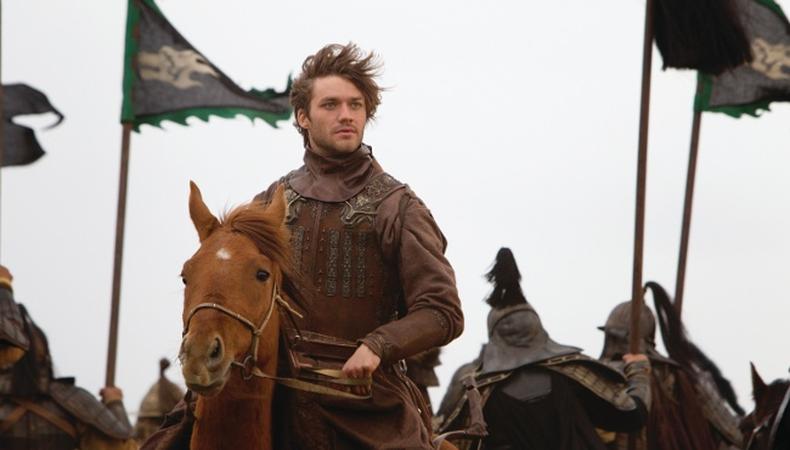
When actors dream of starring in cinematic epics shot in exotic locations, they likely imagine spending their downtime in comfortable trailers sampling local delicacies. For the actors starring on Netflix’s “Marco Polo,” that dream died in Kazakhstan.
“We were way out on the steppe, where there’s no real hotels—no Motel 6s, even,” Tim Coddington, who co-produced all 10 episodes of the new streaming epic, tells Backstage.
“The hotels were cinder-block buildings with no hot water, and often no water at all.”
“Marco Polo” is a drama based on the exploits of the Venetian explorer, who is believed to be the first European to write a detailed account of his travels in 13th-century China, which was then ruled by the Mongol Empire. Harvey Weinstein, whose company produced the series that John Fusco created for Netflix, billed “Marco Polo” as a spectacle “that rivals some of the most successful films we’ve ever made.” Starring Italian actor Lorenzo Richelmy in the titular role, the series was shot in locations ranging from Malaysia, where the court of the great Mongol-Chinese ruler Kublai Khan was re-created, to the Kazakh steppe and the canals of Venice.
Getting the actors off the studio lot required them to endure conditions “they weren’t accustomed to,” Coddington says, chuckling. In Kazakhstan, which stood in for the even more rustic Mongolia, the actors and crew had to commute almost two hours each way from their cinder-block accommodations to the set. When they returned at night, they gathered together for dinner. “It was generally the same meal—boiled mutton or boiled horse or something like that,” says Coddington, who was also a producer on “Mr. Pip,” which was shot partially in Papua New Guinea, and served as a production manager on two of the “Chronicles of Narnia” films.
“It was very difficult, but full marks to all the actors: None of them complained,” he says. “Some of them were used to far better treatment than what we were able to give them, but they could see the situation. There was nothing better around.”
The challenges of the rustic shoot aside, Coddington says the locales brought out the best in the cast, which includes Benedict Wong, Joan Chen, Chin Han, and Rick Yune.
The production hired crew locally and also brought in some featured extras. “We cast in Malaysia and Singapore for some of the speaking roles,” he says. “We didn’t cast in Kazakhstan for speaking roles because we were only there for a couple of weeks filming. But we did recruit many Kazakhstan people to be horse riders…. And we also brought an archer to Malaysia from Kazakhstan, as well as a couple of interpreters.”
Casting performers for a drama that covers scenes ranging from imperial court intrigue to epic battles on the Mongolian steppe was like building a sports franchise, according to Coddington.
“You might not necessarily pick the best individual player for that position, but you pick the best player for that team and for that game,” he says. “When you get the wrong people, they separate out into factions. That didn’t happen. The crew and cast were very close.”
Like this story? See more of our Now Streaming articles here!