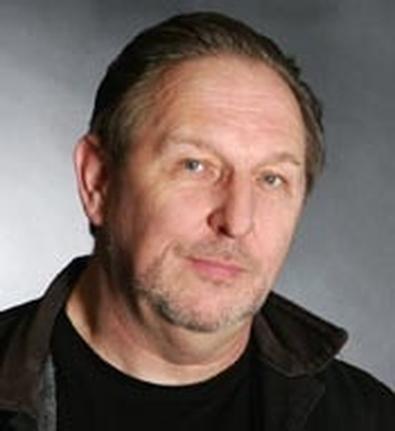
Director Mark Wing-Davey still lives in his native London, but ever since his 1991 Obie Award–winning production of Caryl Churchill's Mad Forest, he's been working primarily on this side of the pond. "What happened was, in general, the work that I was asked to do was more interesting here than it was there," he explains. The New York premiere of Churchill's remarkable play about life in Romania in the months after the fall of dictator Nicolae Ceausescu, a work he commissioned while heading London's Central School of Speech and Drama, established Wing-Davey as a director with a talent for building a company and working with large casts and an affinity for imaginative and political theatre.
Over the past decade and a half, he has also directed plays by Sarah Ruhl, Naomi Iizuka, Tony Kushner, Craig Lucas, and Howard Korder, as well as Shakespeare and George Farquhar, at major companies in New York and across the country.
His current work is LAByrinth Theater Company's production of Unconditional, a new play by Brett C. Leonard in which nine New York stories converge, playing at the city's Public Theater through March 9. "The play deals with interracial sexuality, and it certainly is the seamier side of New York," says Wing-Davey. "But it's an enigmatic piece of modern theatre, and it is hard for me to say what it's about."
Wing-Davey has worked with LAByrinth before: He directed School of the Americas, José Rivera's play about the last days of Che Guevara, for the company in 2006. He is also friends with LAByrinth co–artistic director Philip Seymour Hoffman. (When the Oscar-winning actor was much less known, he played a small role in the director's 1996 production of Churchill's phantasmagoric The Skriker at the Public.) But it's perhaps Wing-Davey's own career as an actor in London that has helped make him an ideal fit for the New York–based company, which was founded by a group of 13 actors in 1992.
Wing-Davey's father, the late John Davey, was an actor, and his mother, Anna Wing, is 93 years old and still working. She is best known as the matriarch on the BBC's EastEnders TV series and performed in Churchill's Blue Heart at the Brooklyn Academy of Music in 1999. "Acting was the conservative choice for me, I suppose," he says, "as opposed to being an accountant, which would have been much more revolutionary." A former member of the famed Cambridge University comedy troupe Footlights, Wing-Davey still has an international fan base for his portrayal of the two-headed Zaphod Beeblebrox in the original BBC radio and television series The Hitchhiker's Guide to the Galaxy, written by Footlights alum Douglas Adams.
In the late '70s—"back in the mists of socialist theatre past," he quips—Wing-Davey was a member of the Joint Stock Theatre Company, an actor-writer-director cooperative. Joint Stock actors helped create new work by doing independent research on their characters and then workshopping the results with the rest of the company. Several plays by Churchill (including Mad Forest) and David Hare were developed in this manner. Wing-Davey still employs a version of this technique, even when the texts are already complete: "I quite like actors going and doing their own research and giving talks, partly because then I'm not the person with the answers."
After seven years as an actor, Wing-Davey decided to switch to directing and teaching. "There are a lot of people like Rufus Sewell and Jennifer Ehle who I taught back in the day," he recalls. "And now they're all rather glamorous pals of mine. When I was acting, the directors that I loved most were the people who made no distinction between teaching and directing." Currently he alternates between the two, though he still takes occasional acting and voiceover gigs. He even returned to the role of Beeblebrox in 2004 for a series of radio adaptations of the later Hitchhiker books. "Acting is not a mystery for me. It's interesting, stressful, and it is difficult, but it's a craft," he says. Explaining how his acting background helps him as a director, he adds, "What I can do if I have to is I can act brilliantly in bursts of 10 seconds. I couldn't sustain it, but I'm never in a position where somehow the vocabulary between the actor and director has kind of disintegrated and the director has no means of communicating."
Classically Bold
Along with his flair for the political epic—he directed an award-winning production of Angels in America at San Francisco's American Conservatory Theater in 1994—Wing-Davey is known in this country for his bold approach to the classics. "I like to recontextualize the classics in ways that I think are interesting for an audience to experience," he says. "What is it at that time in the social, historical sense which also affects how you might watch it in the present?" For his production of Farquhar's The Beaux Stratagem at Berkeley Repertory Theatre, he set up a trough of rotting fruit and other organic matter (hygienically covered with a mesh, of course), which occasionally sent up the pungent street aroma of Restoration London. "As you came in, the smell was strong, but within about two minutes you got used to it."
As for his approach to Shakespeare, you might recall his 1995 Troilus and Cressida in New York's Central Park, which featured a Cassandra trailing a vacuum cleaner and a Ulysses who read L. Ron Hubbard. Speaking about his approach to the classics, Wing-Davey says, "It's not that I feel it has to be done in modern dress; I don't. But I do seriously think that history only exists in the present." Of his 2003 Central Park production of Henry V with Liev Schreiber, he notes, "I had taken a view about the play itself as a piece of propaganda and something which was the nature of history and how we viewed history. So the set kind of reflected history and the fact that history is simply created in the present."
Wing-Davey is now working with his Henry V set designer, Mark Wendland, on Unconditional. He credits the designer with suggesting the style of the production: "Funnily enough, as a piece it is written in a proscenium-arch way, but Mark came up with this way of looking at the play as if you were looking into it more as a cockpit." The play is staged in a transverse style, with most of the audience facing each other, "as if they were on the short sides of a tennis court looking in, and on the long sides there's just one row of audience looking down on the action." Some scenes have very minimal dialogue, while in others characters talk continuously. "Because you're constantly shifting in between different realities," he says, "the challenge is how to make that work." In other words, it's the kind of play this director enjoys working on most.
Wing-Davey is excited by plays that unfold as a "sequence of events which are not entirely predetermined by the author.... You want people to be engaged in an attempt to decipher moments and then put them together in any way so there are ambiguities and odd kinds of twists and turns in how they perceive things. Even though every single moment in any of my productions is meant, you don't have to watch the play like a crossword puzzle, because there is no right or wrong answer."
Outtakes
Winner of a 1991-92 Village Voice Obie Award for directing Mad Forest and a Bay Area Critics Circle Award for directing Angels in America
Directed the U.K. premiere of Bat Boy: The Musical at the West Yorkshire Playhouse
The first appointed artistic director of London's Central School of Speech and Drama (1988–90)