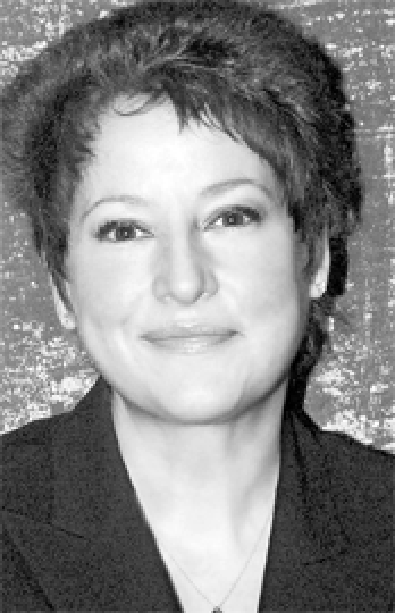
Deborah Aquila has an uncanny knack for spotting talent. For example, she cast Oscar winner Adrien Brody in a couple of films back when he was but a teenager, most notably Steven Soderbergh's King of the Hill. She also gave Michael Rapaport his first prominent feature gig, a plum starring role in the critically acclaimed indie Zebrahead. And we can thank her for introducing us to Edward Norton, who garnered an Oscar nod and a Golden Globe after she cast him as complicated murder suspect Aaron Stampler in 1996's Primal Fear.
So how does Aquila know when an actor has something just a little bit special? "Talent wins," she says simply. "I'll say it until the day I die." Of course, she adds, that talent also has to be seen, so an actor often must be his or her own marketing person. "You really have to be resourceful and clever and know your business inside and out," she says. "You just have to be relentless in your pursuit of [your] art."
Aquila seems to genuinely care about actors; she speaks passionately about working with them, about wanting them to do well, about finding the right person for each and every role. Perhaps that empathy comes from her own background in acting: She earned her degree from New York University's Tisch School of the Arts in conjunction with the Stella Adler Conservatory. "I love actors. I don't want to do anything where I'm not around them," she explains. "So I'll either do this for the rest of my life or teach. I enjoy both very, very much. I think I was trained to work well in this arena. But as far as performance goes, I have such respect for actors, because it's something I could never do. I mean, I tried: I certainly got up there, and I was onstage. I started as a singer, and then I went into acting, and I was with Stella for a long time. But I was much more comfortable behind the scenes. I was more present, not as much out-of-body."
After casting commercials for about three years, Aquila landed a gig as an associate to noted casting director Bonnie Timmermann, working on such projects as the TV series Miami Vice and Michael Mann's Manhunter. From Timmermann, she picked up a few valuable lessons: "See everything you can see. Never say no to a young person, because they grow and they change, young actors," Aquila says. "They metamorphosize more often than not. And she always taught me to never hit right on the nose -- go a little right, go a little left." And why is that? "It's more interesting," she says. "More creative."
Starting With 'Sex'
Aquila's independent casting career began with a little project called sex, lies, and videotape, the 1989 feature film debut of writer-director Soderbergh. "[The film] could have been easily misunderstood, especially at the time that it was being made," she says. "Steven's a visionary, and you just trusted where he was going to lead you was going to be a safe place."
She still remembers finding then-unknown Laura San Giacomo, who was eventually cast in the breakthrough role of sexy, sarcastic Cynthia. "She was actually doing a play called Beirut," recalls Aquila. "I don't know if she was understudying the day I went to see her or if Marisa Tomei had already left the play. I love Marisa too, of course, but Laura was a brand new face for me that just fit this part really well."
Aquila has since amassed an impressive résumé that includes a seven-year tenure as senior vice president of features casting for Paramount Pictures and such titles as The Shawshank Redemption, The Brady Bunch Movie, The Gift, House of Sand and Fog, and the critically lauded FX series The Shield. Even with more than two decades in casting under her belt, she can name the roles that have presented her with her biggest challenges without missing a beat: Norton's part in Primal Fear, and the young version of Anthony Hopkins' role in 2003's The Human Stain. The latter part eventually went to Wentworth Miller, who is now a bona fide TV star on Fox's hit series Prison Break. Aquila once again knew talent when she saw it. "You needed certain qualities in [both of] those roles that had to change throughout the whole film, and had to change truthfully," she explains. "Edward's character in Primal was like a layer cake in that you had the actor, Edward, playing a character named Aaron, who was really Roy playing the character of Aaron. Each characterization had to be fully defined, developed, and truthful; further, the presentation of each had to be spontaneous so that their respective emotional lives had to be percolating inside the actor's imagination at all times.... We read a whole lot of young men for that role in Human Stain as well; Wentworth had the innate understanding and deep emotional connection to that character. It was a situation where that emotional connection and understanding of the role augmented what was already a great reading and interpretation."
She recently worked on the pilot of Showtime's upcoming series Dexter, starring Six Feet Under's Michael C. Hall; next summer's wannabe blockbuster Evan Almighty, featuring Steve Carell; and Tony Goldwyn's The Last Kiss, which comes out next month and stars Zach Braff and The Human Stain's Jacinda Barrett.
Last Kiss, notes Aquila, involved putting together an ensemble, which presents its own set of challenges. "That's very different.... The group of people you're casting [all have] to be friends," she says. "So they had to be age-appropriate, they had to be personality- and persona-appropriate."
Back to the Story
When it comes to working with filmmakers, Aquila firmly believes in knowing as much as possible about the characters she's casting. "I'm very big on backstory," she says. "I'm very big on being a pain in the tush when it comes to writers and directors and asking lots of question as far as backstory [and] character history. It's a very theatre-based method of casting. The more I know about a characterization and the more history I know of the character, the more clear the picture becomes."
Aquila also believes in reading with every actor who auditions for her. "Without sounding pretentious, there's a certain energy or hit you get when you read with a person," she says. "You're sort of in the scene with them. I'm a teacher as well; I've taught for years, and I teach what Stella taught me. It's much more of a visceral response when I get into it with an actor, reading opposite them."
That said, actors who read with Aquila should go in having done their homework. "They've got to be prepared," she says. "They should be as prepared as I am. I'm not somebody who suffers excuses easily or lightly. It's like, you're here, you're here for a reason, you love what you do, do it well. Be respectful to yourself."
Not surprisingly, then, her biggest pet peeve is when an actor offers up the excuse that he or she is not prepared. "Of course everybody has schedules and everybody has lives and sometimes life gets very complicated. Believe me, I have two children, I understand," she says. "But if I'm present, then I beg those people to be present, as well."
Aquila also wants actors to know that CDs honestly want them to do well. "We want you to be good," she says. "Hey, you know what? Here's a selfish reason, even if it's not [altruistic], which with most casting directors, it is pure altruism, because we believe and we want you to be good: [But if] you're good? I get to see my kids. You get the part; I get to go home. I mean, that's just being flippant, but the truth of the matter is that we want you to succeed."
Aquila teaches script analysis and interpretation in the Adler tradition, and says she often gives her students that old maxim that artists of all stripes hear so often: "If you can do anything else, you should." "But then again," she adds, "my daughter's a painter, and I tell her the same thing. She actually just came back from Northwestern [University] for the summer. She didn't take one painting course for seven weeks, and she found herself getting up every morning and painting. That's an artist, you know? When you have the need to do it, when you can't not do it. Then you just have to follow your heart and follow your dreams."