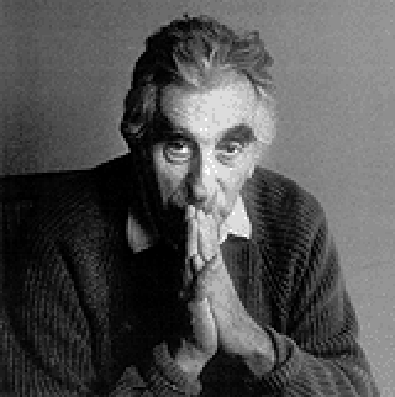
Jeff Corey, who died in Malibu on Aug. 16, was among the last great acting coaches to emerge from the theatrical/cultural foment of New York's theatre scene in the 1930s. A Hollywood actor through the '40s, he was blacklisted in the '50s, and turned to teaching both for employment and creative stimulation, and mentored generations of actors over the next few decades. Corey contributed this piece, about his approach to acting and acting training, to Back Stage West some years ago. We thank his widow, Hope Corey, for her assistance. A public memorial for Jeff Corey will be held on Sept. 28, 10 a.m.-noon at the Mark Taper Forum, 135 N. Grand Ave., in Downtown L.A.
There's an old aphorism: "Nothing is really lost--there's something on top of it."
Occasionally in my mind's eye, I know exactly where to locate a particular folder in my crammed filing cabinets--but more often than not, it's simply not where I remembered it to be. When that kind of frustration is compounded by several fruitless searches, I go through all my files like a spring-cleaning ritual.
Of late I've come across outlines for practically every one of my class sessions from 1951 through 1954. I'm impressed with my discipline at the time, and I must say the files triggered an array of names in my memory--literally hundreds and hundreds of students past and present.
But, in retrospect, I realized that my detailed preparations, however commendable, were also the result of an unremitting panic that made me think, I've got to prepare--I don't know enough. After all, teaching was thrust upon me when my acting career was interrupted by the blacklist. I never consciously wanted to teach.
But as it turned out, I needed those classes, not only for financial sustenance but for the measure 4of creative ballast they afforded. My hope was to keep my ship, figuratively speaking, on an even keel. And to do that I simply had to keep the classes interesting. So I devised a range of exercises--very good ones, too, if I may say so--so as not to be set adrift if people did not bring in sufficient scene work. The old chestnut about necessity being the mother of invention was the operative force in my case. In fact, according to my notes from the time, I conjured close to 100 acting "etudes" in those early years.
But something unsettled me back then; it's not reflected in my copious notes, but it does stay in my memory. It wasn't a concern about the validity of the exercises as such but about the procedures I was following. I remember very clearly an enlightening experience fairly early in my teaching, around 1954. The house was quiet and I was alone in my backyard theatre with some time to think. I looked at the books, the improvised lighting, the lines of chairs, the little stage and my wonderful blackboard, on which I boldly spelled out many of the principles that guided my teaching. I had determined that I would devote that entire afternoon to a quiet perusal of what I do right as a teacher, what my areas of confusion might be, and how I might I simplify my teaching.
A word about the blackboard: My busy use of that classroom device, and of the aphorisms I hand-printed on placards in my studio, was inspired in part by the eccentric millionaire Mrs. Barnsdall, who donated about 50 acres of beautiful hillside below Sunset Boulevard to the City of Los Angeles, including several Frank Lloyd Wright structures. All she asked in return for this generosity was the right throughout her lifetime to post huge public signs extolling liberal sentiments about humankind, social responsibility, threats to the environment, and the relevance of art in an enlightened society. In a more modest manner I posted as many placards as my studio walls could contain, with precepts like Mark Twain's "Courage is resistance to fear, mastery of fear--not absence of fear," or Ibsen's maxim, "Drama cannot deal with characters whose wills are atrophied," or Stanislavski's description of over-used mannerisms as "The despotism of acquired habits."
In any case, on the aforementioned afternoon of backyard introspection, I erased whatever was on the blackboard, stood in front of my "tabula rasa," and reached for a piece of fresh chalk, ready to coin a new teaching catch-phrase. My eyes were shut and I deliberately tried to clear away all extraneous thoughts and impulses. "Go blank," I said to myself. After a period of time, my eyes still closed, I approached the blackboard and inscribed these words: "Teach People, Not Things."
It was deliverance.
I had a list of all the people in my classes on four separate sheets of paper--a list of at least 70 actors. I shut my eyes again and waved my right hand around and around and then brought my index finger down on a single name on the roster. I had already decided that the work for all the classes in the following month would be related to that randomly selected actor's needs or attributes. As it turned out, it was not just luck or happenstance that the problem to be explored--originally pertaining to just a single student--would invariably apply, to one degree or another on a continuum, to every student.
That became my procedure every month for succeeding years: a plan of action happily emanating from my encounter with the accommodating blackboard that read "Teach People, Not Things."
Those Infernal Methodists
When asked the tiresome question, Am I a Method teacher?, I wince. Poor Stanislavski, whom I esteem, has been dead for a long time. Peace unto his ashes. To qualify as a genuine teacher of the Stanislavski system would require you to reincarnate yourself and turn into Konstantin Stanislavski, nee Alekseyev, himself.
In David Magarshack's book Stanislavsky Directs, he quotes Stanislavski telling his actors that there is "no actual method, there are only a number of basic principles and exercises that I suggest an actor practice." He also cautioned actors that he was not "writing out prescriptions for one or another method of teaching. It is exactly such an approach that gives rise to all sorts of aberrations and dryness, which can result in nothing but harm and boredom."
In my fifth decade of teaching it placates me to have learned that Stanislavski himself also complained that "the majority of those who have come to study the art of acting will leave the studio?. Many of those who stay behind will also leave, for the temptation to earn money by slipshod work is very great."
There is no denying the remarkable discoveries outlined in his books My Life in Art and An Actor Prepares, but it is critical to understand that Stanislavski never intended these to form an immutable methodology. It was a system he updated, adapted, and revised with each new play and each new set of actors.
We cannot reinstate the late 19th century environment from which he emerged. Today actors are beset by the technological, artistic, and professional conditions of our era. The best that any of us can do is to read Stanislavski carefully, along with Brecht, Peter Brook, Edwin Duerr, and the Group Theatre practitioners (Clurman, Strasberg, Meisner, Stella Adler, Carnovsky, Lewis, etc.), and try to integrate into a good acting class whatever is useful to the individuals therein--and most importantly to accept that it is not gospel.
As a young actor I had the best and the worst of Method training. The early classes I attended in 1935 allowed actors to be fanciful and to integrate their individual points of reference. An ex-boxer, Brett Warren, was directing me in Lope De Vega's farce The Pastry Baker, to be done at the Provincetown Theater in Greenwich Village. We rehearsed well in terms of the social comment De Vega seemed to illustrate, making each character's objective clear, and so forth. Then one day Brett said to me, "Hey, kid--I want you to go to the Bronx Zoo and watch a warthog for a couple of hours."
I dutifully took on that assignment and came to the next rehearsal incorporating in my speech the snorting guttural sounds I heard from my warthog model. Brett liked it and encouraged me. I put small plastic curtain rod rings in my nostrils to make them look porcine. On the same one-act bill with this pugilist's De Vega was Odets' Till The Day I Die. This was something different, and I felt so good about the clarity of the entire cast in approaching their roles. Among them was Lee J. Cobb.
Subsequent to that early Method class, I had the remarkable opportunity, for a 22-year-old, of touring for three years as Rosencranz in Leslie Howard's Hamlet. On tour all the young actors talked about the exciting Group Theatre, the Theatre Union at the Old Civic Rep on 14th Street, and the newly formed Actor's Repertory Theater, which had presented Irwin Shaw's Bury the Dead. The Depression notwithstanding, it was a halcyon period in the American theatre.
When the tour was completed, I returned to New York and eagerly joined my second Method class at the New Theater League. The atmosphere in that class, unfortunately, was forbidding. There was a zealous insistence on only one way to approach the art of acting--if you could not conform to it, you were not truly acting. It took me a long time to recover from that experience.
When I consider my decades of struggle to avoid Method jargon, it is not amiss to relate the experience of John Wesley and his theology students in 1729. An Anglican minister, Wesley started an experiment at Oxford University to design a more relevant method of prayer and devotion. The young students were drawn to his method and began to avoid classes taught by the more tradition-bound theology instructors. In retaliation Wesley's faculty colleagues labeled him and his student followers "those infernal 'methodists.'"
It is astonishing how the word Methodist, once used so scathingly, became the official name of what is now one of the largest Protestant denominations in the United States.
Sieze the Moment
There are many good classes that start with sensory work and related exercises in concentration and relaxation before the actors can proceed with scene work. Perhaps because of my own disposition, I always wanted to get up in acting classes and just do the scene work. So my choice as a teacher has been to have people at the outset do scenes, no matter how bad, and then employ improvisational methods and sensory devices to enhance the work then and there.
As Joseph Jefferson, possibly the most successful and admired American actor of the 19th century, wrote in his autobiography: "Many instructors in the dramatic art fall into the error of teaching too much. The pupil should first be allowed to exhibit his quality, and so teach the teacher what to teach. This course would answer the double purpose of first revealing how much the pupil is capable of learning and, what is still more important, of permitting him to display his powers untrammeled. Whereas, if the master begins pounding his dogmas into the student, the latter becomes environed by a foreign influence which, if repugnant to his nature, may smother his ability."
In fact, I try to eschew "technique" as a topic of discourse. A host of actors have heard me tell them again and again that an actor's "technique" could be defined as the 1,001 (or perhaps the mere 20) ways available to you when you are having difficulty with a role. The more strategies you have, the greater your technique.
Formalism in any art form takes over when too much attention is paid to extraneous and over-practiced ritual at the expense of individuality and temperament. The director/producer Arthur Hopkins, who had produced most of Philip Barry's plays and John Barrymore's notable Hamlet, was suspicious of the word technique: "Technique is substituting effect for cause. Technique is dependence on externals. Externals develop into tricks. Tricks are the pitfall of art. The director can free the actor from dependence on tricks by helping him cultivate authority through clear perception of the characters, by faith in his own inner resources."
Indeed, in all the years I have taught, I stressed the importance of bringing as much of yourself as you can to your work. The Russian novelist and playwright Gogol had suggested that actors simply ask themselves, What would you do in the given circumstances of the play? An actor should be able to imagine any human predicament and assess that "on a continuum, I can envisage myself in that circumstance, and though I never personally encountered this situation, a formidable part of me understands it. By engaging my fancy I can comprehend the behavior of character as dramatized."
In Pat McGilligan's volume Jack's Life, he quotes my one-time student Jack Nicholson, paraphrasing me as saying: "His basic theory was, you have to have at least 75 percent in common with any character you'll ever play, even if it's Hitler or Peter Pan. What you have to find is that 25 to 5 percent difference, and that's what you have to act. The other part you just forget, 'cause it's there. You couldn't lose it if you wanted to."
I had to learn this the hard way before I could teach it. In 1940, in California, when the Actors Lab was founded, my friends Jules Dassin and Roman Bohnen tried to josh me out of my obsessive attempt to be "truthful." If only I had read Vakhtangov's remark many years earlier that "an inordinate search for psychological truth always leads to a psychological hernia." Or Stanislavski's admonition: "There are actors who no sooner try to do something than they are immediately checked by the inner fear of a false note. Such excessive feeling for truth may paralyze the will."
It's just as well that I went through that agonizing experience myself, though, because there have been hundreds of occasions where I spotted those self-same strangulating attempts on the part of students to achieve "pristine truth." It always helped to acquaint them with a phrase Stanislavski employed: "scenic truth," or rather, the truth of make-believe. The set can be made of canvas and the scrim of cotton, but the audience is not being cheated.
Quite frequently I observe actors as they "take a moment" before a scene. It was a phrase I first heard from some of the Group Theatre people. As it was described to me, you take that moment to determine where you are coming from, what has transpired up to this moment, what you expect to happen, who you anticipate meeting, and whether it will be easy, difficult, joyous, or whatever. If the scene begins with two or three or more people in a room or a clearing in the forest, a medieval dungeon or a flophouse, one must be attentive to the place and the people in it, peruse it, give it a history, react to it in a manner appropriate to the story being dramatized.
I might ask myself, in character: "Do I really want to be here, should I leap into the encounter or lay low?" The preparation for the moment, obviously, must be related to a script you're well acquainted with, but as a good actor you must forget that you know the conclusion and work on the immediate problem. I try in my preparation to search for the stage reality "out there" in the environment of the oncoming scene rather than closing my eyes in a dark corner and introspecting.
On a film set, I often explain to the director not to think me an oddball--when the A.D. calls out "rolling," I start improvising out loud until I hear "action," and then I segue into the dialogue as written. On location in Drumheller in Alberta, Canada, the camera operator thought I was about to have a fistfight with Jeff Fahey in The Marshall series until the crew convinced him that it was just my way of preparing. More frequently than not, actors working with me like to join in these "pump priming" preludes.
There is a virtue in "coming into" the scene rather than just entering.
Not to compare myself with him, but Alfred Lunt was a master at this--in bringing onto the stage a whole life, belonging uniquely to the character he was portraying. In an unforgettable entrance in Durrenmatt's The Visit, Lunt was first seen emerging from the railroad station's outhouse, having just buckled his trousers. He could now greet the day after a most gratifying evacuation.
Soren Kierkegaard described a similar power and presence in the German actor Beckman, who played with the Konigstater Theater troupe in Copenhagen: "He has no need of team play, of scenery arrangement.... He paints the scenery himself as well as any painter could.... He can come walking in in such a way that one sees the whole thing: through the dust of the highway, one espied a smiling village.... He is capable of coming with the street-urchins following him--whom one does not see."
Beyond Advanced
When people call me, they frequently ask me if I have a "working actors' class," and I respond that most of the time 95 percent of union actors are not working at all in the industry. There has never been such a prerequisite in my classes; for those fortunate enough to be working, good for them. As a teacher, I myself have been happily called off to work as an actor for weeks or many months at a time--and rarely has a follow-up role been just waiting for me.
Perhaps my dislike of the category "working actors" stems from the time I rented a studio at the Circle Theatre on El Centro in Hollywood during the blacklist. A class taught by a soap opera director and an actor acquaintance of mine abutted our studio. They posted a huge sign facing the street announcing that their instructors were "working actors and directors." Of course they had a right to do their own promoting, but I thought it rather crass at the time. I was not competing with them and fortunately my own classes continued to be well attended.
My accountant once told me that I was the only one of his clients who operated a business not listed in the phone book. Perhaps it's quixotic on my part, but I chose not to solicit students through ads in the trade papers or the yellow pages. It doesn't reflect in any way on many good people who do advertise. It just isn't my dish.
In my phone conversations with applicants to my class I often hear the inquiry, "Do I teach an advanced class?" I tell them that I teach acting classes, and sometimes the work is good enough to be categorized as "advanced," but I'm not inclined to label it so.
The 19th-century actor Joseph Jefferson once proclaimed that "every artist should be the head of his own academy." The post-impressionist painter Henri Matisse felt categorically that "there are no rules outside of the artist."
This kind of attitude is not wildly iconoclastic. One can, and surely ought to, learn from the inspired practitioners and theoreticians of the past and present--and then go on to what you need and what you do best.
Become the head of your own academy. BSW