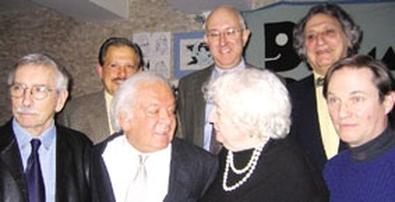
On Mon., Jan. 17, playwright Edward Albee, actor Richard Thomas, and producers Elizabeth I. McCann ("Three Tall Women," "Amadeus") and Martin Richards ("La Cage aux Folles," "Sweeney Todd") gathered at a Midtown restaurant to talk about the American theatre's approach to social change over the past 50 years. Curiously enough, the topic of the Drama Desk panel was barely addressed. Instead, in a freewheeling conversation, the participants talked about the extraordinary cost of mounting a show, the evolving role of the producer, the need to develop young and multicultural audiences, and their own experiences in theatre early in their careers.
Thomas, who is currently co-starring in "Democracy," recalled that when he auditioned for Jose Quintero's production of "Strange Interlude" in 1963, Quintero asked, "What do you want more than anything else in the world?" To which Thomas replied, to be an actor. "Quintero said, 'Good, you got the part.' " Thomas added, "I wish all auditions were that easy."
Drama Desk board member Ellis Nassour, who co-moderated the panel with Drama Desk second vice president Charles Wright, asked Albee how the New York theatre scene dealt with issues of social change at the start of his career.
Albee noted that he worked south of 14th Street, "so my notion of what was happening on Broadway was corrupted. We had a skewed vision." In the late 1950s and into the '60s, he continued, the downtown scene routinely produced Beckett and Ionesco, along with the more experimental new playwrights.
Wright wondered what happened when "Who's Afraid of Virginia Woolf?" made it to Broadway in 1962.
"I don't think it changed much," Albee remarked. He further suggested that New York theatre in general and Broadway in particular has had little impact on the world at large. The only thing that has changed, Albee pointed out, is the price: "In 1962, the play cost $42,000 to produce."
McCann, who has produced many of Albee's works and will soon be mounting a "Virginia Woolf" revival on Broadway, said, "It will now cost $2 million."
"Everything has gone up except the author's royalty," Albee said. "It used to be ten percent. Now the maximum is five percent."
He commented that there is little adventurous theatre on Broadway, although it's occasionally the "home for middlebrow work," much of which comes from someplace else anyway.
"But do Broadway shows change anything? No." He added that there is a greater possibility for audience-changing plays Off-Broadway than on Broadway, and an even greater possibility in Europe than in the United States: He cited the work of Pina Bausch.
McCann pointed out that shows and audiences have evolved. She recalled that when "The Moon Is Blue" played on Broadway in 1951, the two protagonists lived together out of wedlock and that was considered "totally off-bounds, certainly to a Catholic school girl. But I found a way to get in to see it."
That remark generated a big laugh from the audience.
McCann continued seriously that today anything goes, especially on television -- specifically, on reality TV.
Thomas quipped, "It's not reality TV. It's TV reality."
McCann stressed that compared to what's on television, "the theatre is pristine when you talk about social change." Theatre is still in the forefront of discussing social issues. She praised Joseph Papp for the early plays he produced about Vietnam and later AIDS: "Hollywood catches up. But we have the edge."
Still, all agreed that years ago there was a greater chance of seeing a socially or politically relevant show than there is today, even Off-Broadway.
Thomas remembered that when he was an adolescent growing up in New York in the early and mid-'60s, experimental theatre was part of the cultural climate: "I cut my teeth on 'Tiny Alice' and Ionesco." He said that he and his friends would read "The Zoo Story" aloud.
Martin Richards, who produced the original production and current revival of "La Cage aux Folles" and the original "Sweeney Todd," cited his father's reactions to those works as typical of the culture at large: "He said, 'Why can't you produce plays about normal people?' I think we've grown and now realize that the characters in those plays are normal."
McCann observed that it's still very hard to raise money for experimental works and that she never tells a potential investor that a play is "experimental or has a social conscience. Instead, I'll say it's a boy and a girl in love."
Richards added that because of the cost of producing and the need for many investors, the producer has essentially become a nonentity.
McCann agreed, saying, "You now see an array of names above the play's title. There are now more producers than actors in a show. It's producing by committee and it's all wrong. It's like everyone in first class getting to fly the airplane."
Laughs.
Richards commented on the ever-growing demands of the investors: "First, they wanted to be invited to the cast party. Then they wanted two tickets for the opening night. Then four tickets every night. Then they wanted the chance to get a Tony nomination. Then it was having their names on the marquee."
He recalled one investor sitting in on a rehearsal of some Hal Prince production and feeling free to give Prince endless notes on revisions, all scrawled on reams of toilet paper.
"That's where it belonged," said Thomas.
Laughter.
"Prince took the notes," Richards continued. "When I asked him why, he said that the investor was giving the production $3 million. He said, 'I don't have to follow his suggestions. But I have to read them.' "
Albee said the problem with these "notes" is that they are always designed to make the production "more commercial."
McCann retorted that the issue is that no one knows what's "commercial. Everyone is now hell-bent on doing musicals based on movies. So who would do 'West Side Story' today? That's based on Shakespeare. Who would do 'Oklahoma'? That's based on a play. Now it's all about 'catalogue musicals': using the music of Elvis or the Beach Boys. Add a few plot points." She reflects, "You can also get rid of the composer."
The conversation then turned to the need for theatres to consciously train their audiences to appreciate more-provocative work. Thomas said that when he recently appeared in a production of Albee's "Tiny Alice" at Hartford Stage, audiences found it very funny: "That would not have been possible without Mark Lamos producing that kind of theatre for several decades."
A member of the audience observed that at one time colleges taught the humanities; now they are largely institutions of vocational training: "If you put kids in front of 'Rhinoceros,' they wouldn't know what it's about and they wouldn't care."
Thomas agreed, but emphasized, "Young people love irony and for that reason love 'Democracy.' What they've lost through literature, they've gained through witnessing the political process."
Albee made the statement that only a minority of an already small audience enjoys serious theatre: "It's not only economics. Theatre has become a quasi-social event. Plays have to be seen because they're hits. The theatre audience is 95% white, 95% over 55, and 95% wealthy. We're talking about an issue that doesn't concern the majority of the country. And there's nothing much we can do about that, except continue to do what we're doing."
Richards equivocated a bit, saying that there are productions that attract young people -- "Rent," as a case in point: "The problem is that that audience will not then go see 'La BohĂ ̈me.' They're not interested in theatre that doesn't reflect their experiences."
McCann was not entirely convinced. She said that at a recent matinee of "Gem of the Ocean," the audience was filled with inner-city high school kids. She admitted that she was not optimistic when she saw them sitting there: "But to my absolute stupefaction, these kids listened with an extraordinary intensity. When the curtain came down, they were on their feet, stamping their feet, and shouting out the actors' first names. This was not naturalistic theatre; it was a heightened acting style. But it was good theatre. The kids were responding to good theatre."
Wright asked if the experience might pave the way for more theatregoing on the part of these kids.
McCann said she hoped so, but suggested that there were many obstacles -- not least the impact of television and the computer: "Kids go to the theatre and they don't know where to look, especially if it's a farce and characters are coming in and out of doors." The other problem, at least for a multicultural audience, is that plays don't usually reflect their experiences. And most relevant is the prohibitive cost of tickets.
The panelists talked about the challenges of mounting more matinees and lowering costs as a possible way to bring in new and diverse audiences.
"Our schedules are defined by the unions," noted McCann. "When I asked the unions to do an 11 o'clock, 1 o'clock, and 5 o'clock production of 'Charlie Brown' that was not doing well and would ultimately save jobs, Equity said no. There is inflexibility. If they agree to an additional performance, then you get into a conflict over meal breaks."
Someone from the audience asked the panelists, what should the theatre do in the age of Bush?
Albee said that political theatre is more complex than it once was: "I suppose political means questioning values. I feel that all serious theatre is sociopolitical. It holds up a mirror and says if you don't like it, change it. And that's not agitprop. But most people like only frivolous, escapist stuff."
He continued, "The agitprop plays of the '30s that were leftist and union-directed were useful. They were not terribly good plays, so they vanished. There's more political theatre in those plays that ask if we're participating in our lives. I feel if more people spent more time keeping themselves alive, we would have had different election results. I have never met a serious artist who was anything other than a liberal Democrat."
The audience applauded.
The panel wound up the evening with a look at how new playwrights can get produced.
Richards insisted that producers are always looking for good material and that he is open to receiving it, with or without an agent's stamp of approval. If nothing else, his readers will consider it.
Albee said new work can find a home in Off-Off-Broadway venues: "The problem is moving beyond that. The problem is the regional theatres that want to move their productions to Broadway. It's not that we lack interesting new playwrights. But we lack the ability to move them from smaller theatres to larger theatres."