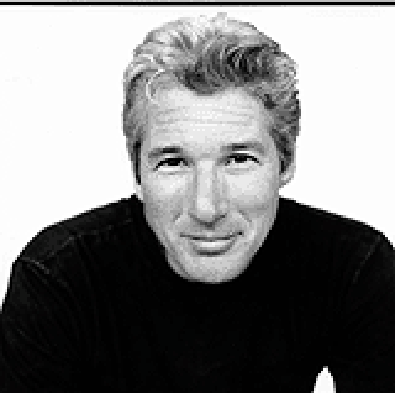
Richard Gere has been quoted in interviews as saying, "I don't want to be a personality." Throughout a career that has spanned more than 30 years, this veteran actor of stage and screen has preferred focusing on artistic issues related to his craft rather than on anything "Hollywood." He finds it more pertinent pondering the challenges of particular roles than analyzing the reasons behind peaks and valleys in his career. His intense desire for privacy, coupled with the smoldering image of a cocky, coldhearted ladies' man emerging from such films as Looking for Mr. Goodbar (1977) and American Gigolo (1980), led to a public perception that he was heir apparent to the James Dean/ Marlon Brando angry-young-man persona. There's little about Gere today that suggests anger or stereotypical Hollywood myths. He's a respected and serious-minded craftsman, a devoted family man, and a generous humanitarian who has weathered and risen above the mean-spirited media scrutiny that plagues many celebrities.
Gere has blossomed into a versatile and renowned screen star with staying power. He can still pull a chauvinistic narcissist out of his hat and score a huge success-consider 1990's Internal Affairs and 2002's Chicago. Yet he can also be a charming romantic comedy lead (Pretty Woman), a vulnerable leading man (An Officer and a Gentleman), a devastated wronged husband (Unfaithful), or a dashing knight in shining armor (First Knight). In his current film, Shall We Dance?, he's a warmhearted but emotionally unsatisfied lawyer, whose workaholic life and stale marriage lead him to secretly enroll in a ballroom-dancing class. In this effervescent comedy, he trips the light fantastic through some delightful ballroom dance sequences and sweetly evokes the simple charms of a middle-age-crazy man seeking to restore magic in his life. What we see in Gere nowadays are the myriad faces of a skilled actor. In this new film, the dangerous street punk of Goodbar and the swaggering male prostitute of Gigolo have made a 360-degree turn into an endearing mix of Gene Kelly and Jack Lemmon. One senses there will be more heels, macho men, lovers, sensitive protagonists, and sundry unexplored character types in his still-evolving and ever-prolific career. In a recent conversation, Gere was mellow, upbeat, and cordial, though still intensely focused on the serious business of his cherished profession.
Back Stage West: First I want to congratulate you on one of the most informative and delightful Q&A sessions for a film I have ever had the pleasure of attending. It was in early 2003, at the Back Stage West-sponsored screening of Chicago at the Directors Guild. We had been told one or two stars from the movie would attend, and, at the end of the screening, almost the entire principal cast suddenly filed onstage for a fabulous discussion of that amazing film.
Richard Gere: Obviously we all loved the film and saw it as a family enterprise. So we tried to do as many of those things together as we could.
BSW: I also want to mention that I just saw a screening of Shall We Dance? and was thoroughly captivated by your characterization. This is light years away from the roles I first saw you in, when you played self-assured, arrogant, dangerous characters.
Gere: Are you saying my performances are less self-assured these days?
BSW: No, no, no. I'm speaking of your approach to the character.
Gere: I'm just kidding. Thanks for your comments
BSW: Can you tell me a little about the early steps in launching your career?
Gere: I was born in Philadelphia, and raised in Syracuse, N.Y. I spent a couple of years in college [at the University of Massachusetts]. Then I left school when I was offered a job at the Provincetown Playhouse, which worked under a two-week repertory system. You rehearse for two weeks, then play for two weeks, and, while playing, you're rehearsing two weeks for the next one. It's incredibly difficult and intense. As I recall, we did five or six plays, some of them three-act plays. To be constantly learning a play and performing at nights causes lots of pressure and anxiety--just to even remember the lines. But it's good training for an actor, extraordinary training, actually.
BSW: What was the next step? Did you go to New York?
Gere: No. The director of that theatre was the production designer for the Seattle Repertory Theatre. Alan Fletcher, who was the director for Seattle Rep, had been in Provincetown to talk to my director, and he saw me perform in a couple of the plays. He asked me if I would perform with his company, so I said yes and went to Seattle to perform there for a year. After that, I came to New York. I did a lot of plays, then, after I had worked in films for a while, did Bent onstage in New York. That was the last time I was onstage [in 1980].
BSW: Prior to Chicago, audiences never thought of you as a singer or dancer, and in your new film you dance even more. Is it possible we will see Richard Gere's name on the marquee of a Broadway theatre, or starring in the lead role of a new film musical?
Gere: No, not really. I'm not seeking out theatre roles. I wouldn't rule it out entirely, but I'm not temperamentally good at the repetition. If I accepted a play, it would have to be something pretty amazing. The truth is, I have two young kids, and I like spending time with them and putting them to sleep at night, which I couldn't do if I was at a theatre every night. When these two films [Chicago and Shall We Dance?] came along, I enjoyed the opportunity of trying something new. The irony is that my first jobs in New York were musicals. Then there was a 30-year hiatus prior to Chicago. I did a bunch of musicals in those early years, but Grease [in London and New York] was the most successful one. In the New York production, I was the understudy for all the male characters, so I was basically going on every night doing different roles, which was wonderful training. For Chicago I had to brush up my musical skills, since I hadn't used them for so long. I've been involved in music my whole life [composing and playing instruments]. Almost every day, as part of my exercises, I get up and write something. But the style required in Chicago was very specific. It was a very different approach to using my voice than I had ever done before. I also didn't tap dance, so I had to learn that. Yet the dancing I did in Shall We Dance? was actually harder. In Chicago my tap scene was interspersed with the trial scene, so I didn't have to sustain it beyond passages of 10 to 20 seconds. For the ballroom dancing in this new film, I had to be really continuous with it and have a routine that has a dramatic movement to it.
BSW: You've made approximately 40 films. Which have been your favorites?
Gere: In recent years I'd have to say Chicago. We all had such a great time, and Rob Marshall was such a joy. And we were so well-received. All the way around, it was a great experience. From the early period, one of my favorites was definitely Days of Heaven. It was the first one that I made, and there was an amazing amount of talent involved. Terry Malick wrote and directed it. Nestor Almendros shot it, with Haskell Wexler doing some additional shooting. Sam Shepard and Brooke Adams were wonderful actors to perform with.
BSW: Have there been times in your career when you were unsatisfied with the way things were going?
Gere: Sometimes I have been interested in projects that were less commercial. There have been films I've done that weren't blockbusters and maybe weren't as well received, but there was always some internal reason I wanted to do them. It happens with every actor once in a while--you like a role in a film, but the film as a whole doesn't come off as well as you had hoped. Making films can be a very inexact science.
BSW: Have you been involved in producing some of your own films?
Gere: I have, but it's a pretty thankless job--lots of headaches and hard work. Everyone else gets to have tantrums and be difficult and artistic, but the producer can't usually do all that. It's not a great job for me. Having said that, the job of a producer is often something that I sort of take on anyhow. I've been around a long time and sometimes have good ideas to share. As far as directing, I might like to do it at some time--it could work temperamentally but probably not practically. To walk away from everything else and focus for a year and a half or two years on a movie is something I couldn't do. I like taking a role, working on it, then letting go of it and moving on to something else.
BSW: Are awards important to you? Do you hope to win an Oscar?
Gere: No, that's not important to me. I think when my career began, those things had a certain romance to them. I've seen too many great performances get no attention, and mediocre performances get a great deal of attention. It's all very relative. Yet it's perfectly fine when it happens. All of the attention I got from Chicago was great fun. I've been working a long time, so I have a lot of friends in this business, and there was a lot of genuine warmth toward me at that point, which was very gratifying.
BSW: Are there any roles that you passed up and later regretted?
Gere: I'd say there are a couple, but I won't tell you what they are. For the most part, I think I've been right. My batting average has been very good.
BSW: Are there lessons you've learned in your journey that you might want to share?
Gere: I think the important thing is for actors to find their own way creatively. I had an extraordinary teacher, Wynn Handman, in New York. He runs the American Place Theatre. Lots of famous people have come through his studio, but you wouldn't be able to tell it by their acting style, because it's not a uniform style. What made him such a great teacher is that his mission was to help you find your thing, whatever it is, and help you develop that. You can learn a great deal by mimicry, but the truth is, you've just got to find your individual way. We've all got something special that can be developed, and that's the important thing. The healthiest way to go into an acting studio is to say, "I want to work on such and such different things." You need to be proactive. Don't go in expecting to be molded. For instance, a lot of American actors don't get a chance to work on Shakespeare very much. You can find a teacher who specifically can work with you on that, and help you make breakthroughs. But it's really your own energy, your creativity, your impulses that count. BSW