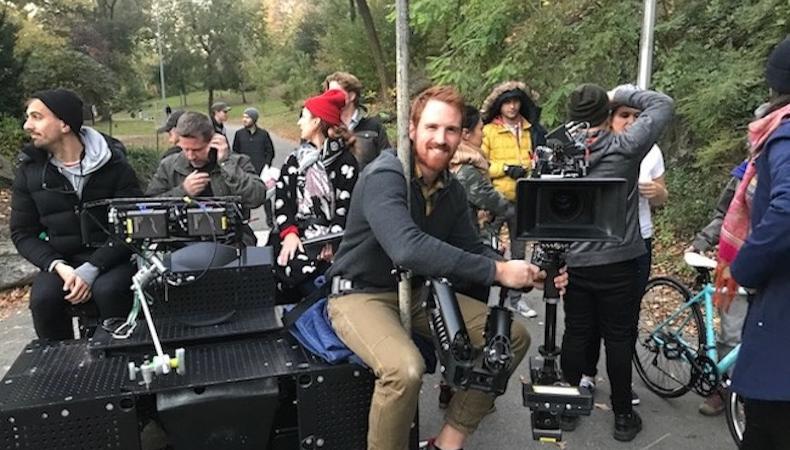
If you’ve watched a television show or film in the last decade, you’ve seen a Steadicam shot: They’re the long takes that follow and capture the action continuously without cuts. What seems impossible is made possible, primarily, by Steadicam operators like Bill Saxelby, who’s worked on projects including HBO’s “The Leftovers” and Bravo’s “Odd Mom Out.” He spoke with Backstage about his craft.
For those who don’t know, what does a Steadicam operator actually do?
Steadicam operators execute very stylized shots—those shots that kind of seem like they’re floating and continuous. It’s essentially pulling off an impossible traditional camera shot, which would require a dolly track and a crane. It’s those kind of looks, where it’s a camera following somebody. The most prominent industry term is called ‘the walk and talk,’ which you’ll see in most half-hour or hour[-long] sitcoms or dramas, where two people are walking down a street.
READ: How to Act for the Camera
What kind of equipment does the Steadicam operator use and wear?
It’s a three-part piece of gear. There’s a vest that I strap to my torso, and hooked into that is what we call the “arm,” which is a spring or canister-loaded, two-segmented arm that allows the camera to be lifted and also stabilized. It’s doing those two things, where it’s taking the weight of what’s called the “sled”—that’s the piece of equipment that actually has the camera put onto it. That’s a vehicle to mount the camera to, and it has on it a frictionless gimble that allows you to pan or tilt the camera any which way, and that’s mounted to the arm, which is mounted to the vest, which I wear. You kinda feel some weight in your lower back, your hips, just above your knee. That’s kind of where you’re bearing all the load.
How did you find yourself in the realm of camerawork?
I was studying film at University of Texas, and I got an internship as an office P.A. on this tiny movie that Nicole Holofcener wrote and directed. I had kind of made it known that I was more so gearing myself into camera, because at the time I wanted to be a [director of photography], so they eventually transferred me to a general set P.A. When it was appropriate, I would go over to some of the camera guys, but not burden them too much while they were working. I got cozy with them and I was fortunate enough that the first assistant was really receptive to my questions and my eagerness, and then told production that they needed a camera P.A. and they chose me for the rest of the job. So I went from office to set to camera, all in one job.
When you first started operating cameras, was there a lot of learning on the job? How did you actually figure out how to do it?
You don’t get a learning day. Nobody’s like, “Hey, let’s let this fella mess around for a bit.” It was a combination of skills that I had coming out of making movies in film school, already operating fluid heads and working with dollies, and then it’s a lot of being very attentive when you’re on set. I was always watching the other operators, asking questions. Again, when I was trying to get in good with the camera department on that one job, I was always making sure that it was never in an intrusive part, but when everything was calm, when we were doing rehearsals with the second team, I would go in and ask those questions.
What is a Steadicam operator’s working relationship with the actor? Do you often have to give them instruction?
The only time I [direct an actor] is if we’re doing a Steadicam walking scene—we call it a “push”—where I’m walking backward and they’re coming at me. A lot of times, you slow down the actor’s gait by about 20 percent because if they’re walking full steam ahead, you’re running backward. You’ll feel like you’re a little more reserved, but on the lens it won’t look like that. You’ll look very natural. If you’re bending down in frame to pick something up, just milk it for an extra third of a second so that you’re giving me the time to come down with you, come back up. Our goal is to make sure we get you as the actor featured as much as we can on screen.
Do you have any advice to offer someone who wants to get into camerawork?
It’s all about figuring out what your possible “in” can be. Do you know anybody that works in the industry? And it doesn’t matter what department; do you have a friend who is a costume designer or is a sound mixer? Because they’ll know somebody in camera. People in our industry, it’s a very apprenticeship, craft-based industry. People, more often than not, are interested in bringing up a new era of craftsmen and craftswomen. So it’s always a big leg-up to figure out where you can get your in. And if anyone who reads this article wants to contact me personally, that’s totally fine. That’s a tool for somebody to use: myself. It’s a very odd industry in that there’s so many different ways you can sneak in, because it’s a very relationship-based industry. It’s people first.
Ready to step in front of the camera? Check out Backstage’s film audition listings!