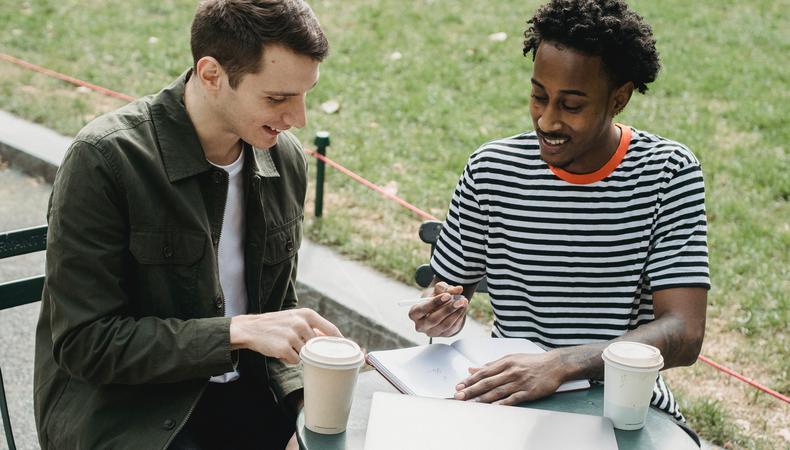
Ah, what can be sexier than waking up, turning over, and having a production meeting in bed? Or having an idea in the shower and drying off while screaming said idea to your partner down the hall? Or burning the chicken in the oven because your writing session carried on a little too long? This, my friends, is what it looks like to collaborate with a partner.
The one time I went on a Tinder date with a non-theater person, he told me to meet him on his lunch break at the high end gym he worked at in Chelsea. He wound up giving me a tour of the facility all while trying to sell me a membership. LOL, right? But personally, the idea of dating someone who I couldn’t create with didn’t sit well with me. It even frightened me. My boyfriend of almost seven years, Remy, and I met at a “Book of Mormon” Equity Principal Audition (EPA ) and had our first kiss during the intermission of “Aladdin” on Broadway. He asked about moving in with each other during intermission of “The Hunchback of Notre Dame” at Papermill Playhouse. Stick to what you know, am I right? Now we host “My Broadway Memory” on Broadway Podcast Network as well as produce and write together.
But it took us a second to write punchlines while cooking with our air fryer. So, how does one get there and what goes into an artistic and collaborative romantic relationship?
1. Don’t push the boundaries.
When an old manager of mine found out I was dating another actor, I was told to reconsider because it might distract me and create a hostile environment. I didn’t listen and Remy and I kept clear boundaries with each other. A year into dating, we kept our artistic lives almost completely separate, not even going to the same auditions together. Though, one of the best experiences for us as a couple, albeit trying, was the first time we were called back for the same coveted role for an out-of-town tryout. One of us wound up moving into final callbacks, which provoked honest conversation about respecting space, preparation, and process.
I found these transparent conversations to be worth it as they provided realistic expectations all while understanding that our careers come first. If Remy was preparing for an audition, I’d see him the next day and that was mutually respected.
 How Theater Artists Can Collaborate While Social Distancing
2. Set aside the ego.
How long before my next gig? How long will I be away for? What am I even doing with my life? These are big questions worth asking and a relationship certainly won’t answer them, but maybe a collaborative partner can help. Just avoid forcing it.
Especially when we were just starting out, there was an understanding between Remy and I in terms of our hopes and dreams. Though we were falling in love, our career goals were the most important. Non-negotiable, especially after what we just paid for in college tuition. It was always set in stone that Remy would leave NYC for a bit to try out L.A. for pilot season. I think he might have even mentioned it on our first date. So when the time came for him to pack, I knew that I’d have to trust this time apart would ultimately be the best for us and his commitment to the journey made me fall in love with him even more.
What I learned from this was that if I held on, if I tried to get him to stay, it would stunt our growth together and individually. Without this time apart I wouldn’t have learned valuable information about myself. And who knows how long he would be staring out of the window daydreaming of the time he lost in L.A. and what could have been. If your partner has an impulse, put your ego aside and support it.
3. A square peg can’t fit in a round hole.
Even though we both have “actor” as a proficiency in our multi-hyphenate identity, we have two very different approaches to our career. We didn’t want to strain collaboration if it didn’t feel natural, but after years of learning about ourselves and the world around us, opportunities finally came to us.
Creating with Remy has stayed enjoyable because we’re being honest. Simple. Plainly us. Isn’t that what all art should be? Sometimes it’s just not that deep and maybe it shouldn’t be when collaborating with a partner. If I didn’t unload the dryer, I don’t want passive-aggressiveness dictating the creative process, especially on a project that can determine if the world continues spinning. You can’t leave your drama at the door when you’re both already inside.
As Sondheim so eloquently wrote, art isn’t easy but it does get easier with a support system and sometimes that support system is someone you met while auditioning for the same role. Just don’t push it, set aside your ego, and communicate. Do we have moments where our collaboration skills are undefeatable? Yes. Do we have moments where our ego threatens its presence? Sure! But there is one thing that makes it easier—we both can commiserate at the end of the day, speak the same artist language, and always put on YouTube and watch Patti LuPone sing “Rainbow High” from “Evita.”
Looking for remote work? Backstage has got you covered! Click here for auditions you can do from home!
The views expressed in this article are solely that of the individual(s) providing them,
and do not necessarily reflect the opinions of Backstage or its staff.