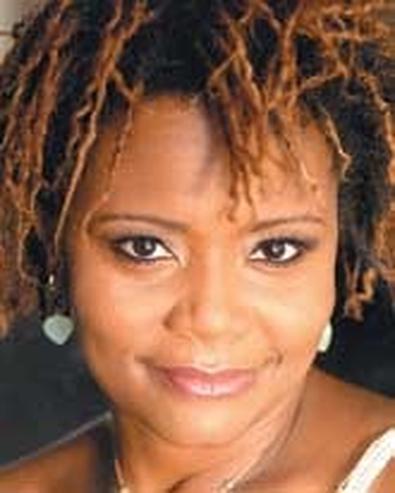
Despite the obvious classism -- and, perhaps, to a lesser extent, racism -- evoked in the Tony Kushner-Jeanine Tesori musical "Caroline, or Change," Tony Award-winning actress-singer Tonya Pinkins, who plays the title character, views Caroline's plight from a personal (not social or political) perspective. Caroline is an African-American domestic working for a Jewish Louisiana family during the months of November and December of 1963. President Kennedy has just been assassinated and the civil rights movement is gaining momentum.
That's not to say that Pinkins denies the play's cultural context and its ineluctable impact on the characters. Nonetheless, she insists, "Caroline's problem is that she sees herself in a limited way; she can't imagine other possibilities for herself. Realistically, the classism and racism were huge -- and I'm not sure it has changed that much -- but, in the end, we are still responsible for our own lives. We only make ourselves more powerless by blaming others for our circumstances. There is no reality except our view of that reality. Things have the meaning that we give them!"
One thing is certain: The events that transpire in "Caroline, or Change" are complex, open to interpretation, and bring to the surface (among the characters) a host of ambiguous feelings about race, class, and, most central, money. The "change" in the title refers literally to loose change (as in nickels and dimes), along with the headier meaning of "change" as in evolving times and personalities, not to mention reinvented relationships within the family and, by extension, the society at large.
"Caroline, or Change," which bowed Off-Broadway at the Public Theater on Nov. 30 (and is reportedly slated for a Broadway transfer), depicts the friendship between the stoic and beleaguered Caroline -- facing her own family conflicts and money crises -- and her pal Noah, the white family's child, a lonely and isolated figure in his own right. Noah has recently lost his mother. His father, a distant and removed man, has remarried a woman who is trying very hard to be Noah's mom, but not quite making it. The pivotal event centers on her effort to give Noah a sense of responsibility by insisting that he take the change out of his pockets before Caroline launders his clothes. If he fails to do that, she says, Caroline keeps the change.
At first Caroline refuses, insisting, "I don't steal from a child." But later, as Noah deliberately increases the amount of money left in his pocket in order to help her, Caroline relents and takes it. She hates both herself for copping the change and the family for being in a position to dole it out; and when Noah reneges, asking her to return the money, emotions boil over. Noah makes a racist remark and Caroline, in turn, voices anti-Semitism. Full of anger, shame, and self-loathing, she quits the job she has held for decades, a job that she has not really hated (perhaps even liked), but at the same time resented profoundly. In the end, however, Caroline returns to work, although her relationship with Noah will never be the same. Pinkins' performance as a proud woman, trapped and humiliated, is dazzling.
"Caroline has to go back because she needs that job, but I don't see it as an act of resignation, because she has learned that she has power, at least over her own actions. Caroline has changed." So maintains Pinkins, a charming and gracious 40ish Chicago native who meets me in a Public Theater conference room. "In the beginning, Caroline is unaware of who she is, but in the end, she is a conscious human being, aware that she makes choices and that these choices have an effect on others. She realizes, for the first time, that she is seething with rage. With the money come hopes and dreams that become so consuming, she explodes. That explosion is not acceptable."
A major challenge in playing Caroline, it would seem, is that she is not the most likeable figure; in fact, she borders on the unpleasant, grimly blank and never smiling. Interestingly, however, Pinkins does not find Caroline's lack of appeal an issue. "I like having the chance to show the humanity in a person who isn't very nice," Pinkins insists. "I identify with her. When I was a kid, everyone thought I was conceited and not a very nice person. That's not true, but that's how I was perceived.
"In every way I identify with Caroline. I am also a single mom with four kids; I have known financial struggle, and what it's like to have had an abusive relationship with an ex-husband."
Nonetheless, Pinkins is a far cry from Caroline. Consider this: She receives a call from her kids' nanny, and later interrupts our conversation to check in with her building's doorman about a delivery. More relevant, playing a character like Caroline represents a major departure for Pinkins, who usually plays "the sexy vamp, the diva," she says. "In fact, I couldn't even audition for the part of the maid [played by Regina Taylor] in the TV show 'I'll Fly Away.' They said to me, 'You're so sexy. No one is going to believe that the Sam Waterston character wouldn't sleep with you.' "
Check out Pinkins' roster of voluptuous characters in such productions as "Jelly's Last Jam" (winning the Tony, Drama Desk, Outer Critics Circle, and Derwent awards), "Play On!" (Tony and Jeff nominations and the Black Theatre Alliance Award), and "The Wild Party." Other credits include appearances in "Chronicle of a Death Foretold" and "Merrily We Roll Along" (both on Broadway) and "The Caucasian Chalk Circle" and "The Merry Wives of Windsor" (both at the Public).
Making Things Happen
Pinkins is the child of civil servants. Her father was a police officer (later an insurance salesman) and her mother was a postal worker (later a city bus driver). Pinkins, on the other hand, saw herself as both an artist and scientist "in the tradition of da Vinci and Michelangelo. I did three years of math in high school and was a painter. I'm still a painter," she says, citing Van Gogh and Klimt as her primary artistic influences.
Still in high school, Pinkins began studying acting at the Goodman Theatre Young People's Program and launched her career almost immediately. Over the next 15 years, she performed on Broadway, on television, and regionally. Between jobs, she returned to college, earning her undergraduate degree from Columbia College in Chicago, attending Carnegie Mellon's music theatre program and even a year of law at California Western Law School.
Pinkins is also an activist. In the wake of her experience as an abused wife (one who initially lost custody of her children), Pinkins co-created "Operation Z" (standing for zero tolerance for violence against women and children). Her greatest mentors, she says, are Jane Fonda, Eve Ensler, Shirley MacLaine, and Larry Kramer.
"They all had personal challenges and were able to transform themselves and help others. Eve was sexually abused and started V [vagina] day to raise consciousness about sexual abuse. Jane was bulimic and created several exercise videotapes that have helped millions of women exercise. Larry formed Act Up in response to his own battle with AIDS. I don't know what Shirley MacLaine's challenge was, but she is important because she made it acceptable for the public to talk about spiritual matters."
Pinkins is a strong champion of positive thinking and "making things happen." She maintains -- and promotes the view in her actor's workshop, "The Actropreneur Attitude" -- that "actors are trained to be failures, made to believe that there are no jobs around, and if they get a job, they think they are lucky. There are a plethora of roles, but they have to know where to look and not limit themselves to New York. There's a digital and a global marketplace. But actors have to be able to create their own opportunities, think that they can, and then know how to present themselves. Most actors can't even accept a compliment. They're embarrassed or dismissive.
"You have to be able to receive a compliment, to receive applause," Pinkins continues. "I've been told by the actors in this show that I take too long at the curtain call. But it's my way of allowing the audience to express their feelings towards me, and my way of receiving them."
She adds that the best responses are wordless, and that when theatregoers wait for her after a show "just to hug me and in tears, that's the most meaningful applause I can get."
Pinkins suggests that while the musical may speak to black and white audiences somewhat differently, its resonance crosses racial, ethnic, and economic lines, perhaps now more so than ever. "Almost everyone has a nanny now, although she's not necessarily black. I would hope, however, that an employer today would see a Caroline's potential and help her to do something else."
Asked about her kids' nannies, Pinkins stresses that they are not typical nannies: "They are all artists, working as nannies between jobs."