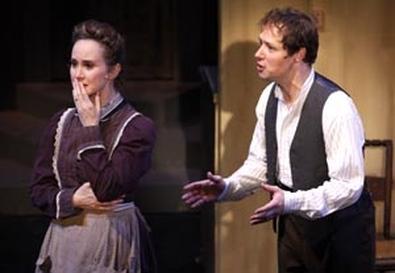
The musical version of "A Tree Grows in Brooklyn" begins in 1904, when Katie Rommelly weds Johnny Nolan, a charismatic singing waiter. Everyone warns Katie that Johnny is unreliable, but she marries him anyway and soon bears a child, Francie. Sure enough, Johnny proves unable to hold a job, and Katie has to support the family by becoming a cleaning woman. By the time Francie reaches the eighth grade, her parents' marriage has dissolved into a series of alcohol-fueled fights. When Johnny freezes to death at the end of an alcoholic binge (and an embarrassing dream ballet), Francie blames Katie for driving him away and forbids her mother from attending her graduation, where she is to give the commencement speech. Katie goes anyway, on the sly, and the two end the show singing a song of hope, in an utter non sequitur.
The enormously talented Jim Stanek imbues Johnny with charm and depth and gives the production a semblance of a gravitational center. As Katie's sister, Sissy (in a role originally played by Shirley Booth), Klea Blackhurst is funny and always welcome. Elizabeth Loyacano, as Katie, and Keaton Whittaker, as Francie, show evidence of considerable ability, but they are hobbled by two-dimensional roles.
Among the chief reasons given for the musical's failure to soar like the novel is the absence of Francie, the center of the novel, from the first act. The Peccadillo and revisers Elinor Renfield and Susan DiLallo attempt to remedy this by giving Francie monologues throughout the show, but unfortunately their efforts do nothing to strengthen the shaky body of the piece and come across as window dressing.
Can "A Tree Grows in Brooklyn" be saved? One hopes so, because its gritty, inspirational tale is evergreen, and its score, which is adorned with such gems as the exquisite ballad "Make the Man Love Me" and the delicious comedy number "He Had Refinement," cries out to be heard. Sadly, however, this production does nothing to advance the cause—and might even set it back.
Presented by the Peccadillo Theater Company at the Theatre at St. Clement's, 423 W. 46th St., NYC. March 20–April 10. Tue. and Wed., 7 p.m.; Thu.–Sat., 8 p.m.; Sun., 3 p.m.. (Additional performance Sat., April 9, 3 p.m.) (212) 352-3101, (866) 811-4111, www.theatermania.com, or www.thepeccadillo.com. Casting by Jay Binder/Nikole Vallins.