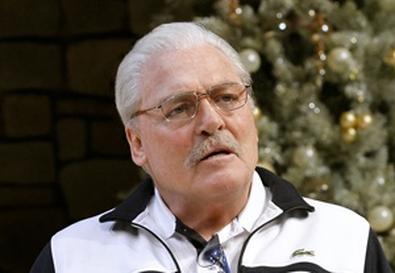
Rest assured. Stacy Keach is still Stacy Keach—affable, articulate, and thoughtful. Though perhaps best known as the cool and canny detective Mike Hammer or the paternal warden Henry Pope, the veteran actor has never stopped acting. Indeed, he is currently appearing in Jon Robin Baitz's new play, "Other Desert Cities," at Lincoln Center Theater at the Mitzi E. Newhouse through Feb. 7. He plays staunchly conservative and emotionally torn husband-father Lyman Wyeth, who heads a well-heeled Palm Springs family crippled by lies and secrets. (The cast features Stockard Channing, Linda Lavin, Elizabeth Marvel, and Thomas Sadowksi.) Thematic motifs include compassion vs. truth-telling and what it means to pretend in life.
Keach admits he understands Lyman's view when he says, "'A lot of people get through the entirety of their lives pretending. At a certain point, that's not the worst thing to do.'" Keach is more ambivalent on whether truth-telling or compassion takes precedence. "I think truth does, but compassion is the cornerstone of our ability to have peace in the world," he says. "Compassion is more accessible. Outside of science, truth is relative. Truth in art is relative to the day, the moment, the mood, and where you happen to be in terms of your life.
"The thing that's so fascinating about this play is the balance between a purely technical responsibility in terms of how to present the play and the emotional responsibility to convey my character and his feelings in a spontaneous way," the actor continues. "Robin Baitz obligates the actor to be spontaneous within a specific framework. That's why I define this play in terms of music—a wonderful chamber piece or a jazz fugue. You have to know the notes, but you play it differently, depending on the audience, the other actors, and their reactions."
Keach is familiar with the world of the play. Though he was born in Savannah, Ga., he grew up in Southern California and frequently visited Palm Springs. More relevant is Lyman's similarity to Keach's father, the late Stacy Keach Sr.: Both men were actors with traditionalist views. In many ways, Keach's performance is loosely based on his father. "It's not an imitation," says Keach. "It's an inspiration."
Favoring His Left Side
For Keach and kid-brother actor James Keach, acting was their bloodline. Still, their parents "would have preferred if I were a lawyer," says Keach. "They were not happy with our choices until we had a modicum of success. But they were just being protective. It's a terrible business, fraught with insecurity and rejection. I've worked steadily, but there have been lulls. And with the financial lulls I begin to think, 'Maybe Dad was right and I never should have ventured down this road.' "
Keach earned his undergraduate degree at the University of California, Berkeley, majoring in English and dramatic art, before matriculating at the Yale School of Drama on a full scholarship. His first acting teacher at Yale was stilted, stultifying, and awash in old-fashioned acting techniques, he says. The dislike was mutual. Keach flunked his first two acting courses but then went on to win the school's major theater honor, the Oliver Thorndike Acting Award. Unlike other young acting students who might feel cowed in the face of a university acting teacher, Keach concedes he came armed with his family background and had a degree of self-confidence that he might not have had otherwise. He felt sufficiently comfortable to appear in a host of college productions and conduct his own acting classes during lunch for other disaffected students. It was an antidote to the lousy teacher, whom Keach now credits with causing him to "take action and maintain my sanity."
His first major break was playing President Lyndon Johnson–cum-Macbeth in the Off-Broadway production of Barbara Garson's political satire "MacBird!" but Keach gained a national following in the guise of Mickey Spillane's "Mike Hammer," a role he almost didn't get. "The producer, Jay Bernstein, saw me as a long-haired New York liberal and thought I was totally wrong for the part," Keach recalls. "I said that's not an issue. I'm an actor." A character's style, politics, or moral fiber—however alien—have never put him off, Keach emphasizes. On the contrary, that's the fun challenge.
"I asked Mickey Spillane for advice, and he said, 'Wear a hat,' " Keach continues. "He meant a pork pie hat, but I wore a fedora, which helped create for me the film noir world inhabited by so many of my favorite actors: Humphrey Bogart, Robert Montgomery, and Robert Mitchum." The fedora certainly gave him a recognizable persona and "made me use the left side of my face because the hat was tilted to the right." He notes with a sly grin, "The left is my good side."
King Lear (performed at the Goodman Theatre in Chicago and the Shakespeare Theatre Company in Washington, D.C.) is the role he is most proud of; the most challenging was Hamlet. "It has many more colors than Lear, though Lear is like Hamlet for an older man," says the actor. He hopes his Helen Hayes Award–winning "King Lear," directed by Robert Falls, will have a shot in New York. But a role he would most love to tackle is Teddy Roosevelt. "I love his energy," says Keach, who has co-authored a screenplay about Roosevelt's trip down the Amazon. Though the script has had a few nibbles, Keach is dismissive: "I don't trust nibbles because you can lose bait too easily."
Make It in New York
Only half in jest, Keach says he chooses roles depending on "the size of the check" but also, more important, family. He says leaving his wife and two adult children for any length of time is an issue. Finding good directors is another. Keach looks for those who inspire and encourage and are never dictatorial. "John Huston was my favorite director," says Keach, who starred in Huston's "Fat City." Keach played a fighter whose better days have passed. "Huston said, 'I have two directions: a little more, a little less.' "
Keach acknowledges he has not suffered from typecasting or ageism. He has no shortage of work in all three mediums, in addition to an ongoing career performing audio books. The latter he views as an exhausting genre. "You only have your voice to work with, you are acting alone, and often doing many characters," he says. "It requires an intensity of concentration for the actor."
Asked what advice he'd give his daughter, who is an acting student at California Lutheran University, Keach says: "It's the same advice an acting teacher gave me at Berkeley: 'Make it in New York theater first, and you'll have a career.' Some actors go straight to Hollywood right out of high school. But there comes a time in every actor's life when by virtue of age or whatever, things change. Without theater, you run the risk of hampering your career. You need television and movies to make a living, but you'll be taken more seriously if you are stage-worthy—stage-worthy in Chicago and Washington, but especially New York."