Whether you’re drawn to the thematic storytelling of “This American Life,” the true crime chemistry of “Wine & Crime,” or the educational deep-dives of “Radiolab,” a podcast’s format defines its personality and determines who becomes a devoted subscriber. Let’s explore the nine most popular podcast styles—and how you can use them to cut through the noise and build engaged audiences.
1. Interview
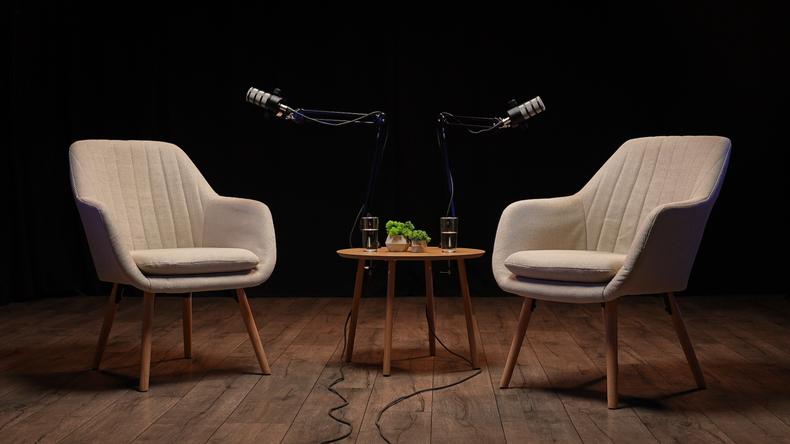
Interview podcasts center around conversations between the host and a guest. Typically, the guest is someone with specific expertise, an interesting perspective, or a recognizable name, while the host acts as both guide and audience surrogate. Interviews can be casual chats or journalistic Q&As. The format works well for virtually any niche you may be hoping to start a podcast in.
Interviews often follow a consistent structure: The host introduces the guest, guides the discussion through curated questions, and closes with takeaways or reflections. Some creators rely on remote interviews using software like Riverside or Zoom, while others host guests in person.
Pros:
- Guests bring their own audiences, expanding the podcast’s reach.
- Each episode feels fresh with a new perspective.
- There’s no need to come up with a full script.
Cons:
- Scheduling guests can be logistically challenging.
- Interview quality depends on the guest’s charisma and speaking ability.
Notable examples:
- “Decisions, Decisions”: Mandii B and WeezyWTF interview guests about all things sex, love, and relationships.
- “Armchair Expert”: Actor Dax Shepard and his co-host Monica Padman have casual conversations with celebrities and experts.
- “In the Envelope: The Actor’s Podcast”: Backstage senior editor Vinnie Mancuso has in-depth conversations with creatives in the entertainment industry who discuss how they got to where they are today.
KinoMasterskaya/Shutterstock
2. Solo (monologue)
In a solo podcast, one person (that’s you) speaks directly to the audience. This is the most personal podcast format available, relying on the host’s knowledge and storytelling ability to carry the show. Solo formats can take many forms, including educational lessons, motivational rants, personal diaries, or commentary.
This format requires confidence and strong voice presence, but it also offers unmatched creative control.
Pros:
- Hosts have total creative freedom.
- Production is simpler.
- Hosts establish a personal, direct connection with listeners.
- With no reliance on others, it’s easier to stay consistent.
Cons:
- It can be tough to maintain momentum solo.
- There’s high content demand on the host for every episode. You need to come up with a lot of ideas.
- Lack of variety may lead to listener fatigue over time.
Notable examples:
- “Hardcore History”: Dan Carlin delivers epic deep-dives into historical events with dramatic flair.
- “The Mindset Mentor”: Rob Dial shares short, motivational monologues focused on a variety of topics.
- “Park Predators”: Journalist Delia D’Ambra explores the disturbing connections between crime and national parks.
3. Panel discussion
Panel podcasts feature multiple voices engaging in conversation or debate on a shared topic. Some panels are recurring teams, while others rotate guests. The format lends itself well to news, politics, or pop-culture commentary where multiple viewpoints can enrich the discussion.
A well-moderated panel should feel like a lively dinner table conversation—fast-paced, opinionated, and even humorous. Without structure, however…it can devolve into chaos.
Pros:
- Panels engage in dynamic and energetic conversations.
- Multiple perspectives are featured.
- Sharing hosting responsibilities reduces pressure on one person.
Cons:
- Managing overlapping voices can be challenging.
- It might be difficult to maintain balance if certain voices dominate.
- Audio quality issues can arise with multiple remote speakers.
Notable examples:
- “The Read”: Kid Fury and Crissle critique pop culture and society.
- Slate’s “Political Gabfest”: A trio of journalists breaks down American politics with occasional guests.
- “Wait Wait… Don’t Tell Me!”: The famed NPR show hosted by Peter Sagal helped define this type of format.
4. Conversational co-hosts
This format involves two or more recurring hosts chatting about topics in a casual, free-flowing way. It feels more like friends hanging out than a formal show, which is part of its appeal. Chemistry is key, since listeners tune in not just for content, but for personalities and banter. It’s all about building a parasocial connection.
Pros:
- Content is natural and relatable.
- The show is easy to sustain if the co-host dynamic is strong.
- The topics and relationships encourage long-term listener loyalty.
Cons:
- The show risks becoming indulgent.
- It can be difficult to maintain quality if energy dips.
- Editing overlapping dialogue can be tricky.
Notable examples:
- “My Favorite Murder”: Karen Kilgariff and Georgia Hardstark mix comedy and true crime in a very popular show with a devoted cult following.
- “The Basement Yard”: In this laid-back comedy show, Joe Santagato, Frank Alvarez, and friends riff on random topics.
- “Call Her Daddy”: Originating as a sex and relationship podcast, Alex Cooper’s candid and edgy style has become its defining draw. She also conducts many interviews, with the formats naturally overlapping.

LightField Studios/Shutterstock
5. Investigative/documentary
These podcasts delve into a single topic typically across several episodes or even a whole season. They rely on journalistic rigor with original interviews, archival audio, and research.
Pros:
- Episodes build suspense that hooks listeners.
- There’s strong potential for virality and binge-listening.
- High-quality storytelling increases credibility.
Cons:
- Podcasts like this can be time and resource-heavy.
- They can require legal clearance and fact-checking.
- This format is not great for quick content.
Notable examples:
- “S-Town”: A journalist investigates a small-town mystery that unravels into a meditation on life.
- “The Dropout”: From ABC’s “20/20” team, this podcast series tells the story of Elizabeth Holmes and the Theranos scandal.
- “The Missing Cryptoqueen”: This BBC series chronicles the rise and disappearance of a cryptocurrency con artist.
6. Educational/how-to
These podcasts focus on teaching something. The tone can range from light and fun to academic. Educational podcasts tend to feature a host (or hosts) presenting researched information, often with examples, interviews, or analogies.
These are perfect for listeners looking to “learn while doing” (like commuting or working out) and creators who want to build authority in a niche.
Pros:
- Podcasts provide real value that drives repeat listening.
- Educational series are great for SEO—specific topics match search queries.
Cons:
- Topics require research.
- Podcasts might sound dry without storytelling or personality.
- Repetition of similar topics can limit growth.
Notable examples:
- “Stuff You Should Know”: Josh Clark and Chuck Bryant explore how everything from black holes to barbed wire works.
- “The Daily Stoic”: Author Ryan Holiday applies ancient wisdom to modern life.
- “Grammar Girl”: Mignon Fogarty shares quick grammar tips for writers and professionals.
7. Audio dramas
Audio dramas are fictional stories delivered via scripted dialogue, narration, and sound effects. They typically mimic radio plays, and genres include horror, sci-fi, romance, fantasy, and thriller. These shows rely heavily on atmosphere, pacing, and immersive design.
Pros:
- Creators have limitless creative potential.
- Listeners can develop into devoted fanbases.
- This type of podcast is ideal for serialized storytelling.
Cons:
- There are high production demands.
- They’re often less monetizable than nonfiction shows.
- They’re harder to produce regularly due to scripting and casting needs.
Notable examples:
- “Limetown”: This six-part fictional investigative podcast looks into a vanished research facility.
- “The Truth”: As a short-form audio drama, each episode experiments with storytelling and sound design.
- “Wolf 359”: This space-station comedy-drama has a cult following and compelling character development.
Accogliente Design/Shutterstock
8. Call-in or listener-driven
These shows rely on listener questions or participation. Formats range from live call-ins to voicemail responses to listener-submitted dilemmas. Often, the host plays audio clips or reads messages before responding with advice or commentary.
This is ideal for building community and audience interaction, and it thrives when the host has a loyal following.
Pros:
- The audience feels involved and valued.
- The questions drive the show, providing easy content ideas.
- This format is great for relationship- or advice-based content.
Cons:
- There’s the risk of low-quality submissions.
- Discussions and submissions require moderation and content filtering.
- This type of podcast can be hard to get off the ground because you’re relying on audience engagement.
Notable examples:
- “Dr. Laura Call of the Day”: On this long-running advice show, the no-nonsense Dr. Laura Schlessinger responds to real callers.
- “Savage Lovecast”: Famed sex columnist Dan Savage answers listener questions.
9. Hybrid
You don’t have to just choose one form. A hybrid podcast mixes elements of two or more formats. You might combine solo commentary with occasional interviews, narrative storytelling with journalistic research, or educational content with roundtable discussions, for example.
Pros:
- You have the flexibility to vary your format.
- Content evolves to be fresh and engaging.
- Using a tailored structure can suit your strengths.
Cons:
- These can be harder to brand or market clearly.
- Hybrid podcasts risk having an inconsistent tone.
- Versatile production skills are a requirement.
Notable examples:
- “On Being With Krista Tippett”: This podcast incorporates a mix of interviews and philosophical musings on spirituality and meaning.
- “The Ezra Klein Show”: In-depth interviews with policy explainers are combined with Klein’s own personal insights.
- “Science Vs”: Science is pitted against fads and myths using both narrative and interviews.
You’ve read through the types of podcasts. Now to decide! Start with your strengths:
- Confident speaker? Try solo.
- Great connector? Interviews may be ideal.
- Story-driven? Narrative could be your lane.
- Got some charismatic friends? Go co-hosted or panel.
Just as importantly, consider your schedule and resources. Podcasting is a long game, so choose a format you can sustain. The format isn’t everything, but it’s the foundation—get it right and you’re halfway there.