In the heat of Off-Off-Broadway production, time can be as scarce as resources. This is the showcase realm: Actors working for carfare and directors, playwrights, designers, and crews giving generously of their time. Not long before opening night, the producer or director (who might well be the same person) has to ensure that everyone has turned in a bio. Someone has to design a program, even a basic one. If the show aims to sell advertising to help raise funds, that takes time, too.
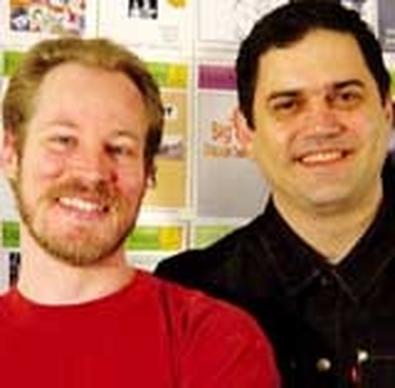
Enter United Stages, a new company founded last February by playwright Jonathan Reuning and director Ian Marshall that provides low-cost, professional-quality programs for Off-Off-Broadway -- they emphasize the phrase "small-venue" -- productions. The idea is to lift one of the many time-consuming tasks from producers' shoulders and thereby provide a product that is all at once a promotional tool, keepsake, and professional statement.
"United Stages started because we were printing scripts," Marshall recalls. "Jonathan would have a play running and because I had design and layout experience, he'd ask me to print his scripts to sell at the box office -- a good idea. Well, we ended up printing a lot of other peoples' scripts too, and the idea moved quickly from printing scripts to programs."
That their idea is popular is an understatement: In nine months, United Stages has provided programs for 29 productions. Emerging Artists Theatre Company was the first company to sign on; TOSOS II, Vital Theatre Company, Blindfold Theatre Company, Messenger Theatre Company, Narrow Journey Productions, Boomerang Theatre Company, Theatre Rats, New York Metro Vocal Arts Ensemble, Lynx Ensemble Theatre, ShakespeareNYC, Woman Seeking...a theatre company, Fugly Productions, and Rising Sun Performance Company followed.
The promise of United Stages has prompted TOSOS II co-founder Doric Wilson to write an open letter about it to the industry. "When it comes to programs," the letter reads, "I date back to the Off-Off-Broadway of the mimeograph machine, cutting stencils, and purple ink up to your elbow. Then I progressed to offset printing and press-on letters and pasting corrections with rubber cement. Finally, it was sneaking 5,000-plus program pages through some corporate Xerox under the glare of some unsympathetic office manager. For 30 years, I have been waiting for a sensible solution! Thanks to United Stages, it has arrived."
Reuning and Marshall explain their success really comes down to smart pricing.
"We find out what a production's contract and ticket price is," Reuning elaborates. "We ask if it's an Off-Broadway show -- we provided programs for 'My Big Gay Italian Wedding' for example -- or Off-Off-Broadway show. This lets us set fair, affordable prices." For a contract higher than a Showcase, the price is $300 for 500 programs and $35 for each additional 100 programs. For showcases, the price is $200 for 500 programs, $25 for every additional 100 programs.
The company's business plan, Marshall adds, "involves offering low, even below-cost rates to production companies -- since we are in business to support small-venue performances -- and to supplement that with program advertising. It's the advertising that pays for full-color programs, glossy paper, and the good overall presentation." The attraction for advertisers, he says, is to be able to reach that highly desirable, 20s and 30s disposable-income demographic.
And there is need for professional-quality programs, both men say, because Off-Off-Broadway, now more than ever, remains the primary fertile ground for the new. With commercial producers and top-level not-for-profit decision makers seeing works that may, if they like them, have a future in a bigger, better venue, a professional program projects a sense of overall professionalism from the get-go.
"Also," Reuning says, "we figure if [small-venue] producers went to Kinko's, it would cost them a little over double what United Stages charges, and that's black and white and not on nice paper. Our service's great feature is that it helps with what is really the biggest burden for a production company -- gathering bios, compiling information, and making programs. We provide continuity. Companies put their information into our database once -- electronically, through our website, www.unitedstages.com -- and an artistic director can ask actors to put in their bios, too. This way, we construct programs in a virtual, time-conserving, constructive way, and the end result is something that says, 'Hey, we're a small theatre, but we're professional. And we're proud of what we do.' "
United Stages also cross-promotes productions of affiliated companies. The back of each program, for example, has a calendar so that small groups that are not familiar with each other, as Reuning puts it, "can be visible to one another. And if a reviewer recommends a show, we'll print a small part of that review in a program of a sister production so [audiences] have time to respond to reviews, not reading a review after a show closes."
Flexibility is key, Marshall says, in meeting clients' needs: "We're trying for a look and feel for programs spanning each show -- it's the Off-Off-Broadway 'uniting' we're all about. Yet each program can be different just as each production can have different needs and requirements. Most shows have artwork; many times postcard art becomes the cover, and we design the cover to allow for various shapes and sizes. We request content three to four weeks ahead of delivery, but when pushed, we can have a turnaround in a week. If a show orders 500 programs, we can deliver 500, but sometimes small-venue productions aren't sure how many programs they'll need. In that case, we can provide a small number -- 200, say -- and check up later for when they need another delivery. We've had shows change casting the day before we print, and we can make the change immediately and still get the programs delivered on time."
It's all part of a philosophy, Reuning concludes, "of promoting, in any possible way, the idea of small-venue theatre as a legitimate destination point for New York City audiences. We want to do everything we can to promote Off-Off-Broadway."