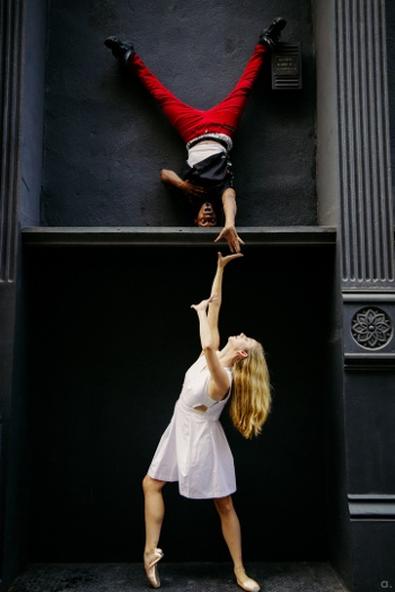
A dance documentary premiered at the Tribeca Film Festival in 2013, but it didn’t center on a prestigious company or a well-known discipline; “Flex Is Kings” followed a group of self-taught dancers from Brooklyn.
“Flex” is a dance of contortions that works mainly in the upper body; flexors push their arms behind them at impossible-looking angles while gliding across the floor, sometimes doing hat tricks to add to the spectacle. Often seen in New York City subway cars and in “battles,” several dancers have moved beyond street performances and into world-famous concert halls and theaters.
One such dancer is Jay Donn, a Brooklyn native who’s teaming up for the second time with former American Ballet Theatre principal Michele Wiles to bring a new meld of ballet and flex to New York audiences. Wiles, the artistic director of dance company BalletNext, left ABT in 2011 to create her own performances, which pair musicians with classically trained dancers.
Donn choreographed their sophomore effort, “Don’t Blink,” premiering at New York Live Arts—a home base for “innovative movement-based artistry,” which engages the social, political, and cultural events of our times, according to the website—now through Oct. 31.
“The flex dancing and ballet fuses in one style now,” Donn says, comparing “Don’t Blink” to their first collaboration, “Something Sampled.” “This time you can see more of a connection, more of a risk-taking.”
The duo have moved their ballerinas from tutus and twinkling lights to straitjackets and strobes for the NYLA performance, an aesthetic element that was essential to Donn’s visualizations of the show. “If dance drove you crazy, how would it be?” he asks. The work is very much a meditation on the internal elements of the craft.
“I feel like we’ve actually come back to the roots of dancing, which is all about feeling and emotion,” says Wiles. “Sometimes dancing has nothing to do with technique.”
Self-taught, much of Donn’s choreography was communicated through his movements and the explosive sounds he makes for each one.
“Dancing, it’s a universal language; it’s like math, and I wasn’t using words at first, to be honest,” he says before launching into a beatboxing-like example. “I speak through sound effects, like rhythm, like a song, and you know exactly what to do [if you’re] feeling it rather than trying to understand by hearing. But now I use more language.”
Adapting to different styles of communicating was key for Wiles, Donn, and their dancers, as was fully understanding what it meant to move in each other’s disciplines. Both Donn and Wiles were challenged to flip their focus.
“Jay had us do a flex arm phrase and I remember being, like, ‘Wow, this really hurts! Oh my God, what is this?’ ” recalls Wiles. “It was painful and I remember being very sore. But learning things out of your physicality is what makes an artist. What he really taught us is the communication between one another. We had to find an understanding.”
On the other side, Donn laughs, saying, “That barre is nothing to mess around with! I tired out their arms because they weren’t used to holding them in these geometric shapes, but I was not used to doing squats! My thighs and my ass were burnt out! So it was a good experience for both of us to train our bodies in different ways.”
Their training will come to fruition in the coming weeks. Audiences can expect a bricolage of dance styles that fuses their “energy, passion, and emotion,” as Wiles describes it, with all the grace of a prima ballerina.
Inspired by this post? Check out our dance audition listings!