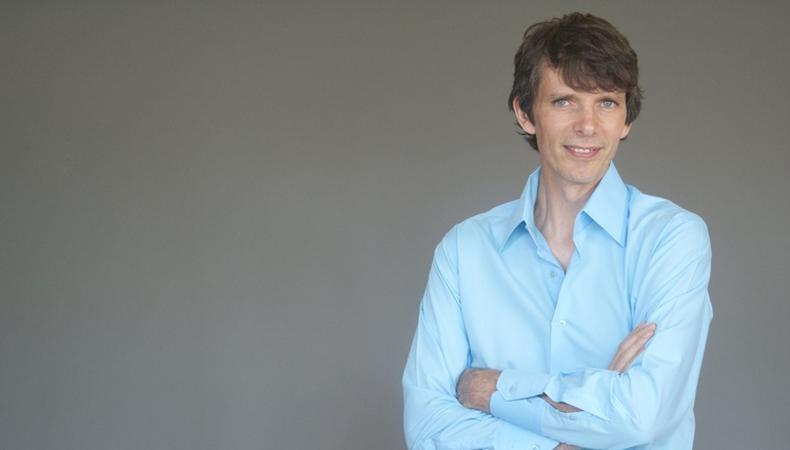
Currently the director and head of movement for the University of Southern California’s MFA Acting program, David Bridel has his hands full: In addition to leading the continuous shaping of the recently revamped curriculum, teaching daily, overseeing the hiring of professors, and directing productions, Bridel is also the associate dean and director of global & artistic initiatives, where he builds partnerships with foreign performance programs like China’s Shanghai Theatre Academy.
After teaching at SUNY Purchase, Rutgers University, The Actors Center in New York, UCLA, and other renowned establishments, Bridel came to USC in 2005, taking on a full-time position in 2006. His varied experiences and training across multiple countries and methods make Bridel a great mentor to his students.
On his influences.
Though he was originally born in London, Bridel has been in the States for 15 years, “so my accent’s a bit of a hodge podge,” he says. “I trained in England primarily. I went to university in England and then I trained with a clowning teacher in France by the name of Philippe Gaulier—a very well known clown teacher. And I was exposed to the Jacques Lecoq pedagogy; although I didn’t go to that school I was surrounded with people who had and became very interested in it. So many of my influences are European but of course I live in work in the U.S. and I respect what’s happening here so I stay open to it.”
On how his influences reflect his teaching method.
“For me personally, in the way that I teach movement it’s quite strongly influenced by disciplines that [Jacques] Lecoq enjoyed focusing on including clown mask, commedia dell’arte, and an integrated physical approach to acting, which is both French and Eastern European,” Bridel explains.
“Regarding the program as a whole however, I think there’s an emphasis that we have, which I’m very excited by, and I don’t think it comes from any particular tradition, and that emphasis is self-generated material. We really encourage our students to develop their own work, either as writers, filmmakers, ensemble members; basically artistic collaboration is a big value that we hold dearly to in our program, so that when you students go out into the world, they’ve already experienced what it feels like to create their own material.”
On what makes USC different.
Bridel says that because the program was new when he joined the USC staff, he had the joy of creating a curriculum that he wanted to create. “Personally speaking I found a lot of independence from this particular job. In the grander scheme when you look at the larger picture of what our MFA program offers, a big advantage is the fact that we’re in Los Angeles, of course. We have access to the film and television industry that helps us enormously in placing our students in front of the right people when they graduate.
“The professional aspect of our MFA program is very strong. We have a unique combination of world class teachers here from all sorts of disciplines. We also like to attract students to our program from all socioeconomic groups; we’re very ethnically diverse and we’re proud of how we reflect the modern face of the United States,” he says.
On improving your craft while training and after.
“In training when an actor is actually in the middle of a conservatory program like ours, one of the biggest mistakes they can make is to attempt to try and understand their experience from an intellectual point of view,” he says. “There’s a component of their work that is academic by nature, but by and large the majority of what they’re invested in is physical, imaginative, and emotional and cannot be sold by rational analysis.
“Secondly, when a graduate from our program or any program goes out into the world and tries to grapple with the problems of the profession, the biggest warning I would have for a young actor is don’t wait for the phone to ring, but create your own work or your own community or enter into a community that reflects your own values. I know it’s not original but I think that’s the most important advice I have for someone who’s just getting out of school.”
Like this advice? Check out more from our Backstage Experts!