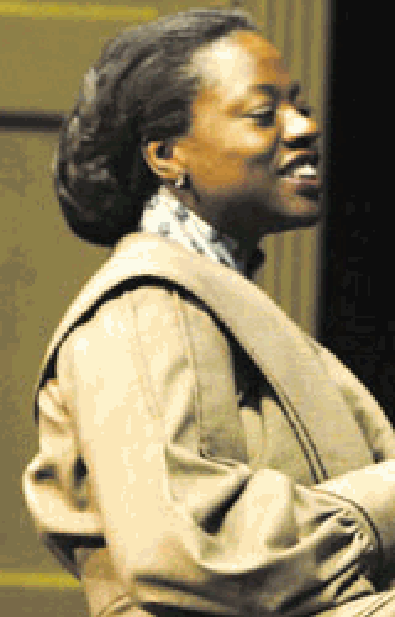
Actress Viola Davis does not feel that the issues her character, Esther, faces in "Intimate Apparel" are all that dated, despite the play's time frame of 1905. Davis is, however, perturbed by something else. "What affects me is the image of the dark-skinned African-American woman as plain. Often that's the role we're thrown into. White women can be classical in their appearance, or they may be off-centered beauties, or plain with spark. But black women are either Halle Berry or Mama."
Esther is neither, but her alleged plainness is clearly a self-defining factor in Lynn Nottage's "Intimate Apparel," a Roundabout Theatre Company production that opened Off-Broadway at the Laura Pels Theatre, Sun., April 11. In a multilayered performance, Davis' Esther is a 35-year-old spinster living in a New York City rooming house, lonely, frightened for her future, and determined to get married -- a feat that's none too easy because of her plainness, it's made evident. Esther is also a talented seamstress, creates dresses and underwear for the ladies of the Gilded Age, and has the makings of a fine businesswoman. "Intimate Apparel" is a microcosm of its time and place, including a spectrum of social types. There is the Orthodox Jewish fabric dealer with whom Esther has a suppressed flirtation, and there is George, the unemployed African-American man Esther marries and ultimately leaves. He is a philanderer and a thief.
"Perhaps Esther's need to have a husband in order to have an identity is of its time," notes Davis in her flower-filled dressing room before a performance. "But I still think the seed of that idea is planted even today, and that women continue to be desperately afraid of being alone. I grew up in an environment where women gave their lives to abusive marriages or were clinging to men who were not emotionally available. I don't care about all the women executives on Wall Street or the words to the song, 'I am woman, hear me roar!' Look at all the rape, abuse, and single moms without financial support. If women are so strong today, why are those numbers so high?"
Davis adds, "In some ways, Esther is a very modern woman, far more liberated than many women right now. She's able to leave George and get on with her life, although she has given him all her money. That was difficult for me. But I'm able to negotiate those aspects of a character that are foreign by reminding myself, 'She's not me.' And that's when I become her. The major challenge in playing Esther is making her emotional journey seamless, to build each moment, and not play the last moment first. It's also challenging to be on the stage without a break. It's relentless."
The 40-ish St. Matthews, S.C. native is no novice to acting or, indeed, to playing strong women. Still, "Esther is a bit of a departure because of her softness," admits Davis, who won a 2001 Tony Award and Drama Desk Award for her performance in "King Hedley II." For her stint in August Wilson's "Seven Guitars," she walked off with Tony and Drama Desk nominations, along with Outer Critics Circle, Drama League, and Theatre World awards. Davis has performed at regional theatres nationwide, and her many film credits include "Antwone Fisher," "Far From Heaven," "Traffic," "Out of Sight," and "The Substance of Fire." She has guest-starred on a number of TV shows and was a series regular on "City of Angels" and the just-canceled "Century City," a drama about a law firm set in the future. Davis played a steely, no-nonsense attorney.
She is matter-of-fact about the show's fast demise, noting nonchalantly, "It just didn't have the ratings."
Emotional Currents
Davis is an amalgam of candor and sensitivity, with emotional currents rippling beneath the surface.
Consider her personal connection with Esther. "One hundred years into the future, Esther would be me," Davis offers. "Her story is my story. I went through my 20s feeling lonely and plain and wanting a man. In my 30s I woke up. Of course, I had had six years of therapy that was not available to Esther. I found myself and eventually God." Unlike Esther, Davis has a good marriage, she says. Her husband is actor Julius Tennon, a man she cryptically describes as "part of the real world."
Davis also has some interesting thoughts on the racial elements in this production and the stereotypes they may speak to in black and white audiences, respectively.
"I suppose some black audiences might object to the Orthodox Jew being the sensitive character as opposed to the African-American male -- not that anyone has said anything to me about that. I'm certainly not bothered by it. I imagine Esther and Mr. Marks [the Orthodox Jew] finally getting together after the play ends.
"As for George -- yes, he is a negative depiction of a black man. But I don't have problems with a black character presented negatively; that's okay, as long as he is also human. And I believe George is human, unlike the portrayals of black men on TV or in film who are just stereotypes.
"This play is unusual and important because of what it does," Davis continues. "How often do you see a black woman as the central character? Or a black woman and an Orthodox Jewish man in love? Where do we see a white woman falling in love with a black woman? All of it is meshed together here. The play is set in 1905, but reflects the multicultural world of today."
Bad-Tasting Medicine
The daughter of a racetrack groom, Davis always knew she wanted to be an actress. She majored in theatre at Rhode Island College and then went on to Juilliard, where she earned an advanced certificate in acting.
"That was an okay experience," she says with an expression suggesting ambivalence. "It was like taking bad-tasting medicine for a cold. It zapped the cold, but was not pleasant going down. They taught technique and the classical training has been useful, even in a realistic play like this. I know how to save my voice and break down the moments. The problem with Juilliard is that they don't celebrate the individual."
Nonetheless, within short order, Davis was working steadily in the regional theatre scene. Her Broadway, film, and TV stints followed. "Television is more cerebral than theatre," she says. "It's largely a matter of staying on your feet and hitting your marks. It takes a certain amount of concentration to do that 18 hours a day. But it's not emotional work.
"And as a black woman I do suffer from more typecasting [in television] than I do in theatre," she continues. "The parts that are written for women of color are either drug addicts or authoritative figures, like judges and lawyers. Television is very focused on demographics. Television wants to talk to the perceptions of young white men, or what the television executives think are their perceptions."
Still, Davis is more than open to doing another TV series. She'd also like to have a shot at some choice theatre roles, most notably Lady Macbeth and Nora, in addition to replaying Isabella in "Measure for Measure," a role she tackled some years ago at Trinity Repertory Company in Providence, R.I.
But that's down the road. Now her thoughts are centered on "Intimate Apparel," a play that required a great deal of research to put an emotional-intellectual handle on an era when women routinely wore bustles and corsets. "I went online to find out who the women were and what they were doing back in New York in 1905," Davis recalls, adding that despite the sartorial restrictions, "there were the first rumblings of the suffragette movement. There was also the migration of African-Americans to New York. It was the place of dreams. Esther came from the South. She was a gutsy woman who wanted to make her dreams come true."
And Esther's strength is precisely what Davis wants audiences to appreciate. "I hope they don't find the ending tragic," she says. "I'd like them to feel uplifted because Esther is starting over and she will make it with or without a man."
She adds, "So far, the most striking responses I've gotten are from audience members who see Esther's beauty and are stunned that she doesn't."