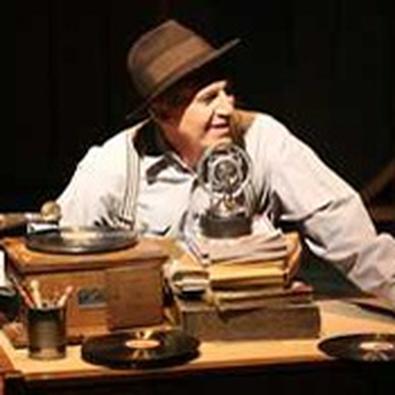
Radio has always been a terrific medium for storytelling, relying on a kind of magic that wends its way into people's hearts through the imagination. Mankind needs its storytellers, and a good story can transport the soul, traverse vast landscapes, and reunite the parts of us that long to be healed. In John Olive's The Voice of the Prairie, three actors winningly take on more than 20 roles while guiding the audience through a nostalgic journey of young love on the run and middle-aged longing, a sepia-tinged early America of prairie lands and radio days, "a strange (and lovely) world where wooden boxes can pull ghosts out of the sky."
Olive's "wooden box" is the radio, but his medium is the black box -- the stage -- which he uses to great effect, weaving a loving and touchingly sentimental story about a middle-aged farmer, David Quinn (wonderfully played by Tom Dugan), who becomes a reluctant radio star in the 1920s. After being discovered by a traveling radio jock who convinces him to go on the air with his tales, Quinn begins to conjure memories of his long-ago love, Frankie the Blind Girl (the exceptional Ashley Bell), and their misadventures as young fugitives.
Director David Rose has brought this play to life with sensitive direction and creative staging. Dugan, with his commanding voice and gentle spirit, brings a distinct character shading to each of his roles, most notably as Quinn. Michael Matthys is delightfully charming as Davey (the young David) and appropriately high-strung and eccentric as Leon Schwab, the man behind the man. The honest and engaging performance of Bell, most notably as Frankie, is a joy to watch. Ranging from a young, willful, and blind tomboy to a complex, mature woman, this young actor conveys an assuredness that belies her years. All three actors flow from role to role with an evenness and unflappability that is fascinating to watch.
From top to bottom this production is heartfelt and heartwarming. David Potts' set creates inventive entrances and exits for the actors. Jeremy Pivnick's lighting conveys subtle mood changes. The sound design, by Cricket S. Myers, helps to define locale. And the minimal properties (by MacAndME) add just enough ambiance, while the costumes (Terri A. Lewis) keep the era firmly in our minds.
The Voice of The Prairie tells Davey and Frankie's story. It inspires us to give voice to our own stories.
Presented by and at the Colony Theatre,
555 N. Third St., Burbank.
Fri.-Sat. 8 p.m., Sun. 2 & 7 p.m. (Also Sat. 3 p.m. Jun. 28 & Jul. 12 and Thu. 8 p.m. Jul. 17 & 24. Dark Jul. 4-6.) Jun. 21-Jul. 27.
(818) 558-7000. www.colonytheatre.org.