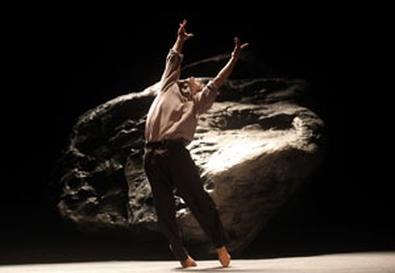
Photo Source: Julieta Cervantes
"Vollmond," on the other hand, is not her greatest work. Fans of her more famous pieces ("Le Sacre du Printemps," "Café Müller," "Nelken") would be forgiven for conjuring images of werewolves and human sacrifices. Bausch made her mark as a neoexpressionist, wringing a primitive animalism out of her dancers and staging the fundamental violence of human relationships. "Vollmond," which was created in 2006 and is receiving its American premiere, reflects a late-in-life preference for the lovely over the bold. She was still digging deeper than most theater artists would dare, but what she discovered lacks grit.
The 150-minute work is divided into two acts, each composed of a series of extremely short overlapping dance sketches exploring the vagaries and challenges of forging lasting connections. The first act has the libidinal energy of a high school prom, short on irony and worldliness but high on outsized emotion and an eagerness for experimentation. Couples form and part, flirt and punish, and occasionally yell "This is me! I am young!" at the audience. In the second act, the ensemble shifts to the more general—and more complex—problem of community building. Personalities and egos emerge while cynicism builds, but everyone ultimately stumbles toward a harmonious balance that looks suspiciously like line dancing. Both acts end with a torrential (and breathtaking) downpour, with dancers splashing and spinning in ever-expanding watery fiestas.
The show transpires in front of a boulder that stands stage left and dwarfs the performers (set design by Peter Pabst). Beneath it runs a moat that traverses the length of the stage and occasionally, when filled with water, serves as a swimming pool for the actors. In the first act, the boulder exudes a spiritual essence. Its stolidity draws out, like Kubrick's "2001" monolith, the dizzying reversals of the ensemble. In the second act, the stone feels redundant. While the performers engage with it more directly than before—they stand on it; they throw buckets of water at it—they don't seem to need it, and one wonders why Pabst chose not to represent the change in tone with a change in scenery.
The evening flows but never flies, provoking admiration but rarely goose bumps or a stray intake of breath. Thankfully, the company offers plenty of moments of virtuosity and charm: One dancer uses her soaking-wet hair to make gentle watery fireworks; the rail-thin Helena Pikon devours a carrotlike phallus-shaped medication; and there is a touching scene in which a young man offers a hand full of water for a melancholy Dominique Mercy (the dancer who now temporarily leads the company) to extinguish his match. The chief scene-stealer, though, is Nazareth Panadero, who makes more than one appearance as a buxom diva who growls sensuous nothings ("It was vunderful…. I dreamed my whole apartment was clean!").
Some of these performers have danced with Bausch for decades, and their devoutness motivates even their most casual leaps and undulations. It is they who justify the time spent watching "Vollmond." Artists' oeuvres may wax and wane over time, but if they are as skilled as Bausch was and the Tanztheater Wuppertal is, they will always be worth gazing at.
Presented by Brooklyn Academy of Music as part of 2010 Next Wave Festival at BAM Howard Gilman Opera House, 30 Lafayette Ave., Brooklyn, N.Y. Sept. 29–Oct. 9. Mon. and Tue., Thu.–Sat., 7:30 p.m. (718) 636-4100 or www.bam.org.