Photo Source: Suellen Fitzsimmons
In 1995, Rapp is a typical struggling New York actor landing a role in a little-known musical. Around the same time, he discovers that his mother has been struggling with cancer back in his hometown of Joliet, Ill. Thus the show's parallel paths are laid out: As Rapp's theatrical star rapidly rises, his mother's health slowly deteriorates. But there is other loss as well: Larsen, his new friend and mentor, dies suddenly the night before the musical's Off-Broadway opening.
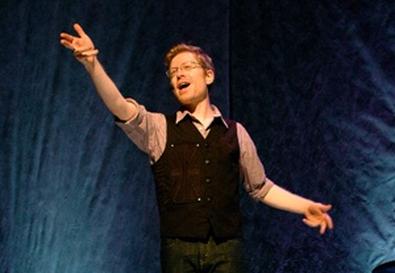
Rapp is an engaging storyteller and singer. He gives you a sense of what it was like to be at the center of a production suddenly exploding into prominence. He also does lively impressions of the people involved in the show's genesis, from the quirky Larsen to director Michael Greif and castmate Adam Pascal. And he clearly conveys what he was going through—rushing back and forth to Joliet to be at his mother's side, the closeness of their relationship, even how his mom dealt with his homosexuality.
Fans of Larsen's work will get a thrill watching up close as Rapp does partial or full versions of 11 songs from the score. But the reliance on Larsen's words and music has a negative effect as well. Rapp wrote the lyrics for the six original songs in the show and composed the music with David Matos, John Keaney, and Joe Pisapia. All of these songs are solid, well-arranged, and well-performed by the five-piece band. But none is nearly as engaging or evocative as Larsen's work, and they seem especially weak when heard side by side.
Presented by Royal Family Productions and the New York Musical Theatre Festival at TBG Theatre, 312 W. 36th St., NYC. Sept. 29–Oct. 9. Remaining performances: Wed., Oct. 6, 4:30 p.m.; Thu., Oct. 7, 8:30 and 11 p.m.; Fri., Oct. 8, 11:30 p.m.; Sat., Oct. 9, 5 and 9 p.m. (212) 352-3101, (866) 811-4111, www.theatermania.com, or www.nymf.org.