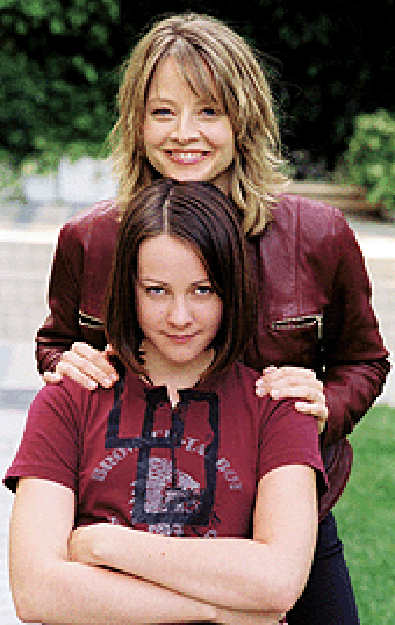
Every now and then a child actor comes along who completely captures our attention. Jodie Foster and Jena Malone are two such actors who at the ages of 14 and 10, respectively, took on tough dramatic roles that wowed audiences and displayed a maturity and a wisdom that was leaps and bounds beyond their years.
Though Foster began acting at age 2, beginning in commercials and continuing with numerous film and television projects, it was not until she conquered the role of the teen prostitute, Iris, in Martin Scorsese's Taxi Driver (for which she was honored with an Oscar nomination) that people took serious notice of Foster's talent. Despite the career breakthrough, Foster didn't think she had a future in acting. Even now, at 39 years old, the two-time Academy Award winner (for Best Actress in The Accused and The Silence of the Lambs) admits that she still can't believe acting is her chosen profession.
While Foster had been working steadily for more than a decade before winning acclaim in Taxi Driver, Malone was recognized as a great dramatic actor nearly from the inception of her career. Within a year of moving to Los Angeles to pursue acting, she landed the lead role of Bone in the acclaimed 1996 Showtime movie, Bastard Out of Carolina, directed by Anjelica Huston. Her film debut as a young girl brutally abused by her stepfather earned Malone a number of accolades, including Screen Actors Guild Awards and Independent Spirit Awards nominations.
Malone continued to pursue work challenging for such a young actor, putting in respected performances in the films Stepmom, For Love of the Game, Donnie Darko, Life as a House, and the cable movies Ellen Foster, Hidden in America, and Hope (directed by Goldie Hawn). Reminiscent of Foster in her youth and subsequent adult roles, Malone's acting has an innate sense of gravity and emotional depth. Like many child actors, Malone has also had to grow up fast. At 15 she filed a lawsuit against her mother for control of her financial decisions and eventually won legal emancipation.
Foster and Malone recently sat down with Back Stage West during a press conference for their latest film, The Dangerous Lives of Altar Boys, in which Malone portrays an emotionally scarred student at a Catholic school and Foster plays a stern, peg-legged, Irish nun. The film was produced by Foster, who said that Malone was her (along with her co-producers and director, Peter Care) first and only choice for the role of Margie Flynn. Foster first met Malone during the making of Contact, in which the younger actor portrayed Foster's character as a child. Though the two did not act together on-screen in Contact, Foster took the time to get familiar with Malone's work before shooting began and became a huge fan of the now 17-year-old. Foster has come to recognize much of her own spirit, integrity, and intuition in Malone, who seems destined to follow in Foster's footsteps, should she choose to stay with acting.
Back Stage West: Jena, has Jodie been a role model of sorts for you? Did you look up to her and her career as you've been working your way through your own?
Jena Malone: Absolutely. I mean, I think it's such a weird business. You feel like you're on your own and you're constantly struggling. Everyone wants you to do all these things, and you have to make the choices that make you happy. And what I've found in seeing what [Jodie] has done--films that are really incredible, like The Accused and Silence of the Lambs and Five Corners--is that it's about really strong female roles and about consistency in picking projects that are really smart and women's roles that I've always looked up to.
I hate to use the [term] role model--to model yourself after someone--but to see what she's done and to see the sort of projects Egg Pictures [Foster's recently shut-down production company] has produced is just inspiring. It's a consistency in content. It's awesome to see someone continually doing that and navigating through it in such an incredible way.
BSW: Jodie, does Jena remind you of yourself, especially when you were her age?
Jodie Foster: Totally. I think we have similar tastes. We have similar tastes in the kinds of movies we like. People say to me, "What were the movies you loved as a young kid that completely changed your life?" I remember seeing Deer Hunter and just being so blown away and thinking, That's what I want to do. Days of Heaven, Badlands, Straw Dogs--all these amazing movies of the '70s and great foreign films.
I want to be moved. I want to make films that move people. So I think we probably had the same jumping-off point in that way. Hopefully, what's heartening for [Jena] is, there is life after child stardom, and I didn't know that when I was young. Everybody kept saying to me, "Well, you know your career is going to be over when you're 16. So you'd better figure out what you're going to do." When I was working at 15, 16, 17, my whole focus was: I just have to support myself because I'm not going to be doing this for much longer. I didn't think I was ever going to be able to keep working.
BSW: Jena, is acting what you hope to continue working at through your adulthood?
Jena: It drives me. It's what I'm into right now. But I can't say that I want to continue doing it for the rest of my life. The thing is I've grown up, in a sense, on movie sets, and I feel really confident and safe in that environment. It's structured, and there are so many different aspects of filmmaking that it's kind of endless. It's something I absolutely love, but to say that I want to act for the rest of my life, I don't know.
You have to find out what you want [as an actor], and in order to maintain what you want, you have to sort of give in a little bit. There's definitely a difference in this business between maintaining a career of a celebrity and of an actor. Those are two different types of lifestyles. I'm more interested in stories and formats. I'm becoming more into photography and knowing how to show someone what you want visually.
I'm going up north to this community college [in California] where I can sort of hide away and take a year off and just study something different. I haven't been in school for a long time. I went to one year of high school. So it's going to be nice to ease back into the experience and take classes. I don't think I could go to [a university like] Harvard. I'm not ready for that. I'm not ready for a full four years. I don't even know what it is that I want. I just know that I need to figure out photography. It's something I'm kind of obsessed with. I need to just mentally and technically fully master that before I can move on to see whatever sort of educational things I want.
BSW: Jodie, were you glad to take a break from acting when you studied at Yale?
Jodie: Well, I didn't. I worked the whole time. I made five movies while I was in college. They were just not that successful.
BSW: Do you find it necessary to step away from acting for periods of time now?
Jodie: I take a good two years off between most movies, and I get a lot of grief for that, because I work less than most actors. I don't know how actors do this back-to-back thing. I mean, I did it when I was young, and I didn't really have a home life or a family at the time, and so I just sort of lived the movie. But you find, as the years go on, you just become a very empty person, because in between working you don't live. When you're shooting 12 hours a day you don't listen to a record; you don't listen to the news; you don't go shopping for food. You don't live a real life. So if you go from movie to movie, you're just living fake life to fake life, and I just find that you don't have much to say after a while.
Jena: I think [life experience] is key. Without it, I'm nothing; I have nothing to draw from. You're never really going to be able to understand life until you go out and experience it for yourself. I think, with acting, you can work back to back [on projects] and continue to give something, but without having that sort of bag of tricks that you come in with--all these experiences....
Jodie: That is so true. "Bag of tricks" is a really good metaphor, because you pull all that out for the rest of your life. You just keep pulling out the same stuff. That's why I always say that the years between 17 and 22 are when you get your bag of tricks and that's where you just keep filling it up. That is where you figure out who you are. From then on, all of your philosophies that you carry to your work stem from that time.
BSW: Jodie, do you believe that there are more opportunities now for young performers, like Jena, to tackle strong, serious work, compared to when you were a minor?
Jodie: There is not a lot of good material for young people or for anybody [these days]. It's pretty slim out there. It always has been and it always will be, but it's true that things are a bit better for young actors now than when I was growing up. I mean, there was no such thing as a movie that was about people my age. We were just daughters or sisters or kids. There were no central characters that were underage when I was growing up. Well, there were a few movies that were, and those are the ones that really captivated me.
BSW: Jena, you have gravitated toward really strong material from the start of your career. What has driven you in your choices, as far as the projects you've gone after?
Jena: Well, I was just auditioning when I did Bastard [Out of Carolina]. Before that I was doing commercials and a Michael Jackson video--whatever I could sink my teeth into. It was like, OK, a Good Humor commercial. Let's do it! But, yeah, you do have to seek [good work] out. At the same time, you aren't the person going out there. It's your agents who are finding the roles, or if you have a manager or parental figures, they are the ones seeking them out.
You just have to find the stuff that you relate to. You can't predict what's going to be good. You can't predict what's going to work. I just know what I like about movies and what I want to see. So I read [scripts] and try to be a part of stuff that I want to be a part of. What's really unfortunate about that is that it's so much harder to say than do. Everyone wants you to sort of give into this idea of being in things that make a lot of money, so that you have the accessibility to make those choices, but I think it's easier to just make the choices.
It's going to be really hard, and I may not be making all the money in the world, but, you know, I'm supporting myself. I don't need a lot of money. If I had to go start flipping burgers at Jerry's Deli because I couldn't pay the rent, I would be perfectly satisfied. It's too important to me to compromise. I just love movies too much to manipulate the audience.
BSW: Jodie, do you think that's why Jena is going to last?
Jodie: She's going to last because she's really talented. And you know what? Even if she made 10 turkey films, she's still really talented. If you're good, it may take 10, 15, 20 years, but you're always going to find your way through.
BSW: Except for studying with private coaches for particular roles, neither of you has had formal acting training. Are your instincts key to guiding you both in your craft?
Jodie: I think instinct plays a huge part in every actor's life. But you also have to come to the set with some ideas, and I think that's really about reading, about really liking stories and the text. And really enjoying going, Gee, I wonder how that person does that? Why do I think people act like that?
Some people just don't enjoy that process. They don't like thinking about human behavior deeply, but that's what kind of keeps me going. But if your only instinct when you're an adult is a child actor's [mindset].... I can't tell you the amount of movies that I made where I never read the script, where I only read my lines. I'd go, "Your line. My line. Your line. My line." I didn't even read other people's lines. I made movies like that. But if you're over 12, you have to have some ideas.
Jena: I'm still figuring it out. I don't have the words and I haven't read the acting books to tell you what the meaning is and what I'm guided by, but I just know you have to have strong choices. You have to be able to have enough courage to make a choice that may be crazy. You have to thoroughly throw yourself out there, strip yourself down, and find some sort of space you can swim in.
Jodie: I never thought that I had any kind of method or system. I thought I was a big fake and if somebody were to find out they'd turn me in. When I was getting ready to direct my [first] movie [Little Man Tate], I thought, I'm going to be working with some actors who have some training, and I think I should read some of these books. So I went to the library and I bought all these books and I started reading and I thought, Are you kidding me? This is what I've been avoiding all this time? A lot of these things are just common sense and what you do anyway. And I was surprised that there is a method to what we do. It's just very personal to me.
Every person has a different way of approaching things that makes them feel unself-conscious. In my case, for example, I need to be distracted. That's what it takes, because I just can't focus that long. I can't focus for 12 hours a day on something dark and dreary and sad. So I need to, like, chew gum and hang out and drink coffee and ask people about their lives and tell jokes, and then I can come back to the set. That's my madness. That's how I deal with it.
As the years have gone on, things that I always thought were unconscious choices, I've realized are totally my choices, and you start analyzing the patterns--enough times of people saying to you, "You've played five rape victims in a row. Do you think there's any pattern to that?" Suddenly you can't let yourself get away with it, and you think back to why you are attracted to what you are attracted to--why you're attracted to how the character resolves a crisis in ways that you cannot resolve them in your own life. You realize it really is all about your therapy and who you are. The wonderful thing about this craft is that, in some ways, it is about, ultimately, making yourself better. It's not a selfless profession. People do it for a lot of selfish reasons. Every time you make a movie, you realize things about yourself that you didn't know before.
This is an excerpt.For the full story, look in the Member's Area. If you would like more information about becoming a member, Click Here