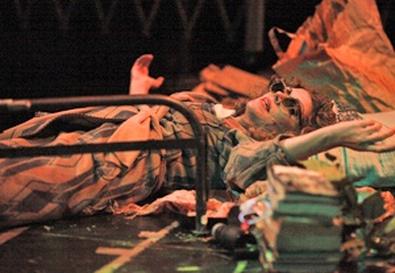
Photo Source: Paula Court
An autobiographical memory play set in a louche New Orleans boardinghouse in the late 1930s, "Vieux Carré" tells the story of a young unnamed writer coming into his manhood and to terms with his gay sexuality. His experiences observing and interacting with the establishment's colorful, desperate inhabitants give him the ability to cast convention aside and become the artist he was meant to be. Among those characters are Mrs. Wire, the ferocious and righteous landlady; Nursie, her put-upon black servant; Nightingale, an aging gay painter dying of tuberculosis; and Jane Sparks, a successful Manhattan clothing designer who gave it all up to slum in sin with the likes of Tye McCool, a stud who works in a strip joint and does heroin.
Williams wrote his first draft while living in the boardinghouse, then continued to rework the play until its 1977 Broadway debut. This long gestation period has led director Elizabeth LeCompte to fuse elements of the 1930s, the '70s, and contemporary times, "so this piece moves forward, so it doesn't stay in the past," as she told The New York Times. Some choices work well, such as the use of disco music to suggest the gay bacchanals of the society photographer who lives in the basement; the Valley Girl performance of Kaneza Schaal as Nursie, which highlights the character's cutting humor by sidestepping the racial stereotype; and the grainy black-and-white video of a gay sex act that torments the writer. Others, such as the brightly colored video of what seem to be contemporary gender-benders and figures clad in Asian robes stalking about, feel extraneous, though it's hard to be sure because the screen, set high in the air upstage right, is too small to really see what's happening on it. And then there are those plastic phalluses worn by Tye and Nightingale, which merely state the obvious.
Doubling in two roles he isn't right for, Scott Shepherd is nevertheless wonderfully effective, locating the essences of Tye and Nightingale with specificity. Less successful is the decision of Kate Valk, doubling as Mrs. Wire and Jane, to play both in a mannered style reminiscent of artificial '30s screen acting. Yes, the young Williams loved the movies, but Valk's admittedly confident and disciplined work, intentionally or not, suggests a disdain for the writing. Best of all is Ari Fliakos' writer. Vividly vulnerable, especially when the character is sitting alone in his room wearing little but a skimpy black thong, Fliakos excels at charting the writer's journey from quiet good boy to liberated artist. LeCompte's decision to dramatize the creative process isn't new (Gordon Edelstein's recent "Glass Menagerie" did it brilliantly, as did John Cameron Mitchell's rehabilitative 1996 staging of Williams' "Kingdom of Earth"), but she and Fliakos execute it well. I particularly liked a sequence toward the end when the text flashed by at lightning speed on a screen as the increasingly confident writer feverishly pounded away on his computer keyboard.
The production unquestionably has a surreal intensity that's very at home in Williams' world. Still, I wondered what effect the show would have on someone unfamiliar with the play. How do you embellish and comment upon a work nobody knows?
Presented by and at Baryshnikov Arts Center, 450 W. 37th St., NYC. Feb. 22–March 13. Tue.–Sat., 8 p.m.; Sun., 7 p.m. (212) 868-4444 or www.smarttix.com.