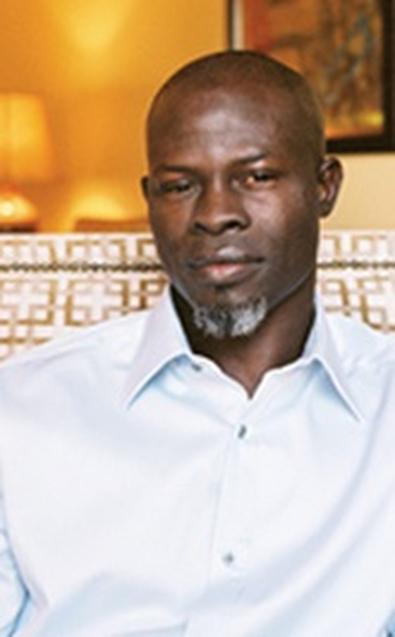
Don't be fooled by what you've seen onscreen: Djimon Hounsou isn't that intimidating. The actor's résumé features a number of credits playing what some film critics have rather offensively referred to as the "noble savage": his breakthrough performance as enslaved Cinque in Amistad; the warrior Juba in Gladiator; his exquisite, Oscar-nominated portrayal of dying painter Mateo in In America. Then there's his upcoming turn opposite Leonardo DiCaprio in Blood Diamond, in which he plays a determined father searching for his kidnapped son. In such roles, Hounsou has employed his steely gaze and powerful 6-foot-4 frame to great effect. In person, however, he is prone to deep laughter, rarely without a smile, and determined to keep a positive outlook on an industry in which it isn't always easy to stay upbeat.
Indeed, Hounsou downplays his early struggles, though it's the stuff great discovery stories are made of. Born in a small village in Benin, Africa, he was sent to France at age 13 to attend school. He ran away and lived on the streets of Paris -- "Not for too long, barely a year," Hounsou demurs. He was then discovered by fashion designer Thierry Mugler, whose support helped Hounsou become one of the country's top male models. While on assignment in Los Angeles in 1989, Hounsou was spotted by Madonna, who cast him in a video for her hit single "Express Yourself." He moved to L.A. and began to land small TV roles and other videos. Then came his first major film role -- in Amistad -- which just happened to be the lead in a Steven Spielberg film opposite Anthony Hopkins and Morgan Freeman.
Even as a child, Hounsou was interested in performing. "I had dreams -- fantasies, really -- about acting," he admits. "I was extremely shy as a boy, and acting was a great way to come out of your skin. I wanted to act in France, but the industry was so small and there was already one black actor pretty much doing all the roles. So when I had a chance to come to America, I decided to stay here." Though only in his early 20s at the time, he wasn't daunted by the sudden change in his life -- despite that he didn't speak English. "Listen, if I had thought too long about it and the measure of the challenge, I probably wouldn't have gone the distance," Hounsou says with a laugh. "I just got excited about the opportunity and jumped on the wagon without thinking. Only later did I wonder, 'Wow, am I going to be accepted in the industry?' It's an industry that's very judgmental, very critical, of the way you sound. If you're not an American with an American sound, it's pretty challenging."
He enrolled in several acting classes, which proved difficult as he was still struggling with the language. He studied with different instructors but cites Harry Mastrogeorge as the one who opened his eyes. "He had such a great understanding of acting and what it takes to do it," Hounsou says.
Onscreen, Hounsou is a natural. It's no surprise that the camera seems to adore the former model, but he also brings gravitas and honesty to every role, even in popcorn entertainment such as the action flicks Constantine and The Island. Asked if he ever had to unlearn anything he picked up in acting class, he says, "Oh, all the time. There are people who have never been to acting class, and they're not clouded with all these misunderstandings about acting. I think it can cloud you a little."
Hounsou says his best school is on a set. "Just doing it and working with people who have been doing it for some time is the greatest training you can get," he notes. "I learned so much just from watching Leonardo DiCaprio. And I'm still learning; my understanding of the language is only getting better, and I think I'm getting more acute with the work onscreen. Hopefully, I'll keep growing."
In the Rough
Hounsou says he chooses his roles based largely on the message of a script and how the script makes him feel. "If I'm emotionally affected by a story, that's good enough for me," he explains, adding that Blood Diamond is a dream role: It satisfies his passion for acting with a terrific character and tells a story that is vitally important to him. "This story meant everything to me for the simple reason that I'm a native of Africa, and there are so many issues around the continent that need to be dealt with," he continues. "If I'm going to be telling stories about Africa, I should be telling the best."
Set in the early 1990s, Blood Diamond centers on two contrasting African men: ex-mercenary Danny Archer (DiCaprio), who is always looking for a quick buck, and Solomon Vandy (Hounsou), a fisherman who dreams of a better life for his children, specifically his 12-year-old son, Dia. When Solomon is kidnapped and forced to work in a diamond mine, he locates a precious stone he hopes to use to bargain for the return of Dia, who has also been kidnapped and sent to work as a rebel soldier.
The film takes a hard look at the global problem of "conflict diamonds" -- gems mined in a war zone and illegally sold to finance war efforts -- but tells the story on a personal level that is gut-wrenching. Solomon's search for his son drives the heart of the story, and Hounsou delivers a performance of fierce determination mixed with fatherly devotion; it's as painful to watch as it is rewarding. Director Edward Zwick knew he needed a compelling actor who could not only draw in the audience but also hold his own against DiCaprio. "Djimon's work has been so extraordinary in smaller parts these last several years, in films like In America," Zwick tells Back Stage, adding that Hounsou's background was a benefit to the part. "He's a West African man, and the idea of casting a West African man as a West African was particularly interesting. There are things he understands and brings intuitively to the part that I don't think could have been captured by anyone else. He has his own qualities which are so particular, and he brings such dignity and internal life to Solomon. At the same time, he understands what the relationship between this man and a white South African man would be like, which lends something to this movie." According to Zwick, Hounsou was the only actor he approached for the role. "I sent his representatives the script, and he called me the very next day, literally almost in tears," the director recalls. "He was the first -- and only -- person I sent it to."
By all accounts, the location shoot in Africa was not an easy one. "This is one film I couldn't get away from at the end of the day, and I'm not necessarily proud to say that," Hounsou relates. "I like to find joy in telling a story. But in this particular story, the emotional content is so overwhelming that it was hard to do day in and day out." Zwick admits he was concerned for his actor at times. "Physically and emotionally, he's being knocked around, and I worried about the emotional wear and tear," the director says. "But you have to believe somebody knows what they're in for. And he never complained; he's got such a professional discipline." Zwick recalls filming a pivotal scene in which Hounsou carries DiCaprio up a cliff: "I had him do it take after take because the light was getting more and more beautiful. He just kept giving his all, and I finally said, 'Djimon, you have to carry him a bit slower and make it look harder, because you make it look easy.' He's so strong and determined, it didn't matter that his legs were burning and destroyed the next day."
In the end, Hounsou says, any difficulties he faced were outweighed by the joy he found in telling such an important tale. "I was so moved to tell this story, and we had so much support from the people in Africa, which helped me get through it," he says. "One of the rewards of being an actor is being able to shine light on this issue and hoping something can be done." Zwick agrees that Hounsou's performance is something special. "There are certain times when people do a part and they hear music you can only imagine," he notes. "They're in some kind of state of rapture because what they're portraying is deeply important to them."
Matters in Mind
Hounsou is looking forward to more projects that matter. Though he isn't fond of auditioning, he did a screen test for a movie about the life of Nelson Mandela he hopes to be a part of. "I so dislike auditioning," he says. "It's so difficult to be in that environment; it makes it hard to really embody a character. But I'll do it if it's required." He also started his own production company to advance projects he's drawn to. "I want to buy and develop material and raise money so I can hire the right people for projects," he notes. "Some are for me to act in; some are just stories that I'm passionate about that have nothing to do with me or my race."
Hounsou has spoken previously about the difficulty of getting the industry to see him for a variety of roles: In a 2003 Back Stage interview he spoke of taking meetings after Amistad was released in which "they thought that I needed to come with a translator and didn't speak a word of English." Since then, Hounsou has shone as Queen Latifah's kindhearted love interest in Beauty Shop and cut loose as voodoo priest Papa Midnite in Constantine. A week after Blood Diamond opens Dec. 8, Hounsou can be seen in the fantasy epic Eragon, as a rebel leader. The two roles couldn't be more different. Hounsou clearly recognizes the need to keep trying new things as an actor. "It's a struggle because when you embody a personality or character so well, it's difficult for people to see you as something else," he notes. "When it's the right role, I'm willing to fight for it."
Though he has worked regularly since Amistad, Hounsou dispels the myth that the offers were rolling in after his star-making turn. "I wasn't overwhelmed with offers," he says. "It's a challenging business, you know? But Amistad certainly put me at a new level of respect in the industry." He also credits the film and his experience working alongside Spielberg with helping him get through times when his outlook on the industry isn't so positive. "I think sometimes about stopping," he says. "It's not so much about wanting to give up, it's about trying to figure out what you're going to do next. Will I get another job? Will any studio want to employ me? You can't help but wonder when the next job is coming, and there's a huge amount of stress that goes with it. What keeps me going is the same desire and drive that brought me here -- and the feedback from people like Spielberg. I have a friend who says anytime I get down on myself, I just need to put in a copy of Amistad. Because it's proof you can do it and make it happen. I try to remember that."