
Good films contain moments of cinematic excellence, where writing, directing, design, and acting combine to create something far more brilliant than the sum of its parts. Great films are chock-full of such moments.
We at Backstage have chosen our favorite scenes from our favorite titles of the year in an effort to answer the question: What makes a film award-worthy? The especially strong contenders of 2017 make highlighting just one snapshot of greatness difficult. As the new year kicks Oscar season into high gear, we’re reflecting on the singular moments that cemented these titles in our minds—and in the awards race.
Billie Jean King takes a moment in “Battle of the Sexes”
“Times change. You should know; you just changed them.”
Sometimes a film’s line is written and delivered so well, it colors every scene that came before it—and every feeling you’ll have afterward. Screenwriter Simon Beaufoy and actor Alan Cumming are responsible for such a line in “Battle of the Sexes,” Jonathan Dayton and Valerie Faris’ adaptation of the 1973 public spectacle of a tennis match between Billie Jean King and Bobby Riggs (Emma Stone and Steve Carell at their most touching and entertaining).
Despite foreknowledge of the rivalry’s outcome, our desperation for women’s equal pay advocate King to triumph over self-proclaimed chauvinist Riggs keeps us on the edge of our seats. When the former finally tosses her racket in the air in triumph, the catharsis is delightful. But then King sits alone in her locker room, sobbing. There’s relief on Stone’s face, of course, but also frustration at how hard she had to work over such a silly challenge; the stakes shouldn’t have been so ridiculously high.
More than anything, we get the sense King needs a moment before continuing that longest and most arduous journey: being her authentic self. When Cumming’s fashion designer Ted Tinling assures her, by gentle insinuation, that their homosexuality will one day be free of discrimination, “Battle of the Sexes” clicks into place. King would go on to become a tireless activist for LGBT and women’s rights, a Sisyphean task into which all trailblazers must pour their blood, sweat, and tears. It was never about a tennis match. It was about battles that continue to this day. —Jack Smart
Elio stares into the fire in “Call Me by Your Name”
“Call Me by Your Name,” the lush and sensuous adaptation of André Aciman’s ode to teenage love (in this case between the precocious Elio and the dashing Oliver) relishes moments of stillness. Focused as it is on longing and budding desire, Luca Guadagnino’s film is a master class in subtlety.
And Timothée Chalamet, as the daydreaming Elio, is its anchor. Whether studying Armie Hammer’s Oliver from across the breakfast table or stealing a glance at him as they ride their bikes, Chalamet finds new and exciting ways to embody what it means to pine for another.
But while much of the sun-dappled flick encourages us to read Elio’s body language in tandem with Oliver (Guadagnino privileges medium shots throughout, refusing the chance to think of one without the other), Chalamet’s performance truly soars in the film’s final moments, when only his face fills the screen. Grappling with the reality of Oliver’s absence (their fling, like their summer, has come and gone), Elio takes refuge in front of the family’s fireplace. In one tightly held close-up, Chalamet’s quiet, ugly crying becomes a thing of sublime beauty. The actor refuses any one reading of Elio’s state of mind, capturing instead the enormity of wistful teenage heartbreak, with brief smiles sneaking in between gritted teeth and furrowed brows. —Manuel Betancourt
The 9/11 joke in “The Big Sick”
There’s a lot to love in Kumail Nanjiani and Emily V. Gordon’s autobiographical romance adapted for the big screen, “The Big Sick.” You might cry one minute and laugh the next, which makes this love story all the more authentic. Its major conflict comes not from the cultural differences of the couple (played by Nanjiani and Zoe Kazan), but when one falls into a coma shortly after their breakup.
Nanjiani and Gordon adeptly cultivate humor from a fraught and inevitably awkward introduction between Emily’s mother and father (Holly Hunter and Ray Romano) and Nanjiani. Nothing exemplifies the tension-born comedy more than when Nanjiani, not long after meeting them, joins Emily’s parents for an uncomfortable hospital lunch. When Emily’s dad asks about his stance on the Sept. 11 terrorist attacks as a Muslim and Pakistani immigrant, he chances a joke: “We lost 19 of our best guys.”
It’s surprising and funny, but it sure doesn’t land with the comic’s distracted audience in the film. He tries to backtrack, but Emily’s parents are called away. It’s a quick moment, and an effective one in that the discomfort is familiar, lingering beyond the scene change. Although not essential to the plot, the would-be-throwaway exchange showcases Nanjiani’s comic sensibility, impeccable timing, and expert delivery. —Elyse Roth
That triple axel in “I, Tonya”
For a fleeting instant in “I, Tonya,” before what audiences know will happen happens, Margot Robbie’s titular Tonya Harding loses herself in the exuberance of a memory.
“I knew I was the best figure skater in the world, at one point in time,” she affirms in present-day retrospect, recalling the period after she landed a triple axel in international competition—only the second woman to have ever done so. As quickly, she yanks herself from the bygone ecstasy. Her face falls; her voice cracks: “Sorry—no one ever really asks me about that.” Early 20s Tonya, fists raised triumphant with endless opportunity before her, smash cuts to the war-wounded woman she’s become, epitomizing every devastating facet of Robbie’s performance and “Tonya” itself.
Directed with tonal irreverence by Craig Gillespie, the biopic does not set out to relay a historically accurate depiction of that infamous 1990s-era scandal, but rather tell a rapturously entertaining story with a layered and endlessly flawed woman at its epicenter. In so doing, it achieves another feat, one that glimmers with the same razor sharpness of an ice skate’s blade: It is a decades-overdue vindication for the real Harding, making human again the punch line that a world has unrelentingly constructed of her. —Casey Mink
Mother-daughter thrift shopping in “Lady Bird”
Since its record-breaking 100 percent rating on Rotten Tomatoes, writer-director Greta Gerwig’s “Lady Bird” has been touted as a “perfect” film. While such remarkable praise is often guilty of hyperbole, this California-set coming-of-ager may be one where the critical shoe fits. Saoirse Ronan stars as the titular 17-year-old (née Christine) and Laurie Metcalf plays her well-meaning but nagging mother, Marion. Both are awards contenders this season as much for their teen angst and class anxiety–fueled fight scenes as for the underlying love that trickles through their steely but cracked façades.
This is best articulated when they go to the nearby Thrift Town to find a Thanksgiving dress for Lady Bird. They flip through the hundreds of colorful and worn garments shoulder to shoulder until Marion asks if Lady Bird is tired because “you were dragging your feet,” inciting a hushed quarrel. That is, of course, until Marion unveils a blush pink dress. “Oh, it’s perfect!” her daughter gushes, interrupting their constant head-butting. Marion later tailors it at her sewing machine. Though they are fogged by implacable insecurities, it’s a moment that reassures us the tension is temporary; these two will make it to the other side of their high-wire act alive. —Benjamin Lindsay
A coup de foudre at a roadside café in “Phantom Thread”
In Paul Thomas Anderson’s gorgeous “Phantom Thread,” Daniel Day-Lewis plays Reynolds Woodcock, the enigmatic couturier who runs his eponymous fashion house according to his rigid whims, acquiring and discarding muses with casual ease. His true accomplice—in business as well as in life—is his sister, Cyril, played with icy majesty by Lesley Manville. Everything in Woodcock’s well-ordered existence is designed to ensure he can focus on his work: creating glorious dresses for socialites and royalty, for women he is as scornful of as he is eager to dress.
Until, one day, he walks into a café. His waitress, approaching, stumbles, catches herself, then catches his eye. They exchange slight smiles. When she comes over to take his order, he asks for Welsh rarebit—with a poached egg on top—and jam—not strawberry!—and tea—Lapsang, in a pot—and sausages. It’s both the order of a child allowed to run riot and of a man who is hungry, and who wishes to control his environment down to the last detail.
After the meal, the waitress (Vicky Krieps, in an astonishing breakout role) returns. “Will you have dinner with me?” asks Woodcock, in his imperious, delicate voice. Five long seconds elapse. “Yes.” A blush hovers over her work-roughened cheeks; her face, in the misty light, exudes the glow of a saint caught in plangent, holy mysticism. It’s a moment of deep recognition balanced against the humor of that enormous meal, a moment that echoes throughout the rest of the film’s complex, maniacal love story. —Rawaan Alkhatib
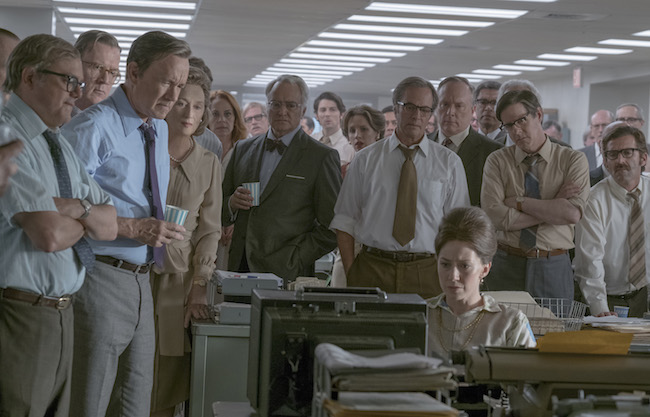
The publishing aftermath in “The Post”
Few films feel as urgent in this political climate as a true story about the free press exposing the White House’s poor decisions; that Nixon-era narrative coupled with Steven Spielberg, alone, is enough to garner buzz. Writers Liz Hannah and Josh Singer have taken it one step further, spiking First Amendment rights with a feminist agenda—and tapping Meryl Streep as Washington Post publisher Kay Graham to carry the torch. One feels its weight when she walks into a boardroom filled entirely with men and is largely ignored and then spoken over. Her nepotistic rise at the paper (and gender) makes her a questionable leader in investors’ eyes and she’s dismissed as incapable—that is, until her executive editor, Ben Bradlee (Tom Hanks), obtains the Pentagon Papers. She’s forced to make a decision: publish them or not? (She does.)
After receiving a call to appear before the Supreme Court, Ben walks into Kay’s office and ceremoniously lays out all the national newspapers with the same front-page story detailing the U.S. government’s lies to the public about the Vietnam War. Arms crossed and smirking, Kay looks down at her paper-covered coffee table. Spielberg positions the camera below to catch her eyeline. “They all followed your lead,” Ben says, standing beside her. After a beat, he examines her posture and follows suit. No matter what comes next, the press has won, and so has Kay. —Briana Rodriguez
Giles translates Elisa in “The Shape of Water”
In Guillermo del Toro’s” The Shape of Water,” mute janitor Sally Hawkins’ Elisa falls deeply in love with Doug Jones’ towering merman-like creature. But there’s another pairing in the film that yields one of the best acting moments of the year: Elisa’s friendship with her neighbor Giles, a gay artist played melancholically by Richard Jenkins.
When Elisa goes to Giles to insist that they rescue, from a high-security government facility, the monster with whom she’s developed a rapport, her plea is urgent: If they don’t act, the mer-creature will be vivisected. Giles is initially dismissive, and Elisa asks him to repeat exactly what she signs.
Jenkins has admitted that Giles acting as translator to Elisa could be something of a cinematic “device.” In practice, though, the moment illustrates both actors at the height of their powers. Hawkins, voiceless, speaks volumes in her passion, but the words echoing from Giles are weary and uncertain. These are best friends who we’ve seen break out into spontaneous tap dances. But here they are not in tandem. The agony on Hawkins’ face does not match the dejected sounds coming from Jenkins’ mouth. Even as she convinces the audience of the necessity of saving the creature, her closest confidant can only sympathize with her, seeing her efforts—and himself—as worthless. He turns away, and she bangs on the wall to get his attention. Hawkins makes Elisa heard even as Jenkins makes it evident that Giles is not quite hearing her. That gap is crushing. It’s also brilliant. —Esther Zuckerman
Ready to star in an Oscar contender? Check out Backstage’s film audition listings!