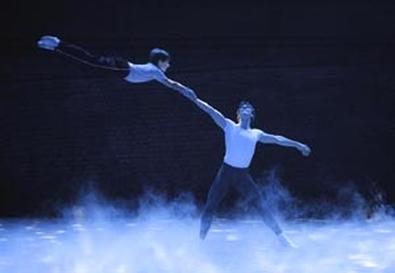
Photo Source: David Scheinmann
As part of his role as "Billy Elliot" on Broadway, he swings across the stage suspended by cables in one of the dance numbers. The effect is thrilling for the 11-year-old performer.
"I almost forget I'm on the wire," said Harrington. "It just feels like I'm flying. It's really cool. I get butterflies when I do it."
Yet these aerial theatrics involve less fairy dust than tremendous preparation—and nerve—on the part of both the actors and the riggers involved.
Actress Nikka Graff Lanzarone says she had always wanted to fly on stage. As Marisa in the new musical "Women on the Verge of a Nervous Breakdown," she gets her chance: Lanzarone—along with actresses Patti Lupone, Sherie Rene Scott and Laura Benanti—is pulled up in the air and sings while being suspended.
Her first time in the harness was a disorientating experience.
"It was just crazy because it's just your body and the rope. There's not much else holding you there," she said. "So you're a lot more aware of where you are in space and how high up you are."
Aerial tricks are fairly common on Broadway right now. Shows that incorporate stage flight include "American Idiot," "Mary Poppins," "Billy Elliot," "Women on the Verge," and the soon-to-open "Spider-Man: Turn Off the Dark."
Stage flying is nearly as old as theater itself.
One of the earliest records of flight on stage was the 425 B.C. production of Euripides' "Medea." For a time in ancient Greece, flight on stage became so common that the comic poet Antiphanes remarked that when playwrights no longer know what to do, "just like a finger, they lift the machine and the spectators are satisfied."
While those early effects were accomplished with a derrick and a crane, modern practices involve heavy machinery—usually created by a flying company that specializes in aerial effects.
The largest companies include Flying by Foy (which does the effects for "Billy Elliot" and "American Idiot," among others), ZFX, and the Sky Box. The costs of such effects vary show by show, depending on the complexity of the effect, the type of equipment needed, how many aerial personnel are needed, and the length of the show's run. For instance, a show like "Billy Elliot," which utilizes only one flying actor, costs can range from $30,000-$35,000, along with a weekly royalty of $300.
In addition to the technical considerations, preparation for the performers is also very extensive.
For musicals like "Women on the Verge," the actors are first required to practice in the harness without singing, so they can learn how to properly move. Aerial instructors also train them on proper muscle control.
"We did a little bit of yoga and some upper body strength," Lanzarone said. "It's a lot of core stabilization and learning how to hold yourself... getting comfortable with orientating your body in three-dimensional space. It's really different from just walking and talking."
Stark Sands, who plays Tunny in "American Idiot," had also never flown before. Yet a routine in the musical required him to sing, dance, and twirl with another actor (Christina Sajous) in midair. So, he and the other actors were sent for training to Las Vegas, the home of Flying by Foy. They practiced in the harness for five days.
Sands said that not having a dance or aerial background made learning the routine difficult for him.
"It was like learning how to ride a bike having never ridden a bike," he said. "It's balance. It's learning where to center your weight... The smallest shift in your weight can throw things in a different direction."
Former actress Sonja Rzepski now works as an aerialist with the Sky Box, . They developed the flight sequence found in "Women on the Verge." While choreographing the movements on stage, she also trained the flying actors on proper technique, which is essential to reducing injuries.
"A lot of aerialists unfortunately do get injuries from pushing (their core) too hard and not training properly," Rzepski said. "I've had some herniations myself and some shoulder injuries, so it's quite common."
Another important aspect in aerial work is safety regulations, which calls for a checkup of the rigging equipment every day. In "American Idiot," checkups include a fly call before every performance, where the actors perform the routine to make sure the equipment is working properly.
During its first preview, "Spider-Man" had a number of well-reported technical glitches. Other shows have had their share of mishaps during a performance.
Once during "Billy Elliot," actor Dayton Tavares was stuck in midair when one of his wires got jammed. "They had to get the stage managers to come on and force him down and get a ladder," recalled Harrington, adding: "That wasn't the best day because that was his birthday."
Yet all the effort into stage flight is in the name of creating a spectacular theatrical experience for the audience. At its best, the effects reflect something special in the show, a heightened reality or emotion.
In some shows, such as "Mary Poppins" and "Angels in America," flight is used to denote a character entrance. In others, such as "Women on the Verge," it reflects each woman's descent into a nervous breakdown. And for "Billy Elliot," the act of dancing is as liberating to the main character as flying—a metaphor, when made literal, that takes the show to another level.
"(Billy) loves the feeling he has when he's flying so that's what he feels when he's dancing," Harrington said. "He's just so happy and free."
For actors like Sands, the effect of flying is just another part of his performance.
"It doesn't feel any different," he said. "The story that I'm telling is that I'm having this fantasy that this extraordinary girl is dropping into my world. I can't take my eyes off her. So the nice thing is I'm only ever looking at her... and it's fully supported acting-wise—especially now because we feel so at home in the routine."
For Rzepski, learning an aerial routine might the first step to a new career path. She was an actor before she decided to run off and, in her words, "Go to circus school."
"Every time an actor is learning flying technique, they are starting their aerial careers," she said.
Even if you don't become a full-fledged aerialist, knowing how to fly is another valuable skill in any actor's arsenal.
"I feel like if I do another show where flying is a part of the show, I think I would pick it up faster, now that I've done it," Sands said, adding:
"I can put it on my resume now. Special skills: flying."