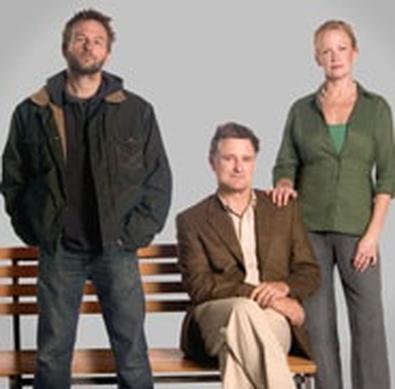
In 1960, Edward Albee burst upon the American theatre scene with a riveting one-act called The Zoo Story, a two-hander about a man named Peter who is accosted by Jerry, a young drifter, while sitting on a bench in New York's Central Park. Nearly 50 years later, Albee has written a companion piece to that landmark work, providing a backstory for Peter. Called Homelife, it's paired with The Zoo Story under the title Edward Albee's Peter and Jerry, which is currently playing at Off-Broadway's Second Stage Theatre under the direction of Pam MacKinnon, who helmed its premiere at Connecticut's Hartford Stage in 2004.
Back Stage recently conducted a roundtable with the three actors in Peter and Jerry: Bill Pullman, who won a Drama Desk Award in 2002 for his performance in Albee's The Goat, or Who Is Sylvia? and plays Peter; Johanna Day, who was nominated for a 2001 Tony Award for Proof and plays Ann, Peter's wife, a role she originated at Hartford Stage; and Dallas Roberts, who plays Jerry.
Back Stage: How did you land your roles in Peter and Jerry?
Johanna Day: I auditioned for it. Edward Albee was there and I was terrified. I thought I'd done a really bad audition at the time, but I did hear what he said to Pam after I left: He sang the song "What a Difference a Day Makes." I got a callback. It was exciting and great to do [the Hartford Stage production], but now being allowed to come back and do it again — it's the best.
Bill Pullman: I didn't think I would be able to do it, because I had committed to another thing that was slightly overlapping. I was expecting them not to be able to move because of the Second Stage schedule, and Edward's schedule too. But then they did.
Dallas Roberts: I didn't know Pam, but she did say, "I'd like this kid to play the part." The theatre said, "We could live with that," and Edward said, "I don't know this person." So then I let him know who I was, briefly, and despite that got the job. I read a third of the script for the audition. I was very flattered to even have that sort of access.
Back Stage: Jerry's monologue in The Zoo Story — the story about the dog — has been a staple for acting students for more than 40 years. How did you feel about approaching this role?
Roberts: I must have been sick when my friends in theatre school did it. If you said The Zoo Story, I would go, "Oh, Edward Albee." But I had never read it. I was very happy that I didn't have preconceived ideas. I told Edward and he said, "Where have you been?"
Back Stage: The first act, Homelife, is a marriage play like so many Albee works, isn't it?
Day: Well, Edward said he felt that The Zoo Story wasn't so much a two-person play as a one-and-a-half-person play, because he's always known that there's this life that Peter has with his wife. He said that it fell right out of his head and onto the page. For me he wrote this extremely well-rounded, smart, funny, kind of out-of-her-mind woman that I get to play. This couple — and Bill and I talk about this often — it's an endless journey, how they work together and what their past is.
Pullman: Many of his plays are about married couples, and you know that with a couple that's seemingly getting along on the surface level, there's something else going on. I'm always struck by how deftly he gets this way in which married couples don't speak easily to each other. That's a perception that probably goes against some conventional thought about married people. There are a lot of obstacles, and maybe the obstacles are more acute because they're married. He allows for characters' fears to just be outside their reach. And he does this dance with them — between what they're saying and what they're wondering or suspecting.
Back Stage: But they're also so articulate...
Day: And they have their own language. All couples do, I believe. It's the only way they can get through it.
Pullman: I'm intrigued by how much Peter corrects himself. Whereas in The Goat, I was spending a lot more time correcting others.
Back Stage: Do you find a similarity between Peter in this play and Martin in The Goat?
Pullman: I see them as very separate, largely because the goat was such a big huge thing that [Martin] was sitting on top of. This is more a growing sense that there's something else, something shocking, that [Peter] hasn't experienced — kind of the reverse of The Goat, seeking the shock as opposed to hiding the shock.
Back Stage: What happens when you put Homelife and The Zoo Story together?
Day: It can't help but inform The Zoo Story more, I think.
Pullman: The issues of Peter's directness — his sense of wanting to maintain a civil idea of how to [behave] — you learn about how deeply that runs in him. Maybe without the first act you might sense that he's somebody who's just stiff and wants to conform to social laws and a generic idea of what decency is. [Now] you realize that those are things that he's put into place maybe because he's conscious of, or afraid of, what the chaos is if he doesn't handle that stuff. So you don't dismiss him as easily. He's actually wrestling a whole kind of philosophy when he's confronted by Jerry. We've been realizing that there's a lot of connective tissue that we didn't see at first. It's just wild to look at The Zoo Story: How would you write a first act for this? Even if you took the same construct of Peter at home with his wife, what would you have him talking about? And how would you set up what gets said by Jerry? Edward does it so deftly. The dog thing is so curious. There's so much about a dog in The Zoo Story and there's a short little exchange about dogs in Homelife, but really precise. It's so subtle, and yet suddenly you're in front of an audience and you realize that they're tracking that one reference all the way through.
Back Stage: Are there changes to The Zoo Story now that it has been moved up to current times?
Roberts: The text hasn't changed much. There are some monetary values that are different. There's a writer who's got a different name than he used to. Edward apparently made cuts to the play in the '80s that still exist now. There are a couple things that fall differently on 21st-century ears than mid-20th-century ears. But certainly the meat of it is just as relevant now as it was.
Back Stage: We've heard how strict the playwright is about his words and the syntax. Have you ever wanted to change a line?
Pullman: Nooooooo. [All laugh.]
Day: Edward's not going to read this, right?
Roberts: It's remarkable, really, how well he knows his play. He knows every line all the time. In fact, we just came up against a situation where the play had been typed out from the published version and whoever typed it missed a word, and we just went with it for four and a half weeks. Edward came in, saw the show, and said it's not that, it's this. And I looked at him sideways — no, it's not, because it makes total sense. Then we [checked the original]. It was definitely a meaning difference. It had to do with upper-middle middle class and lower-upper middle class. But that he would pick that out is remarkable. It's not like the guy isn't doing other things either.
Pullman: You know, with Edward it becomes this game. You kind of develop this thing where you think, Oh, I'm so smart, I can take all these restrictions and make it look like there are no restrictions at all. And then you're very much like all the characters in his play: I'm so smart, I can figure everything out, and I can live with it. So in a weird way, the crafting informs the acting.
Back Stage: Do you think Albee is playing with your heads the way he plays with the audience?
Day: I feel that way sometimes. I remember three years ago, we're getting really deep into some little sentence: Is that because of this or that? And he said, "She's just mad."
Pullman: Control and mucking with your head are interesting things to have on stage, so they're interesting things to have in [Albee's] nature. I said to him once, "We're working very hard to figure everything out," and he goes, "What's there to figure out? It's all figured out right there."
Back Stage: Aside from the intimidation factor, do you find it tougher to work on a play by Albee than one by some other writer?
Day: He has a curious bedside manner. He doesn't mince words; he's straightforward. But he knows all about acting.
Roberts: I think it's much tougher to be in a play that's less well structured and less well thought out. It's much harder to swing vine to vine with a lesser work. And the benefit of this kind of work is that, yes, it does require a lot of you and it requires a lot of your mind and your heart and your whatever you allow it to control. But I find that's when the actors that I know are the most happy and the most fulfilled: when you feel like you're using as much as you can use and you're still not there. You're stretching yourself. So in that sense it is tough, but it's ultimately much easier than other plays.
Back Stage: And the plays are funny too. Do you have the sense that Albee has carefully planned most of the laughs?
Pullman: That's part of the real challenge. The humor is there, and you don't want the audience to take the thing away from you. Because then they get bankrupt early and you have all this stuff at the end. So if they want to have it be a light journey or if they demand that it all have just the brittle drawing-room-comedy thing, then you have trouble doing the whole play. Most of the laughs we get are there because he wants to — I want to say screw us, I guess. Try to get through this because they're going to laugh in a place you don't want them to.... See if you can handle that!