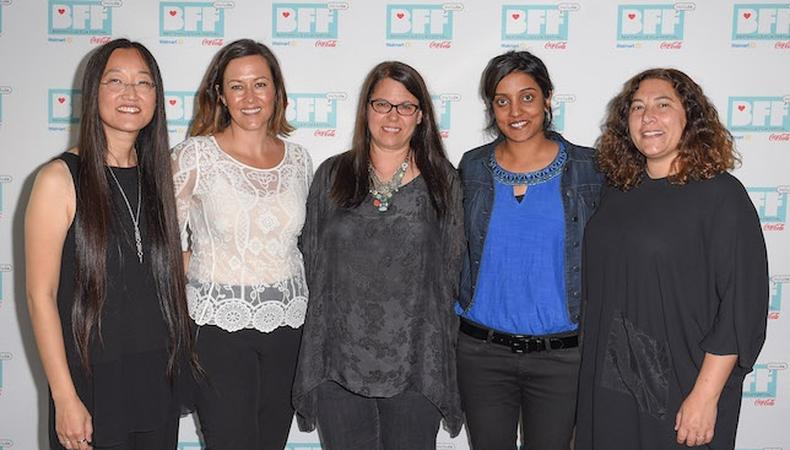
(Pictured l to r: Jennifer Yuh Nelson, Maggie Kiley, Elisa Paloschi, Meera Menon, Malina Saval)
Earlier this month, the Geena Davis– and Trevor Drinkwater–founded Bentonville Film Festival, based out of Arkansas, kicked off its second year of pushing inclusive films with female-driven voices into the mainstream. Using research from the Geena Davis Institute on Gender in Media, which revealed that “across 1,565 content creators, only 7 percent of directors, 13 percent of writers, and 20 percent of producers are female,” a 4.8-to-one male-to-female ratio behind the scenes, 34 films were selected out of 500 for the slate. To shift that ratio in mainstream films, BFF is the only festival that guarantees the winners of the narrative, family film, and audience award categories distribution through corporate sponsors that include AMC and Walmart.
“Having been in movies that really resonated with women, I had a bit of a spidey-sense of how we were portrayed,” Davis said. “The default is always male: crowd scenes are mostly men, most of the speaking characters are men. Same goes for diversity.”
To spotlight a few of those 7 percenters, BFF included in its five-day run an all-female From the Director’s Chair panel featuring Oscar-nominated director Jennifer Yuh Nelson (“Kung Fu Panda”), actor-filmmaker Maggie Kiley (“Caught,” “We Own the Night”), documentary director Elisa Paloschi (“Driving Selvi”), and Meera Menon, director of the fest’s opening film “Equity,” the first female-centered Wall Street story (Anna Gunn stars opposite Alysia Reiner, Sarah Megan Thomas, and James Purefoy.) Malina Saval, associate features editor at Variety, moderated.
During the panel, which took place in Bentonville’s 21C Museum, the directors revealed some of their top resources including the grant-giving Women in Film, and Film Fatales; discussed the process of “letting go” creatively to better their projects; the best advice they’ve received; and working on an indie film budget.
When asked about her mentors, Kiley pointed to actor William H. Macy and his wife Felicity Huffman, who supported her first short film. “When someone’s in a position and they can look at you and see that you have a story to tell and they support you, it’s really wonderful—especially for me, who made such a transition in my career,” she said of her move from acting to directing.
She went on to impart the advice director James Gray gave her when she began directing: “He said, ‘The thing about directing is you have to be 50 percent a total, total control person, have it all figured out, know exactly what you want to do, but then you have to be 50 percent whatever. You have to be able to show up on the day and know what you want but listen when someone says, ‘What if we bring in a blue panel?’ Or ‘What if we move the camera just once?’ You have to be willing to give over to it some of the time.” All the women made a point to surround themselves with collaborators for their respective projects.
When prompted on the differences between women and men directors, Nelson expressed that in her experience, women were more collaborative than men in the creative space and more willing to hear opinions from cast and crew. Saval asked Yuh about her quiet command of a room (mentioned in a Variety article last week), and pointed out that amidst the usual cacophony of Hollywood, the director will simply put up her index finger and a room of loud opinions and people will fall silent.
“I didn’t cultivate that, I’m just a quiet person,” Yuh said. “I won’t be able to compete in a room of screaming people if I try and outscream them. So when [I put my finger up like that] it’s usually because I have a solution, and luckily when [the team does lean forward to listen] I do have a solution, so they keep doing it!”
On casting, Kiley said she frequently casts friends in her projects, and gave an anecdote about a Method actor on one of her films. “[Method acting] is great if you have a huge budget and lots of hours in your day, but when you’re making a 15-day movie in Michigan and you have two takes on everything and someone’s like, ‘I just need a minute,’ I had to remember to let go. I covered the other actor [in the scene] and we eventually got her out of her head. We rolled and she was fine, so sometimes you have to play tricks.”
“There’s a fine line between being a director and being a psychologist,” Menon chimed in. “So much of the craft involves just being able to get people out of their heads because they can get really stuck in there—and it’s not just actors, it’s the creative team as well.”
Inspired by this post? Check out our audition listings!