Today’s left-field is tomorrow’s mainstream. This week, Notes From The Edge discovers what’s stirring in a new breed of British musical theatre, why they are on the rise and why it matters.
“What is a musical anyway? It’s such a weird term.”
—James Frewer, musical director, All We Ever Wanted Was Everything
British musical theatre seems to be undergoing a transformation. There will always be a place for the Wickeds and the Les Mises in the West End – but glance at any fringe (and not-so-fringe) theatre in London this season and you’ll see shows that have music and dance at their core, yet manage not to forsake a strong narrative arc with big hits and a 90-person chorus. In fact, in 2018, you’re just as likely to see a man rapping about violence on a night bus as see a woman move to Saigon to become a governess.
What’s happening?
“It feels as though in the last five years the new British musical community has witnessed a seismic shift,” says Adam Lenson, a director and driving force behind new British musicals. Lenson recently directed Wasted and The Rink at the Southwark Playhouse to critical acclaim. “Theatres seem to be realising that musicals are a form worth pursuing. As life becomes more layered and we have more ‘distractions’ like Netflix, we’re interested in watching more layered experiences.”
So, are we witnessing the rise of the new British musical? Is it time to forget Lloyd Webber and Tim Rice, and to say hello to hip-hop, history and rock?
A musical is, by definition, a piece of theatre that uses music and dance to tell its main story. 2018 has seen a growing appetite for shows with a political edge, and some theatre-makers are using music to tell these stories. Why? Partly because music helps a story to resonate with an audience, and also, because music can make tough truths easier to digest.
London Road – a musical written for the National Theatre about the Ipswich prostitute murders – was an important start.
But this year, the UK has been awash with sparkling new shows that have the unlikely combination of both music and a strong socio-political message at their core. The Assassination of Katie Hopkins at Theatr Clwyd is a case in point. Written by Chris Bush with music by Matt Winkworth, the show looks at social media manipulation and tells an important story about the dangers of this zeitgeist. The songs are provocative and make the audience think – rather than just acting as a pleasant background track.
Lenson adds that the musical theatre community is still having to play against the presumption of what a musical is, but we’re also beginning to realise that it can pull away from our preconceptions – and that’s where the more political layering comes in.
Musicals in the United States often play a social commentary role. Lenson notes that Carousel and Cabaret have political themes at their core. “Shows like Hamilton are showing us that the musical can be all things to all audiences – relevant, accessible to young and old.”
Who is doing it?
No matter where you look, people are developing new and exciting musical theatre.
“There’s so much exciting stuff in development right now,” says Adam Lenson, who singles out Becky Aplin, a theatre-maker who secured the rights to turn the book A History of Women in 100 Objects into a feminist historical show. “The number of people who are skillful and are devoting their time to it is huge…Really excited by how many musicals are in development that would make someone completely rethink musicals.”
Middle Child, a theatre company based in Hull, are pushing boundaries as to what musicals, or gig-theatre means. James Frewer worked as musical director on All We Ever Wanted Was Everything, a production that uses music to signify political shifts – from the optimism of 1997 to Brexit Britain. He explains: “We used music to make All We Ever Wanted really relevant to a Hull audience…We wanted to pastiche things from the ’80s, ’90s, anthemic techno music. I wanted to start each act with a song if you like, and that way the audience can catch on to where you are.”
He adds: “If you want to reach outside of a ‘typical’ theatre audience, they’re going to want to see their lives, and it’s about getting that story just right.”
Another show that looks at the state of the nation is The State of Things, a new musical about growing up in austerity Britain. With music and lyrics by Elliot Clay, the show tells the story of a group of students fighting to save their music course from being axed as a result of arts education cuts. Clay says: “All the cast sing, dance, act and play multiple instruments – so it’s a real celebration of the joys of live performance and a stark warning to those in power denying students the basic human right of the arts.”
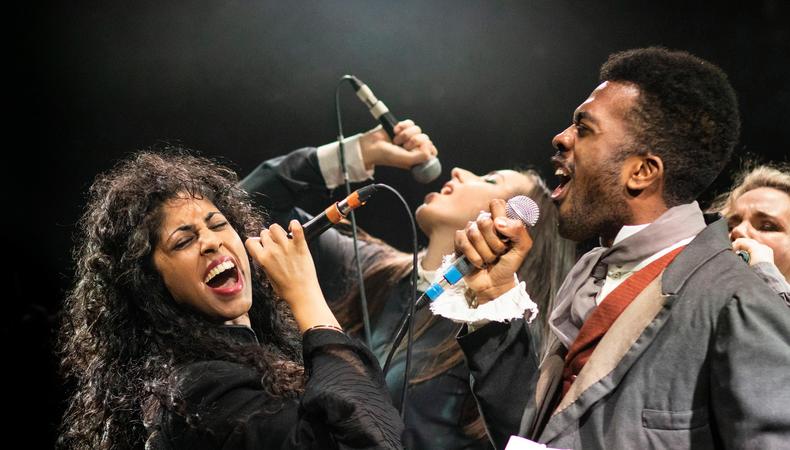
What highlights the febrile nature of current musical theatre is that these are just a few examples. There are many others, few of which would classically be thought of as “musicals”. These include Misty by Arinzé Kene, which takes viewers on a profound journey through inner-city London; and Six, a pop concert featuring the Six wives of Henry VIII singing and competing with each other over who had it worst. Add Emma Rice’s new show Wise Children (at the Old Vic) and of course, Adam Lenson’s involvement in Wasted (pictured), a show about the Bronte sisters at the Southwark Playhouse, and you have a cocktail of collaboration and musical excitement.
Why does it matter?
“We go to a protest to chant. On Remembrance Sunday we listen to the call of a bugle. Music reaches out to an audience and it moves us,” says Lenson. He explains how, in pop music, a major part of the lyric is called the hook, because it hooks you in. "Music is galvanising because it brings people together and empowers you, and works on your brain in multiple different ways.”
Frewer says that in All We Ever Wanted, the script needs music to thrive, and vice versa. “They have to be as one. They work as this weird thing going pushing and pulling each other. When you have such a political, anthemic, huge, rock beast, it gets people fired up, so you’re flying. In the final two minutes of the show, it’s in silence, and the music goes – you’re in such a vulnerable place – and music helps you highlight certain points, but it shouldn’t ever manipulate it.”
Getting involved
As the UK’s new musical theatre scene grows, there will be plenty of opportunities for actors. Lenson says: “I’m always looking for an actor who can sing and dance really well but who also has a brain and likes to be involved in the creative process.” As far as he’s concerned, Lenson says he prefers musical theatre performers who are non-conventional, who have, for example, “auditioned many times for Les Mis, got very far, but don’t quite fit the existing mould and want to develop their own part.”
Lenson thinks everything is related back to acting, as that’s the core. “My observation is you need a technically skilled-enough voice to be able to transmit your acting through the voice.”
With companies such as Hull’s Middle Child producing such vibrant and attention-grabbing work in the north of England, it shows that opportunities exist around the country. With theatres like Theatre Clwyd and Sheffield’s The Crucible investing in and producing fantastic musicals (such as Steel, which James Frewer also worked on), more opportunities are opening up for multi-skilled performers.
The big picture
A new breed of theatre-makers are telling important, politically charged stories with musical elements at their core – and in the process they are redefining Musical Theatre.
Check out Backstage’s UK audition listings!