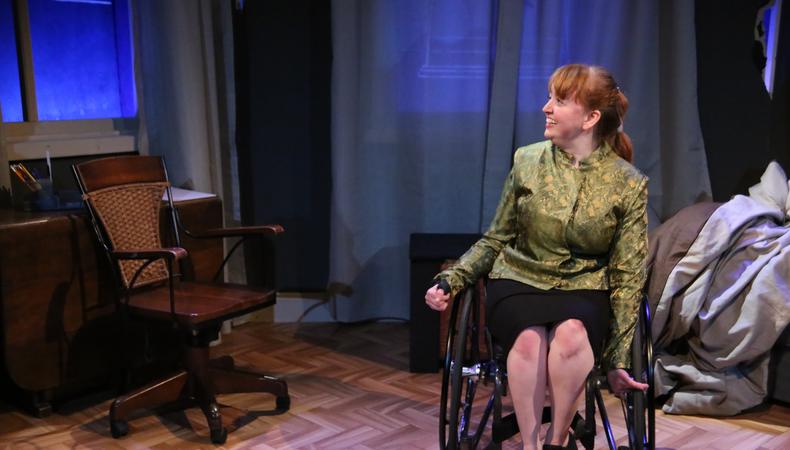
Athena Stevens is a performer, writer, director, and activist born with cerebral palsy. Of all her ambitions, the most surprising is that she’d love to do a commercial for frozen rice.
“My dad still makes fun of me for saying that. He laughed and said nobody sells frozen rice! I just meant a commercial for something totally mundane and unrelated to disability.”
Stevens has performed in the West End, is an award-winning comedian, as well as a documentary maker and writer. Her play “Schism” premiered at the Finborough Theatre where she’s now on attachment. She’s collaborated with artists at the National Theatre, the Globe, the BBC and—whilst she waits for the frozen rice gig—is working to change commercials and how the industry views disability at large. As the spokesperson for the Women’s Equality Party, she’s helping to end gendered advertisements: “If there’s a cleaning product, they have to show men cleaning as well as women.”
One of London’s talented immigrants, Stevens grew up in Chicago and went to University in North Carolina where she met and studied under theatre director Dominic Cooke (Royal Shakespeare Company, the Royal Court). Though she did attend drama school in the U.K., she was forced to drop out because of what she describes as “daily discrimination.” So what made her stay? “I knew that London was the place to crack the industry, not New York. Here the Arts Council not only supports diversity but demands it, just as the BBC has an obligation to put diversity on screen. We can debate if they are doing a good job of that but at least it’s happening. That doesn’t exist in the U.S.”
READ: The Best 24 MFA & MA Acting Programs in the U.S. and U.K.
Obligation alone isn’t enough; Stevens worries that projects featuring a disabled actor can easily become a sort of “box ticking,” with weak scripts or characters that are “plucked from the air.” “A lot of support for disabled artists doesn’t follow through. It’s charity rather than change,” she says. “The industry needs to visibly encourage and employ disabled writers. And those writers must be held to the same standards as everyone else. The No. 1 challenge for disabled people entering the industry is finding legitimate people who are willing to hold your feet to the fire, to make you better rather than pat you on the head and say, ‘That’s good enough.’ We have talent, we need real conversations with established artists who are willing to challenge us.”
Producers also need to do away with preconceived notions about her audience: “We need to get rid of the idea that disabled artists only make art for other disabled people.” Stevens smiles, “partly because there isn’t a theatre that can fit 100 disabled people in it and not have the London Fire Brigade come after them.” Whilst companies like Graeae, a theatre company that champions the inclusion of deaf and disabled actors, have their place, she believes disabled actors and writers must break out of a system that is “infantilising and segregating them,” and crack the mainstream. Stevens’ varied work, much of which doesn’t center on her disability, is a testament to the effort. Her web series, “Letters to Mishka,” demands a better world for ourselves and future generations, and her ongoing documentary, “Day of Small Things,” sees Stevens ask philosophers, artists, businessmen, and single mothers how they measure achievement.
“I write with disability as a metaphor. It’s just a complication,” she says. “I was made disabled by a terrible mistake, but I won’t let someone else’s mistake define who I am as an artist and what my opportunities should and should not be.”
“Get to work,” she advises people just entering the industry. “Fly past anyone who stands in your way.”
Athena Stevens is playwright on attachment at the Finborough Theatre where she is developing a new play. You can see more of her work on her website and YouTube channel.
Check out Backstage’s London audition listings!