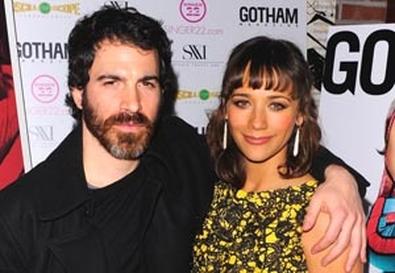
Photo Source: Andrew H. Walker/Getty Images
Back Stage: How did "Monogamy" come to you and what drew you to the project?
Chris Messina: I read Dana's script and I was a big fan of his from "Murderball." We got on the phone and he told me he wanted to basically make a documentary about these two characters, and that was really exciting to me. We talked a lot about John Cassavetes and improvising and doing 20- to 30-minute takes with no marks on the ground. Once I signed off on that, we immediately started talking about Rashida. We didn't know if we'd be able to get her, but we lucked out and we did.
Rashida Jones: A huge draw for me was the chance to work with Chris. I have been a fan for a while, personally and professionally. It was selfish; I thought maybe it would make me a better actor. And I was right, because I felt challenged in the right way by him.
Back Stage: You two knew each other before the film; how did you meet?
Messina: Rashida went to high school with my girlfriend, so I know Rashida through her. Rashida would come over to our house and play with our two boys; they love her. It was confusing and interesting to see what was going to happen, kissing one of my girlfriend's best friends. And it turned out to be amazing. I think the experience we went through together ultimately made us even better friends.
Back Stage: Rashida, how was it for you, kissing Chris?
Messina: [Laughs.] Amazing!
Jones: It was amazing. [Laughs.] I was nervous about it too, because you have to be pretty modern and mature to make that all work well. But the truth is, you have a couple jobs as an actor—yes, you hit your marks, you say your lines, you show up for work on time. But then you also have to do a really good job of keeping what you do at work separate from your life. It's challenging because this film was so emotional and intense, but I felt really safe with Chris.
Back Stage: You're working with a first-time feature director on a very challenging script. Did that give you any hesitation?
Messina: You always hesitate. No matter what you do, you wonder how things will go down. But a lot of people talk about working in the style of John Cassavetes and Mike Leigh and Robert Altman, but very few people stick to their plan. Because what those men did was extremely brave. And on a set, a lot of young filmmakers who preach these filmmakers, when everyone's moving quick and the producers are getting angry and you have two minutes to get a scene, they usually collapse and say, "Let's just say the lines and hit the marks and get out." Dana didn't. He stuck to his guns and we kept to the plan from Day One to Day 18.
Back Stage: You had an 18-day shoot and a budget of $1 million….
Messina: Oh, no. A million would have been giant for us. It was maybe $200,000. We were changing on the streets of Brooklyn. It was run-and-gun, renegade filmmaking.
Back Stage: Do you like that, or does it make you want to do a big-budget, studio picture next?
Jones: It's fun. It's not fun all the time, but you have to make sure it's something you really believe in.
Messina: You definitely crave the perks. After something like "Monogamy," you dream of a craft services table that had something more than Skittles. But it definitely adds to the roughness of the film and the anxiety of the characters. The less money you have, the more freedom you have to explore.
Back Stage: "Monogamy" came to both of you as an offer. Do you find at this point in your career you're auditioning less?
Jones: No way.
Messina: For a small movie like this, we might get calls. But for anything a little bit bigger, we still audition.
Jones: I don't audition as much anymore, but it's probably because I'm on a TV show and don't have time. But I auditioned for "The Social Network" a few times. They weren't sure I was assertive enough to play a lawyer. What happens is, more people know you, and that's great. You don't have to go on tape with the casting director's assistant anymore, but you just go into rooms with bigger people.
Messina: And the more people know you, the more they think they've got you pegged. That was my problem with "Six Feet Under" and "Vicky Cristina Barcleona" and "Julie & Julia," I was doing this nice-guy stuff. And those projects were amazing and I was so lucky, but the problem is, I was going into rooms where I had to convince people I could be more than this nice guy. They were like, "No way."
Jones: There's that thing where you work your ass off for years and years and then you get known for these one or two roles and within six months people are like, "Ugh, her again?" You want to say, "Can't I just be successful for a year without people getting sick of me?"
Back Stage: Rashida, can you tell us what you did to make yourself more assertive in your "Social Network" audition?
Jones: I broke some balls. No, actually, I was really surprised to get that note back because as a person, I am assertive. But I think I'm also a people pleaser and when you walk in that room, you talk to people and you're your nice self. And even when you go into character, all they're thinking about is that nice person who was telling them how much they loved their work before the audition even started. So my strategy was to get down to business and not do a lot of small talk.
Back Stage: Would you be willing to share your worst audition experiences with us?
Messina: One that immediately pops to mind is when I auditioned for "The Sopranos." It was a page-and-a-half scene that was, in my mind, one where you could just go through your Rolodex of headshots and cast. But I went in and auditioned and I got called back. And I went to the callback and figured there would be two other guys, but there were 20 to 30 guys in the room. And they kept me waiting for two hours. And I had a play to get to and I was stressed out but my agent told me to stick around. I finally went in and it was ["Sopranos" creator] David Chase, the casting director, and five or six producers. And the casting director begins to read with me but instead of reading all the lines, she'd say, "Skipping down, skipping down, skipping down…." Then she read the next line. Then I would do my line and she'd say, "Skipping down, skipping down, skipping down…." Then we were done and she said, "Thank you, Chris!" I paused and said, "That's it?" And I lost it. "You have no fucking respect for actors. I waited two hours; I have a play to do!" and I got up and slammed the door. Someone from David Chase's office called my agent not even 20 minutes later and said, "David Chase will never work with Chris Messina again, he will never call him in for anything ever again." But it's my favorite story because it sucked, but I found some kind of voice in the room. And it made me feel a little powerful…and terrible, at the same time.
Jones: I went in for a big TV drama show runner who shall not be named and he looked at his watch three times in my audition. Awesome, right? And I remember I had an audition for "Party of Five" and I waited for over two hours and my brain was just done. I could not finish the audition. I was in the middle of the audition and I just said, "I'm so sorry. I just can't." The words would not come out of my mouth. It's hard, because auditioning is such a different skill than actually being good in a movie. And most people do not really make the room conducive; they're not trying to optimize your performance. And why not make everybody the best they can be? I remember one of my best auditions, I auditioned for Baz Luhrmann for "Moulin Rouge!" and he was so warm and creative. And I was never going to get that part, but it so didn't matter because it was such a good experience. Cameron Crowe is the same way; it doesn't matter if you get the part because you actually became a better actor that day.
Back Stage: Over the years, have there been certain casting directors who have really championed you?
Messina: Francine Maisler has cast me in a lot of things. Ellen Lewis, Deb Aquila, Debra Zane. Some real amazing casting directors who kept trying to get me a job. Mali Finn was like that. Those women love actors and bring you in the room and work with you until you feel like you gave what you wanted to give. It's sad that it's so rare. There are a lot of casting directors that don't like actors. But those women, for me, were trying to get me work and sitting in a room with me and not letting me out until I got to place where they thought I had a shot.
Jones: I've got to give all my credit to Allison Jones because she's an amazing person with a completely original sense of humanity. She's cast me in every pivotal role in my life, starting with "Freaks and Geeks," which was the first thing that incited my desire to do sort of weird, dark comedy. Then she cast me in "I Love You, Man" and "The Office." I was kind of in the middle—I'm slightly quirky but I'm also too dark to play the lead. I'm kind of black, I'm kind of white, I'm kind of Jewish, I'm kind of not. It was hard to find where my place was, and her sensibility really got me in a way that I maybe didn't even get myself.
Back Stage: Chris, out of morbid curiosity, have you ever run into David Chase since that audition?
Messina: I haven't, but recently somebody came up to me and told me from the exact same story, told from David Chase's point of view. It was a similar story, though I think I came off like an asshole. And I was. But I think I needed to be. And I think he's a super-talented man and I hope maybe he changes his mind someday. But I'm not holding my breath.