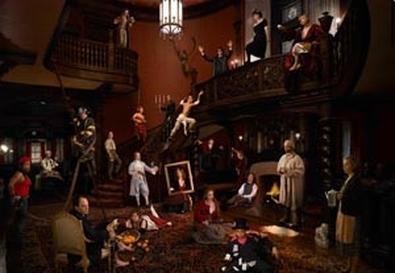
Photo Source: Courtesy of Lookingglass Theatre Company
The show opened at Northwestern in February 1987, and by the summer of 1988, the cast had raised $10,000 to bring it to the Edinburgh Festival Fringe. Walking through the Scottish streets one night after a few Guinness stouts, they came up with the idea to start Lookingglass Theatre Company.
"It just seemed like a crazy thing to do," remembers founding ensemble member Larry DiStasi. "But David believed we could, so we were like, 'Okay, if you believe we can do it, I guess we can do it.' "
Twenty-three years later, Lookingglass is the fifth Chicago-based company to receive the Regional Theatre Tony Award, making the Windy City home to more winning troupes than any other city. The previous Chicago winners are Steppenwolf Theatre Company, the Goodman Theatre, Victory Gardens Theater, and Chicago Shakespeare Theater.
"Chicago really is the most vibrant theater community in the country," says Lookingglass artistic director and founding member Andy White. "We're not competing for theater audiences; what we're doing is cultivating theater audiences."
What started as eight acting students rebelling against the Establishment has grown into a 22-member ensemble of actors, designers, writers, and directors who produce original works and literary adaptations developed through a physical, improvisational, and collaborative rehearsal process. Since its founding, the company has presented more than 50 world premieres.
Lens of the Lookingglass
Lookingglass fuses storytelling with stimulating visual and physical elements. The founders credit Northwestern's acting training with the company's ensemble mindset, and they attribute their mission and creative focus to their college acting teacher, David Downs. At Northwestern, acting students remain with the same class and teacher from sophomore to senior year, which encourages tight-knit collaboration and ensemble-driven work. Almost all the founding members were in Downs' class.
Downs emphasized "looking to the play to tell you what choices to make and finding a character within what the play is asking," explains David Catlin, a founding member and one of Lookingglass' first artistic directors. Adds White, "There's sort of a holistic view of a play that's not just exclusively from the actor's point of view. That emphasis on storytelling has definitely affected how I view my job as an actor."
Early on, the group teamed up with Northwestern graduate student Mary Zimmerman, who later became a Lookingglass ensemble member. Zimmerman specializes in bringing literary masterpieces to the stage, and her epic adaptation of Ovid's "Metamorphoses" had its world premiere at Lookingglass in 1998, then transferred to Broadway, earning her a Tony for best director of a play in 2002.
Viola Spolin's improvisation games drove the rehearsal process for "Alice in Wonderland," and Zimmerman's work incorporates the teaching of choreographer Pina Bausch, who challenged the boundaries between dance and theater, an important element in Lookingglass' focus on physicality.
"We've developed a brand that people expect, a kind of physical-quality component to our storytelling," says Catlin. "But the thing that drives play selection is 'Why must this story be told?' That's at the core of everything."
The emphasis on physicality and the creation of new work often requires actors to learn special skills. The company's 1994 production of "The Master and Margarita" introduced more circus artistry, and the troupe began working with former circus performer and current Lookingglass artistic associate Sylvia Hernandez-DiStasi, who runs the Actors Gymnasium in Evanston, Ill., with her husband, Larry DiStasi. Many actors train there for Lookingglass productions.
Molly Brennan, who has worked with the company on two shows, including the most recent production of "Alice," says her physical training gave her an advantage for these types of roles. When she auditioned for the role of the Red Queen, she had to prove her physical strength and flexibility before reading any text.
A risk that comes with this type of work is injury. Brennan knocked two vertebrae out of place during a performance of "Alice" on tour in Atlanta. It also happened to be her birthday. "Lookingglass Theatre Company is a fantastic company to work for as an actor," she says, reflecting on the incident. "It was like being a football player, where you mess something up and they send you to a great doctor and you're back on the field."
Because most of the company's works are world premieres, directors often empower actors to create parts of the work themselves, and everyone in the room is expected to contribute to the process. "There's a large sense of creation that I always look forward to," says actor Minita Gandhi, who recently worked with the company on the tour of Zimmerman's "The Arabian Nights." "That really separates them. Everybody is strongly committed to telling that story. Everybody is open to ideas. It was a really thrilling experience. I felt like it pushed my limits as an actor."
Between Chicago and L.A.
After Northwestern, many Lookingglass members felt the need to go to Los Angeles, including Schwimmer, who left soon after graduation. Many others would follow in the years to come, but White believes these comings and goings have only helped the company continue.
"It's not sustainable if there's no flexibility," he says. White also took his turn in L.A., appearing on the CBS series "TV 101" in the late 1980s. "None of us likes to feel like our dreams are being curbed."
Schwimmer returned a few times before landing "Friends" and performed in the company's first professional show, "Of One Blood," about the murders of three civil rights workers. It was produced at the Edge of the Lookingglass, a former late-night venue in Chicago's South Loop. Smashing Pumpkins played there before making it big, and Chicago contemporaries Jeremy Piven and John Cusack performed there with the New Criminals Theater Company (now the production company New Crime Productions, which produced the Chicago-set cult favorite "High Fidelity").
Schwimmer's success also helped Lookingglass gain recognition, according to Catlin, who says the actor's "Friends" fame was partially responsible for the company's ability to set up meetings with Chicago's mayor to secure a permanent performance space. As a result, the city selected Lookingglass for an $8 million capital campaign, and in 2003 the company became the resident troupe at a 270-seat convertible theater in the historic Water Tower Water Works.
With the influx and outflow of company members, everyone has had to step up to keep Lookingglass going. "We established very early on the notion that anyone could be a leader," says White, who recalls a turning point at an artistic retreat in the early 1990s, when the female company members spoke up about feeling undermined by the male-dominated environment. At that point, the ensemble members decided to make a change.
"We created a system for any kind of major issue or important vote," Catlin explains. "We go around the table and everybody speaks and everybody has an opportunity to be heard."
"When you have an artistic home, you have a greater degree of self-determination," says White, "as well as artistic connections that excite you and challenge you that are hard to find as an individual actor trying to duke it out in L.A."
This feeling of community is shared by artists who come from outside the ensemble to work with it. "You automatically feel a sense of family, even if you're not one of the resident company members," says Gandhi, adding that she appreciates Lookingglass' commitment to diversity, both in the adaptations it chooses and its casting decisions, particularly as an actor of ethnicity. "People really listen to each other. It gives the actors an even stronger backbone than they already have and really makes them stretch farther than they might in another rehearsal process."
But the founders don't want to undersell the importance of luck. Good fortune combined with sometimes crippling perseverance—Catlin lived at the theater for nine months, subsisting on gas-station burritos—pulled the company from year to year.
"We've just kind of been blindly, stubbornly chugging ahead," says Di-Stasi. "I feel like that's why we've succeeded, because we didn't feel like it was an option to stop."