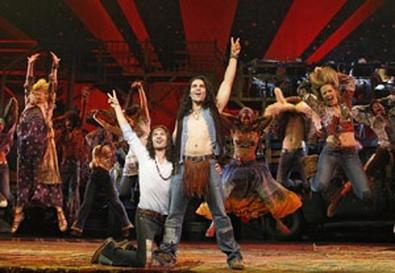
Photo Source: Joan Marcus
Now Burkhardt and Remillard get to go on together every night for the 2010–2011 national tour, which makes a 10-week stop at Broadway's St. James Theatre, opening July 13. "All of the fans who were sad that we left are so excited that we're back," Remillard says of returning to New York. "It's been kind of rock concert-y." The rising stars share their four-year journey and how they finally made these iconic roles their own.
Back Stage: How does it feel to be back on Broadway in the roles that you originally understudied?
Steel Burkhardt: [Laughs.] It feels pretty good. I don't feel any different than like just going to a random city, except for the fact that we have the full production team here. There are a little extra nerves because they're all watching you.
Paris Remillard: I'm trying to think about it like it's just another stop on the tour. We were all pretty keyed up to be back on Broadway anyway.
Burkhardt: And the superfans, we like to call them "Hair"-balls. To have them there is great. You know they're probably like, "What's different? What's changed?" And you're like, "Oh, my God."
Remillard: But also it's beneficial that we've been on the road eight months doing these roles. Both of us also went on a good 30 or 40 times each as Claude and Berger on Broadway.
Back Stage: Do you feel pressure that people, especially in New York, could be comparing you to Will Swenson and Gavin Creel?
Remillard: I'm sure that people are always doing that. I don't think about that at all on stage.
Burkhardt: I do because Will and I look very similar. People have talked about the fact that we look like we're brothers. I feel like I'm taking over for my older brother. But I feel pretty confident especially after doing it for so long and having a mentor like Will in the role and also having done it with Gavin for a while [in the West End]. And now being able to grow in it together. We did understudy rehearsals the entire time during the run in 2009 and in the park. We've been doing it together forever.
Remillard: It's not like we just took over the roles. We actually had a full rehearsal process for the tour since the show had closed. [Director] Diane [Paulus] and [co-author] Jim [Rado] said, "Try to wipe what you've done before as much as possible. This is yours now, so start over." So we really got to have a rehearsal process to rebuild it, which was nice.
Back Stage: How did you make the roles your own?
Burkhardt: One of the lucky things about this show in particular is that it's written for every single tribe member to put a little bit of themselves in each of the roles. That's how I thought about it. Will's a completely different person than I am. Gavin's a completely different person than Paris is. So we're able to be kind of like, "Well, this is how I would do it."
Remillard: The intention is going to be the same. You're telling the same story, but it's going to be different because we're different people. It's really just filtering those intentions through us and the way that we've interpreted these characters.
Back Stage: As an understudy, sometimes you're under pressure to mimic the person you're covering. Is it hard to make the role your own?
Burkhardt: The first couple of times you go on, they kind of want you to, but that's where I got into a mind-blow a bit. I thought that's what they wanted, but they were like, "No, no, no. We want you to bring your own self to it."
Remillard: Especially with Berger. Berger can kind of do whatever he wants. I covered Wolf too, and I felt like my job was to, if nothing else, do exactly the blocking that they do. It looks like we're just sort of running wild on stage, but if anybody's in the wrong place, people get hurt. I really felt that my job as an understudy was to do that as much as possible. But it's going to be different. Even if I tried to do exactly what Gavin did or exactly what Bryce [Ryness] did as Wolf, it's going to be different because I'm such a different person than either of them.
Back Stage: Do you feel the freedom now to make it your own?
Remillard: Totally. When you're a cover, sometimes you don't go on for a couple of months and then suddenly you're on, and you spend the whole show being like, "What's next? What are the words to this song again?" So you're sort of in your head the whole time thinking ahead and trying to make sure that you have everything in order. When you get to do it every night, you can really just live in it a lot more.
Back Stage: Was there a mentorship role between Steel and Will or Paris and Gavin?
Burkhardt: I think I created one. Some people get all of their blocking from the stage manager, which is probably the correct route. But I went straight to Will. I'd be like, "What do you do during this part? Where do you go? Can you show me this part?" Like I had no problem with it, and he was more than willing to help me out. It was a way I could better cover the role so everyone else felt comfortable around me.
Remillard: When they were working on scenes with Gavin or Bryce, I tried to be there as much as possible so I could actually take the notes that Diane was giving to them so I could then incorporate those instead of just trying to mimic what they did. If I actually got the note from the director, it wasn't like I'm just going to say this line like they did or whatever. It's I know what the director's intention is for that thing so then I can access that.
Back Stage: What are things that you learned from Gavin and Will that you bring to your performances now?
Remillard: The easiness that Gavin has on stage—I will never have but I strive for [it]. When he's on stage it looks like it's the easiest thing in the world. I'll never have his musicality and his voice, but just watching that effortlessly come out of him, that's something I could only dream to be able to achieve someday.
Burkhardt: Knowing when to breathe. Because the whole time, Will set it up for Berger to run around and be crazy in almost an ADHD sense. But it's also knowing when to have those little moments to catch your breath because otherwise, you'll never be able to do eight shows a week.
Back Stage: A lot of "Hair" is about the tribe and the collective chemistry that the tribe has together. How would you describe the cast's tribal mentality?
Burkhardt: One thing that we really have is the tribe has come together with [marriage] equality. We were all inspired by Gavin Creel. He took the whole cast in 2010 and we marched on Washington. It was a way for you to show kids it's okay to be gay. Especially with all that stuff that happened a year ago with the kid jumping off the bridge. And all these videos that people are putting out saying it's okay; you're going to go through a rough spot. You got to show them.
Remillard: It's everybody looking out for everybody else. Everybody caring about everybody and spreading that out into the rest of the human race. We really are all part of the same tribe. And that's the whole message of equality that we've been trying to show. Whether it's homosexuality, whether it's black, white, whatever it is—we're all just people, and that's really what the tribe mentality is.
Back Stage: "Hair" is the only Broadway credit so far for both of you. How do you think this will impact your career, to play Broadway in a leading role?
Burkhardt: I hope in a good way. I have no idea. You can't see the future. Hopefully the right people like what you're doing and enjoy you as a performer and an artist and a person, and they're going to want to hire you and you'll work. Otherwise, I can always go back to painting houses.
Remillard: This may be the last job I ever have, and you just enjoy every moment of this job and then when the next thing comes, then you move on to the next thing. There are a lot people, especially in this business, who are always projecting to the next thing. And I would rather just live in what I'm doing right now.
Back Stage: What advice would you give aspiring actors?
Remillard: Just do as many shows as you can. I didn't go to school. I took a couple of acting classes here and there. The only vocal coaching I get is like from Steel.
Burkhardt: I'm his vocal coach. I have more classical training.
Remillard: I learned everything from doing shows. I really think the more you do, the more comfortable you get and the better you get at it.
Burkhardt: Just live life. Do stuff. If you're an actor, the more you experience, the more you have to draw from those experiences into your acting. I've lost people in my life, so therefore I know what it's like to imagine someone like Claude leaving. I draw from that experience knowing that I've lost friends and family in my life. It's an experience. I'm not saying go kill people.
Remillard: But if you need to do that to experience death, it's okay. It's for art. [Laughs.] I know a lot of people who have gone to specific schools that teach what types of theater are legit, but do everything. I've done masking clown stuff. I did improv. I've done all types of children's theater. Shakespeare. Every type of theater. It's all valid and it's all work. I've worked in a theme park doing a '70s revue show. It's all work.
Burkhardt: I didn't know that. Do you have a video of that?
Remillard: I don't think so, but I did wear a blue bell-bottom jumpsuit for part of it.
Burkhardt: The only thing I ever did like that was show choir. We'd wear bell bottoms and we did, like, a Styx thing.
Remillard: I think the kind of humiliation from doing a job like that helps you. It's all totally valid.