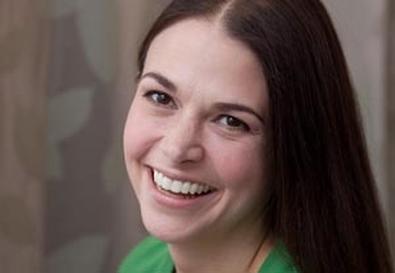
Photo Source: Robin Holland
"I've wanted to be a stage performer from the time I was a little girl," says Foster in her dressing room before a performance. "To be working in the theater and to be recognized in this way is amazing." The nomination carries further significance because it is the most challenging role Foster has tackled. For starters, there's the show's pedigree, not to mention the major stars who have taken on the sexy, cocky Reno Sweeney. "To think of myself in the same sentence with Ethel Merman or Patti LuPone, I couldn't wrap my head around it," Foster says. "It took me a long time to convince myself that I could do it."
Her major stumbling block is how far removed she is from the brazen Miss Sweeney. Foster is soft-spoken and totally unassuming. With few exceptions the roles she has played—from the awkward, naive Millie in "Thoroughly Modern Millie" to the impish Princess Fiona in "Shrek: The Musical"—had at least some connection to Foster's temperament. "We've shared a sensibility or a sense of humor, but Reno is a devil, a troublemaker, a badass," Foster says. "It was so interesting to try and find that within myself."
Though she had seen a snippet of LuPone's performance during the 1988 Tony Awards, and "had a sense of what Ethel Merman had done," Foster refused to view their performances again once she signed on for the role. Determined to make it her own, Foster admits frankly she was also afraid of feeling further intimidated if she watched their legendary spins. Instead, Foster studied Betty Hutton and especially Barbara Stanwyck films, most notably "Ball of Fire." Foster's ambition was to incorporate their assertive styles by working from the outside in.
"I usually try to find similarities between myself and the character," she says, "But this time it was very different. What I needed to get was the way a woman like Reno walks into a room. When I walk into a room I'm apologetic. Reno has no apology. I was so uncomfortable; I didn't know how to grapple with walking into a room and wanting everyone to look at me. That first scene when she comes on is the key to the whole part, and it was the hardest scene for me to crack. I need to have ownership, no apology, fearlessness, and ease. She's awesome. I felt, 'How the hell am I going to do that?' " She pauses to quip, "Typecasting." Beat. "I'd like to have more of her in me."
What makes it all the more stunning is that Foster never auditioned for the role; director-choreographer Kathleen Marshall offered it to her. Admittedly, Foster hasn't had to audition for a musical role in years and, perhaps not surprisingly, her first response was a resounding yes before the panic and the second thoughts surfaced. "I went back and forth, hemmed and hawed, talked it over with my agent," she recalls. "I didn't know if this was right for me. My instinct was that this was going to be difficult. I got offered the part six months before the first day of rehearsal, and my agent said I didn't have to do this. There was time to pull out."
Foster ultimately had a change of heart precisely because it was such a risk and challenge. After all, that's why she had gotten into the business. "That's what I wanted to do—to push myself as an artist and as an actress," she says. Undoubtedly, there were hurdles. "Three breakdowns followed by three breakthroughs," says Foster. But in the end, despite her fear that her performance wouldn't come together, it's clearly a triumph. It's not just the awards, nominations, and reviews; it's also the admiration of her onstage colleagues. Consider what co-star Joel Grey, an Oscar and Tony winner with a host of mega-credits, has to say: "Sutton brings a risk-taking vibrancy that makes use of her tremendous technique and always has the potential to surprise and amuse."
Marshall notes: "Sutton is simply a wonder. We all throw around the term 'triple threat,' but she is the real deal—a deeply emotional and truthful actress, a singer of extraordinary range and versatility and an incredible dancer with style and technique to spare. She brings all this and more to her portrayal of Reno Sweeney. What's more is her unique relationship with an audience, the wonderful sense you get that she is doing this all for you."
Sibling Revelry
The Georgia native was performing from the outset—dancing up a storm and belting her little heart out. When a local production of "Annie" was being cast in Augusta, Foster's mother took her to the audition, and Foster nailed the title role. Foster's elder brother Hunter, a successful actor and playwright, expressed interest in performing at about the same time. Though he had acted in church performances, his sister's gig in "Annie" was the "turning point for both of us," she says. "My brother thought, 'If she can sing, maybe I can sing,' and he auditioned for a production of 'Godspell' and got it."
Foster's father worked for General Motors, and her mother was a homemaker. They were not stage parents, but they recognized the talents in their two children and cultivated those talents. Their children's respective genders played no role in their expectations, Foster says, adding she experienced no conflict with her brother, despite their common pursuits. Now that they're adults, she says, "It's so amazing we both get to do what we love."
When the Foster family moved to Troy, Mich., Foster landed her first major professional break. During her senior year in high school, she heard about an open call for the national tour of "The Will Rogers Follies." They were looking for chorus girls who could tap and were at least 5-foot-7, she recalls. Foster scored and spent her final year of high school on the road, earning her diploma through correspondence courses.
Following a brief stint at Carnegie Mellon University, where she majored in musical theater, Foster dropped out, feeling "lost and confused and not sure what I wanted to do," she says. "It was an amazing program but not right for me." She moved back with her parents, who were now living in Memphis, Tenn. She waited tables, volunteered at a local children's theater, and toyed with the idea of attending other colleges that were nearby. "I thought about studying science; I liked science, but nothing felt right," she says.
Her brother's invitation to visit him in New York turned out to be fortuitous. "It was the mid-'90s, and I went to a couple of open calls, which I read about in Back Stage," she says. "One of the open calls I read about was for the national tour of 'Grease,' with Rosie O'Donnell, and four days later I got it and I was on tour." Foster was 19 years old. From that point on, she has moved from show to show to show.
She defines herself as an actor who sings and dances. "Acting is essential," she says. "Young people often ask me what's most important: acting, singing, or dancing? And I always say acting. You can move your arms around and sing high notes, but if you're not conveying something, it's meaningless."
Ironically, acting is the most recent skill on her roster of achievements. Indeed, besides dance training, she had no formal study in either singing or acting until fairly recent. She studied dance from the time she was 4. As for her voice, it was "big, but I didn't know what to do with it," she says. "Acting came last, though I had a natural ability. I've now taken several acting classes and song performance classes in the city, and finally I feel, 'Oh, oh, I get it.' "
Outside the Box
Foster's turning-point year came in 2010, even before she came on board to play Reno. Indeed, as she tells it, her career trajectory during that time inadvertently most prepared her for her current gig. She took the year off from performing eight shows a week in order to do her own solo concert across the country and at The Carlyle in Manhattan for two weeks. "That taught me how to have ownership on a stage and be responsible for entertaining an audience all by myself," she says. "So did playing Fay Apple in 'Anyone Can Whistle' at Encores and a dominatrix in a straight play, 'Trust' at Second Stage Theatre. The dominatrix was a broken character, but still the character is very much outside the box for me. I'm not sure I could have done Reno without playing those characters or doing my solo show."
Although she is not often asked to audition, she auditioned for "Trust." "I don't get as nervous as I used to," she says. "I teach at Ball State University in Muncie, Indiana, and at NYU, and I tell my students that, at auditions, 'Your greatest asset is who you are, your singularity. People want you to do well. So just be prepared and be yourself.' " She adds, "But then I have to take that advice too."
Foster is every bit the committed teacher, conceding she play-acted teacher as a youngster and is now fulfilling an old fantasy. "I love teaching. I still feel like I'm 15 years old. The gap between the time I was 17 and now feels very small," says the 36-year-old actor, "and I want to share my experiences with young people and give them support and encouragement. Teaching is a major part of my life."
As for onstage roles, Foster would love to tackle Mama Rose from "Gypsy" at some point. But she'd also like to do a contemporary musical. So far she has appeared in revivals or shows set in earlier eras, like "the '20s, '30s, or a medieval period," she says, laughing. "I'd also like to do a contemporary straight play. If there was a role that excited me on a TV series, I'd definitely be interested. But I don't actively pursue it."
Consistently modest, she says that in five years she'd be very happy to "still be working and teaching."
"Anything Goes" is playing through Jan. 8, 2012, at the Stephen Sondheim Theatre, 124 W. 43rd St., NYC. Tickets: (212) 239-6200 or www.telecharge.com. www.anythinggoesonbroadway.com.