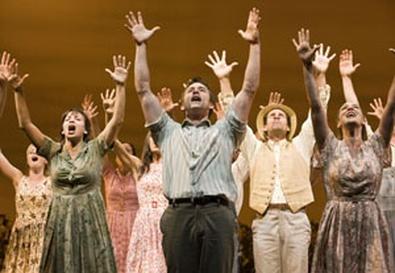
Photo Source: Craig Schwartz
By inserting superfluous Agnes de Mille–style ballet segments, as if this were a modern-day Rodgers-and-Hammerstein opus, and pumping up the volume and the histrionics, it's clear Menken, director-choreographer Rob Ashford, and co-librettists Slater and Janus Cercone envisioned this adaptation as more of an artsy prestige musical than a sentimental bromide for "The Sound of Music" crowd. Dominating the endeavor is the larger-than-life portrayal by Raúl Esparza of antihero Jonas Nightingale, a seemingly amoral evangelist who leads an itinerant gospel choir, selling false dreams of spiritual epiphanies to desperately naive citizens throughout Middle America.
When Nightingale and his band of charlatans find themselves stranded in the severely parched bucolic burg of Sweetwater, Kansas, due to a stalled bus, they embark on their usual routine to raise needed cash. They bilk the beleaguered townspeople out of money they scarcely have, via a deceptive carnival sideshow, which promises faith healing and divine miracles in exchange for a collection plate full of lucre. What the hard-hearted Nightingale—survivor of a traumatic childhood—didn't bargain for was falling for a gutsy greasy-spoon waitress (Brooke Shields as Marva McGowan) who sees through his schemes, and the power of genuine faith rather than the ersatz variety he pushes.
Esparza has a dynamic singing voice and is a formidable presence, but his Mephistophelean con man seems a shade too smarmy for us to buy into his eventual redemption. The performer also sometimes indulges in a mush-mouthed Brando broodiness that seems inappropriate here. Shields sings sweetly if not spectacularly and provides a welcome note of calmness amid the boisterous goings-on. As Marva's crippled son, Boyd, Nicholas Barasch is charming, avoiding bathos and helping us look past the Tiny Tim connection this role could suggest. Kecia Lewis-Evans boasts a terrific singing voice as the choir director, and Kendra Kassebaum, an accomplished actor-singer, has fine moments as Nightingale's sister and accomplice, who comes to terms with her conscience.
Robin Wagner's scenic design is surprisingly minimalist. It proves quite fluid, meshing well with Donald Holder's ravishing lighting effects and William Ivey Long's flavorsome costumes. Boyd and Nightingale's stirring duet "Walk Into the Sunset" and the title-song finale come closest to matching Menken's previous standout work. Yet this project will need its own commitment of faith—and major retooling—to make a successful leap to Broadway.
Presented by Center Theatre Group at the Ahmanson Theatre, 135 N. Grand Ave., L.A.
Oct. 3–24. Tue.–Fri., 8 p.m.; Sat., 2 and 8 p.m.; Sun., 1 and 6:30 p.m. (Added Thu., 2 p.m., Oct. 21. Dark Sun., 6:30 p.m., Oct. 24.) (213) 972-4400. www.centertheatregroup.org.