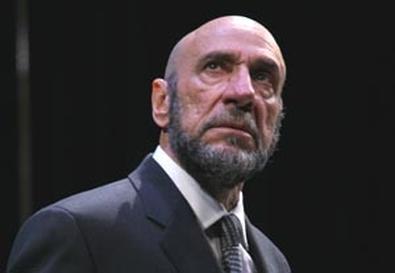
Rarely do you get the chance to see two productions of the same Shakespeare classic headlined by two vastly different Oscar-winning actors at the top of their game. Not long after Al Pacino finished his acclaimed Broadway run as Shylock in "The Merchant of Venice," F. Murray Abraham essays the same role in an Off-Broadway limited run for Theatre for a New Audience, as part of a tour. This is a reprise of the company's 2007 production, in which Abraham starred. Though Abraham's Shylock is not as theatrical as Pacino's, and Darko Tresnjak's production is not as complex as Daniel Sullivan's shaded staging, this "Merchant" is still worth catching.
Tresjnak sets the play in "the near future," and this Venice is as slickly high-tech as Sullivan's was quaintly Edwardian—thanks to John Lee Beatty's cool set, Linda Cho's stylish costumes, and Matthew Myhrum's vibrant videos—yet the materialistic values are the same. Everything and everyone can be bought or sold, including the hand of the lovely Portia and the flesh of Antonio, the titular merchant, who offers his body as a bond to the avaricious Shylock. In Shakespeare's day, the Jewish Shylock was a one-dimensional villain, but in modern times the role has often been reinterpreted as an undeserving social pariah driven to madness by anti-Semitism. But Abraham's Shylock is not mad; he's scarily sane. While Pacino grandly railed against his adversaries, Abraham bears their malice with measured equanimity, allowing his resentment to build slowly. During the climactic trial scene, in which the moneylender prepares to exact his payment from Antonio's bared bosom, Abraham carefully paces outbursts of vehemence against the cursing gentile throng for maximum impact. When Shylock is finally defeated by the disguised Portia, Abraham lets this reserved man's dignity totally crumble and he becomes a sobbing child. It's a devastating moment.
Tresnjak casts Antonio and his comrades as crass Wall Street traders ever ready for boozing and whoring, while Shylock is pious and sober. This tends to put the central conflict in black-and-white terms, with little area for gray—a region occupied by Sullivan's production—but it's still a valid choice. In another unsubtle ploy, the homoerotic bond between Antonio and Bassanio, Portia's successful suitor, is brought right to the forefront here, with the two men openly kissing.
Portia's troubled reaction to her lover's divided loyalty and her hints of racism are played with intelligence by Kate MacCluggage. Usually this heroine is enacted as a totally-in-control feminist, overcoming the sexism of whatever period the director chooses. MacCluggage finds welcome room for doubt and ambiguity.
Tom Nelis gives full body to Antonio's hatred of Shylock and love of Bassanio (a fine Lucas Hall). Christen Simon Marabate makes for a sly Nerissa, Portia's maid. Raphael Nash Thompson finds humor in the Prince of Morocco, one of Portia's failed suitors. Only Ted Schneider overplays his character, turning Gratiano, Nerissa's lover, into a rowdy frat boy out of a Judd Apatow movie. It's the only jarring note in an otherwise solid "Merchant."
Presented by Theatre for a New Audience at Pace University's Michael Schimmel Center for the Arts, 3 Spruce St., NYC. March 4–13. Tue.–Sat., 8 p.m.; Wed. and Sat., 2 p.m.; Sun., 3 p.m. (212) 352-3101, (866) 811-4111, www.theatermania.com, or www.tfana.com. Casting by Deborah Brown.