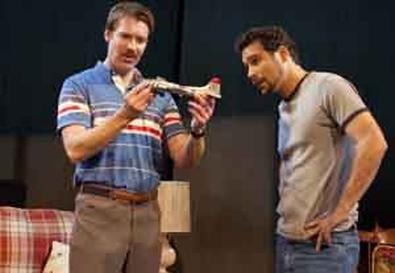
What is up with Manhattan Theatre Club? It's a mystery why this distinguished company, which normally chooses challenging work or at least entertaining, broad-appeal fare, would offer a mundane thriller/soap opera like Beau Willimon's "Spirit Control." This predictable melodrama, revolving around a haunted air-traffic controller, is like a cross between an old "Twilight Zone" episode and a Hallmark Channel TV movie.
It opens interestingly enough, with Adam and Karl starting a normal day guiding planes into the Spirit of St. Louis Airport. Spirit control is the name of their workplace, a moniker dripping with unsubtle irony that will figure later in the story. Tensions mount when the pilot of a small aircraft loses consciousness, and Adam must instruct the plane's sole passenger, a hysterical woman with no flying experience named Maxine, in landing the vehicle. Without giving too much of the corny plot away, the outcome of this emergency shatters Adam's home and work lives as he becomes obsessed with Maxine, imagining her everywhere. The crackling beginning soon descends into weepy sogginess as Adam drifts away from his loving wife, Jess—eventually losing her to the steadier Karl—and his hostile son Tommy. The playwright lazily denotes the passage of time by equipping the characters with more-sophisticated cell phones and having them exchange views on the latest websites.
Willimon may have wanted to write a tragedy about how random events can irreparably damage us, but he fails to develop his characters beyond basic outlines, so we aren't moved to care what happens to them. He also fails to examine Adam's obsession with any depth, so the final resolution—which you can see coming a mile away—has no impact. What psychological void does Maxine fill for Adam? Willimon offers no answers or even possibilities.
Director Henry Wishcamper does what he can to elevate the material above its TV-level standards, but there's only so much that tight staging can accomplish. Likewise, the cast tries to step beyond the rigid confines of the script but can't always make the leap. Jeremy Sisto earnestly conveys Adam's frustration at losing his connection with his son, but he doesn't come across as the tortured victim of a destructive passion, which seems to have been the playwright's main intention. As Maxine, Mia Barron has the impossible task of playing a dramatic device, a projection of Adam's imagination. Still, she manages to make a modicum of sense of this figment's objectives, particularly in a bizarre monologue that fuses the shards of scattered information about Maxine with Adam's own psyche. Maggie Lacey makes an appropriately loving yet confused Jess, Aaron Michael Davies is a surly Tommy, and Brian Hutchison is a supportive Karl. Willimon doesn't give them much more than those qualities to play. Charles Borland completes the cast, offering a solid cameo as an FAA official.
Robin Vest's set design is spare and functional, while Natasha Katz's lighting and Aaron Rhyne's projections create a spooky atmosphere. Broken Chord's sound design realistically conveys the world of air-traffic controllers. Too bad the same can't be said for the play.
Presented by Manhattan Theatre Club at City Center Stage I, 131 W. 55th St., NYC. Oct. 26–Dec. 5. Schedule varies. (212) 581-1212 or www.nycitycenter.org. Casting by David Caparelliotis.