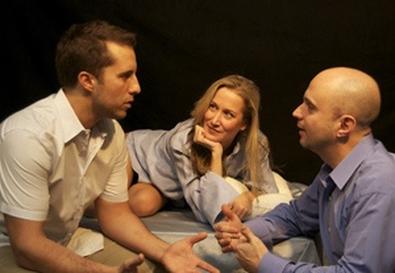
Photo Source: Jesse Teeters
After a brief prologue of golden but troubled youth on college graduation day, which sets up both a romantic triangle and incipient professional pecking order, we jump 15 years. Slack off but charming Dean has given up pursuing his dream to be a screenwriter, settling for a dead-end job designing Internet news sites. He's engaged to the impossibly understanding Lisa but unenthusiastic about their impending nuptials or starting a family. Party girl Suzie, who once had a thing with Dean, has returned from working with Nicaraguan children and survived a divorce, but she's just as loud and shallow as ever. Intellectual Graham, who once lusted for Suzie and got a master's in film from USC (where Dean couldn't get accepted), followed a girl to England, where he ended up working for her father in finance and made a fortune. Graham has returned to Hollywood to finally use his degree and be a producer. Dean has one last script, which Lisa says is the best thing he's ever done. Suzie longs for the good old days. But when Graham, instead of offering to produce Dean's script, wants to buy it outright and put his own name on it, things get sticky.
Brooks' effortful backstories for his three main characters never ring true. Indeed, the characters barely change, unlikely considering what they've been through. The biggest problem is the embittered Dean, who complains endlessly about being frozen out of Hollywood, for reasons never entirely explained, considering how good he's supposed to be. Then there's that screenplay, a World War II story that's described as "the next 'Schindler's List.' " Unfortunately, what we hear of it sounds awfully kitschy, which is not such a good thing when dealing with the Holocaust, though not surprising considering how remote the subject matter is from Dean's life and persona. As for the manipulative Graham, he comes across more as an act of authorial revenge than an actual person. The women are no more than devices, there to facilitate the main story of the duel between the two men.
Under Jenny Greeman's straightforward direction, the cast is pretty much defeated by the writing. Real-life married couple Jonathan Sale and Heather Dilly strike believable erotic sparks, and Dilly contributes a welcome energy, but they can't make us care about either character. Diana DeLaCruz makes a sweet-natured Lisa but fails to convince us as to why Lisa's there in the first place. Brooks plays Graham, who is described in dialogue as "cute" and in stage directions as "looking fantastic, confident, successful." Actor Brooks, alas, gives Graham an overpowering sense of sleaze, completely undercutting writer Brooks' intentions.
What may seem like little things can actually be revelatory of core problems. When Dean confronts Graham on the night his screenplay is up for an Oscar, he simply knocks on the door of Graham's fancy downtown L.A. hotel room. Of course, the chances that schlumpy, desperate Dean could ever have gotten to that hotel room are virtually nil. When a writer is willing to take that kind of shortcut, and at such an important juncture, it speaks volumes.
Presented by Badlands Theatre Company at 59E59 Theaters, 59 E. 59th St., NYC. Jan. 16–Feb. 6. Tue. and Wed., 7:15 p.m.; Thu. and Fri., 8:15 p.m.; Sat., 2:15 and 8:15 p.m.; Sun., 3:15 and 7:15 p.m. (No performance Sun., Feb. 6, 7:15 p.m.) (212) 279-4200 or www.ticketcentralcom.