Photo Source: Ves Pitts
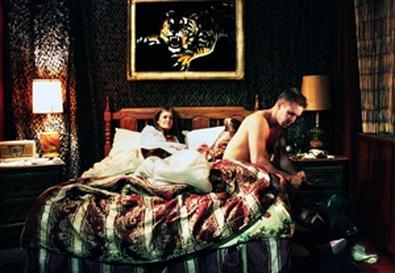
Claude Dunphy, a handsome and muscular good ol' Southern boy home on leave from Vietnam, has returned from some solo bar-hopping on his wedding night and found his nearly naked wife in bed and covered with scratches and bruises. She insists he used her for rough sex and then fell asleep, so drunk that he has no memory of what he did. He insists he didn't do it and demands to know who did. The dance that follows is a violent pas de deux of desire.
Adam Couperthwaite and Erin Markey don't miss a trick as they delineate the shifting dynamics between the newlyweds. For the most part, the bride is in control, and Markey's Mrs. Dunphy is an intriguing and combustible mixture of heated desire and cold calculation. Couperthwaite gives Claude a powerful sexual appeal and an inherent sense of dangerously fragile decency. Both actors address the sexual content forthrightly and bravely, exposing considerable flesh and surging desire just inches away from their audience.
Chamberlain's site-specific staging turns the 20-person audience into a collection of voyeurs, something Markey significantly enhances by constantly locking eyes with individual patrons. It's a smart choice, because it suggests for us today how transgressive the subject matter would have been in 1970. The wonderfully florid and squalid production design, by Christopher Keegan and Chamberlain, is dominated by a lurid painting of a tiger, on what appears to be a black velvet background, that hangs over the double bed and provides the evening with a deliciously satisfying button. Duncan Cutler and Chamberlain's subtle sound design keeps the specter of the Vietnam battlefield hovering throughout. Derek Wright's atmospheric lighting is a wonder in such an unforgiving space, and special mention must go to Jason Howard's expertly done fight direction, which Markey and Couperthwaite execute with primal force.
Chamberlain has added a musical prelude for Markey that is basically there to get her into the room but nevertheless feels entirely appropriate. He also wisely directs on several levels. A simple reading of Williams' text suggests that Claude has indeed been cuckolded. Chamberlain allows for that possibility, but he also suggests that the proceedings may be an elaborate game that lets both husband and wife fulfill their sadomasochistic desires, or, conversely, that the husband is being goaded, possibly even trained, by his wife to become a willing participant in satisfying hers. It leaves one pondering long after the curtain.
A fascinating footnote: Williams has given Claude the same surname as Truman Capote's rugged longtime partner, the dancer-turned-writer Jack Dunphy. While "Green Eyes" is most definitely about a man and a woman, the surname suggests that the playwright didn't think his observations should be restricted to heterosexual relationships. Nevertheless, in 1970, writing about a sadomasochistic gay relationship was probably one country too far, even for the provocative Williams.
Presented by Carleigh Welsh, Christopher Keegan, Travis Chamberlain, and Performance Space 122 as part of Coil at the Hudson Hotel, 356 W. 58th St., NYC. Jan. 9–23. Wed.–Sat., 8 and 9:30 p.m.; Sun., 5 and 7 p.m. (Additional performances Mon., Jan. 10, 8 and 9:30 p.m.) (212) 352-3101, (866) 811-4111, or www.theatermania.com.