Photo Source: Meg Green
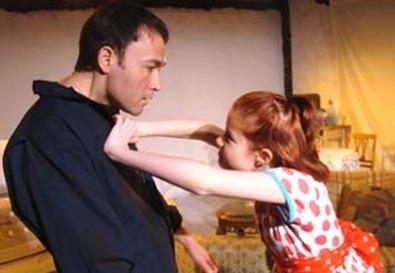
Lee Eden has Rhoda's self-possession down pat and knows how to turn on the charm in a way that could easily fool a roomful of gullible grownups. But we don't see the wheels turning: Eden doesn't convey Rhoda's calculation sufficiently or bond enough with Christine (Sharon Hunter), her increasingly desperate, horrified mother. It makes one appreciate Patty McCormack, the original Rhoda, all the more. Eleven years old and tall, Eden takes some getting used to as an eight-year-old. And no pigtails—Rhoda should always have pigtails.
Hunter begins as a conventional mom and carefully adds layers of ambition, ambivalence (as she discovers more about Rhoda), and panic (when Christine learns her true identity—according to Anderson, and it's a stretch, evil is hereditary but skips generations). It's a much less hysterical performance than Nancy Kelly's in the film. But without a multifaceted Rhoda to play against, Hunter is often doing the heavy lifting, despite a generally fine supporting cast. Wynne Anders captures all the silliness and pretension as the nosy landlord, and special mention must be made of Mark Armstrong's outstanding Kenneth Penmark: Though he's in only two scenes, his unconditional love for his family (in the first) and anguish (in the second) are real and spot-on.
I hate to pick on a black-box company with no budget, but S. Barton-Farcas, who directed and designed the set, gives us a downright weird 1950s well-to-do living room: 1920s phone, 1930s radio, sofa on a riser above the rest of the set (to double as Rhoda's bed). Her actors play mostly downstage front and seldom look at each other. Characters just enter after ringing the doorbell—wouldn't they wait?—and one actor allegedly headed for the second floor walked out the front door. Better blocking, please.
Anderson's play is enjoyable for its 1950s structure—bells and phones always ringing to introduce plot points—and its then-shocking cocktail chatter on such subjects as homosexuality and incest. It ends far more creepily and satisfyingly than the movie, and the author's penchant for high-flown poesy is kept well in check. This isn't an ideal "The Bad Seed," but with so few old-fashioned well-made plays on the boards nowadays, we'll take what we can get.
Presented by and at Nicu's Spoon, 38 W. 38th St., 5th floor, NYC. April 9–24. Wed.–Sat., 8 p.m.; Sun., 2 p.m. (212) 352-3101, (866) 811-4111, www.theatermania.com, or www.spoontheater.org.