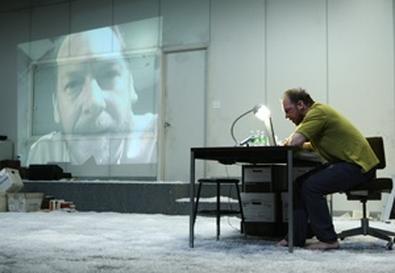
"Notes From Underground," Bill Camp and Robert Woodruff's adaptation of Fyodor Dostoyevsky's novella, is a harrowing evening of theater that will appeal to those who delight in profound but difficult thought and exhaustive emotional venting. The faint of heart and easily bored are not the audience Theatre for a New Audience is cultivating.
In this Yale Repertory Theatre production, which has arrived in New York after a stop at La Jolla Playhouse, actor Camp and director Woodruff have created more of a theatrical confession than a play in the traditional sense of the word. The story and text are Dostoyevsky's, but the adapters have updated the setting to our world, complete with laptops, webcams, onstage synthesizer players, and canned beverages. This ploy could easily have foundered on the shoals of pretension, but Camp and Woodruff mostly avoid that by letting the central character's humanity dominate the proceedings.
In the first half, an unnamed former government clerk explains why he prefers living underground, divorced from a society that he despises and that ignores him. In a torrent of words, he refutes the notion that mankind's nature is essentially good, insisting that we often deliberately act against our best interests. These thoughts, he explains, arise from the memory of an incident that happened to him several years previously. The second half of the play is his recollection of that crucial moment: his encounter with a young prostitute named Liza. She believed him to be a possible rescuer from her sordid life, but he drove her away with a brutally honest demonstration of his inability to be "good." That failure has haunted him ever since, and we realize that his avalanche of verbiage and philosophizing is a rationalization for it.
Camp leaves no emotion unearthed in his scathing, bravura portrayal of the man. As Liza, Merritt Janson is heart-rending. The scene in which the man "breaks" her is almost unwatchable, and yet we can't avert our eyes from it. David Zinn's snow-blanketed set and Peter Nigrini's poetic projections mirror the misery in the man's mind and freshen the tale without diminishing its pressure-cooker intensity.
Dostoyevsky wrote his novella in response to ideas current in mid-19th-century Russia. That immediacy is gone, but his unflinching examination of one man's soul produces timeless and universal insights, and what he says about mankind's determination to louse up opportunities to better itself throws a thick wet blanket over our flabby and sentimental notions about progressivism. At the end, when Dostoyevsky has purged himself by spilling the naked, shameful truth, he realizes he has nothing left to say and simply stops. That's good advice for all writers.
Presented by Theatre for a New Audience in association with Baryshnikov Arts Center at the Baryshnikov Arts Center, 450 W. 37th St., NYC. Nov. 11–28. Schedule varies. (212) 868-4444 or www.smarttix.com. Casting by Tara Rubin Casting.