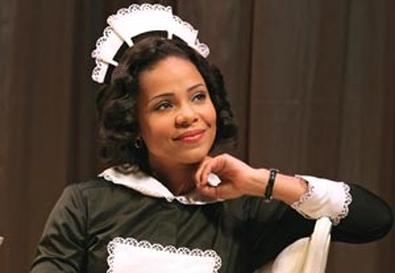
Photo Source: Joan Marcus
The title character is a talented performer determined to make her mark in 1930s Hollywood, but her race and gender confine her to maid roles. While working in that capacity for a girlhood friend, the white star Gloria Mitchell, Vera learns of a juicy servant part in an upcoming Southern epic with echoes of "Gone With the Wind," "Jezebel," and "Imitation of Life." She snares the role and launches a decades-long career, but racist attitudes continue to limit her employment opportunities. In a fascinating and daring move, Nottage sets the second act in 2003, with a trio of pretentious academics debating the significance of Stark's journey while viewing her final TV appearance, on a talk show in 1973. The three eras are re-created with style and wit in Neil Patel's sets and ESosa's costumes.
Throughout this imaginative and wildly funny trip through 70 years of American pop culture, Nottage expertly demonstrates how movies and TV reflect larger societal shifts in race and gender issues. Vera becomes a representative not only of actors like Hattie McDaniel, Louise Beavers, and Dorothy Dandridge, who struggled for dignity and identity, but of all African-American women of the period.
Director Jo Bonney, who maintains a sprightly comic pace in the first act, deftly juggles the two timelines in the second, while a sensational cast finds both parody and pathos in characters who represent a variety of recognizable showbiz types but are nonetheless still individuals.
Sanaa Lathan gives an outstanding performance as the gritty Vera, painstakingly detailing her voyage from eager, sexy newcomer to cynical, bitter veteran. Lathan's portrait references and pays tribute to a galaxy of African-American performers, including the forgotten Fredi Washington (of 1934's "Imitation of Life") and the legendary Sarah Vaughan. Stephanie J. Block's Gloria is a delightfully selfish diva in the Bette Davis/Joan Crawford mold, who gracefully shifts into grand-old-lady gear in the second act. Kimberly Hébert Gregory nearly steals the show as Lottie, Vera's caustic roommate, a Broadway veteran so desperate for any movie job that she'll shuck and jive like Stepin Fetchit for the first director to cross her path. Gregory is equally captivating as a sanctimonious scholar. Daniel Breaker does a similarly dazzling dual act, strutting sexily as a jazz musician with a crush on Vera and then pompously posturing as a critic analyzing her career. Karen Olivo is a riot as a sultry temptress and a radical poet, David Garrison slyly pokes fun at Jewish studio heads and bland chat-show hosts, and Kevin Isola garners guffaws as a temperamental Russian director and a Jagger-ish rock star.
Presented by and at Second Stage Theatre, 305 W. 43rd St., NYC. May 9–June 12. Tue., 7 p.m.; Wed.–Sat., 8 p.m.; Wed. and Sat., 2 p.m.; Sun., 3 p.m. (212) 246-4422, (800) 766-6048, or www.2st.com. Casting by MelCap Casting.