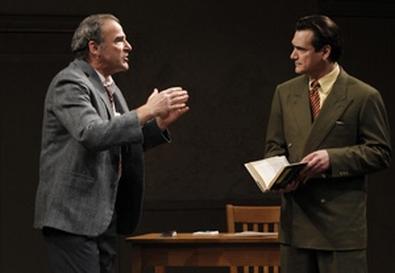
Rinne Groff's new three-person play, a commission of the Public Theater and Berkeley Repertory Theatre, is a fictionalized account of author Meyer Levin's obsession with "The Diary of Anne Frank" and his quixotic, decades-long campaign to get recognition for his rejected and suppressed stage adaptation. Groff tells this fascinating and rather scary story imaginatively, with marionettes of Anne Frank and other characters, both in the diary and in Groff's play, employed to unsettling effect. But director Oskar Eustis fails to guide star Mandy Patinkin to a disciplined portrayal of Levin, here renamed Sid Silver, allowing the actor's insufficiently shaded and over-the-top emoting to undercut the proceedings.
The play begins in 1951 in the offices of Doubleday, where the middle-aged Silver, as Otto Frank's official representative, is trying to bully an editor into publishing the diary. The rest of the first act follows Silver's writing of his stage adaptation, its ultimate rejection by Otto in favor of a "less Jewish, more universal" version by Hollywood screenwriters Frances Goodrich and Albert Hackett, and Silver's lawsuits and incessant vicious personal attacks against Otto and others, which ultimately threaten to destroy his happy marriage. Act 2 begins in 1966, with Silver and his family having moved to Israel. Here he breaks his promise to his wife never to mention Anne again and ends up getting a theater company to mount an illegal production of his script. It gets excellent reviews that call it better than the official version but is soon shut down by Otto, sending Silver galloping over the edge of reason. Groff ends her story in 1981, with a dying Silver still raging, doing such things as writing a letter to the Pulitzer Prize committee demanding that it rescind its award to Goodrich and Hackett.
Matt Acheson's haunting puppets—beautifully manipulated by Emily DeCola, Daniel Fay, and Eric Wright from a catwalk above the stage—are used to enact scenes from both dramatizations. But the most arresting moments come when the marionette Anne interacts with Silver and others. The Act 2 scene in which Anne, voiced by Silver, appears in bed between husband and wife and bargains with her to be allowed to stay is a stunner. But Groff lets the play peter out in an awkward two-person scene involving a minor character and a final imagined dialogue between Anne and Silver, here both puppets, that leaves the question of whether he was devoted to her cause or his own unsatisfyingly hanging.
Patinkin sounds like ideal casting—who does a compulsive artist better than he?—but he's acting basically on two notes: quietly edgy containment and operatic rage. When Silver suffers a panic attack in Act 2, the actor's tortured breathing and high-pitched keening are so distracting that they utterly obscure the scene's content. The approach ultimately makes Silver into something of a cartoon: When he screams a line like "If you really loved me, long ago you would have killed Otto Frank!" to his wife, it's eye-rolling, not chilling.
Matte Osian can't make too much of an impression with a succession of colorless editors, lawyers, and publishing executives, but he does stand out as the ambitious Israeli director Silver cons into staging his play. Hannah Cabell does a terrific job moving back and forth between the confident and controlled Miss Mermin, a junior editor at Doubleday with big plans for herself, and Silver's wife, a free-spirited Frenchwoman driven at one point to attempted suicide.
Eustis stages the show well on Eugene Lee's minimalist set, which makes effective use of Jeff Sugg's enhancing video and projections. But it's hard to understand how, after out-of-town runs at Berkeley and Yale Rep, he allowed Patinkin to bring this misconceived performance to New York.
Presented by the Public Theater, Berkeley Repertory Theatre, and Yale Repertory Theatre at the Public Theater, 425 Lafayette St., NYC. Feb. 17–March 13. Tue.–Sat., 8 p.m.; Sat. and Sun., 2 p.m. (Additional performance Wed., March 2, 2 p.m.; no performance Sun., March 6.) (212) 967-7555 or www.publictheater.org. Casting by Jordan Thaler and Heidi Griffiths.