Photo Source: Joan Marcus
The time is 1958, and the place is Bennington, Vt. Eighteen-year-old Mary Katherine (“Merricat”) Blackwood and her older sister, Constance, live in a grand old house on the outskirts of town with their sickly Uncle Julian. Six years earlier, Constance was acquitted of the murders of the rest of her wealthy family, all poisoned at dinner. The survivors keep to themselves, allowing only a handful of visitors, and are envied and hated by the locals, who continue to believe Constance guilty. The Blackwoods' odd equilibrium is upset by the arrival of handsome cousin Charles, who romances Constance and encourages her to rejoin the world. This infuriates Merricat, and the battle for Constance commences.
What the show desperately needs is a good lyricist. Almond and Bock share that credit, but it’s a misnomer. These are not lyrics, just sung text, and the words don’t work with the music in ways that allow their content to land. Rhyme is treated like the crazy old aunt in the attic: It’s there, but it must be kept out of sight at all costs. But the judicious use of rhyme, coupled with coherent structural patterns, is what gives song force and weight. If you eschew it, you need to replace it with something equally potent. Almond’s music has attractive harmonies, arresting accompaniment figures, and intricately textured orchestrations (by Almond and music director Dan Lipton), but the songs are too often insufficiently shaped and lacking in compelling vocal lines. They also lack dramatic purpose, repeatedly expressing little but tone and stalling the action. It’s telling that the show comes most alive in several of Bock’s well-written book scenes, particularly the Act 2 opening, a flashback to the night of the murders that’s a brilliant idea and perfectly placed.
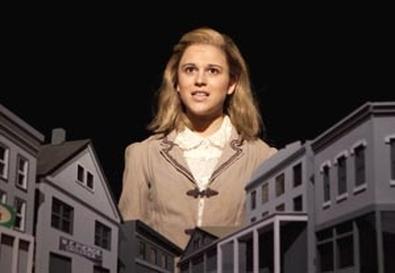
The top-flight cast is led by the commanding Alexandra Socha as Merricat. Haughty and fierce, yet with an underlying vulnerability, Socha rivets our attention and sings powerfully. Jenn Gambatese, also a vocal phenomenon, is perhaps just a shade too off-kilter up top as Constance, but she soon finds the center of this warm-hearted, eager-to-please, yet also prideful woman who both fears and longs for the world. Bill Buell is a sardonic delight as Uncle Julian, registering strongly despite the character’s lack of a song. Sean Palmer’s Charles exerts a powerful sexuality and charm and carries the proper 1950s assumption of being the man of the house, even if it’s not his house. In supporting roles, Beth McVey, Joy Franz, and William Parry all do incisive work.
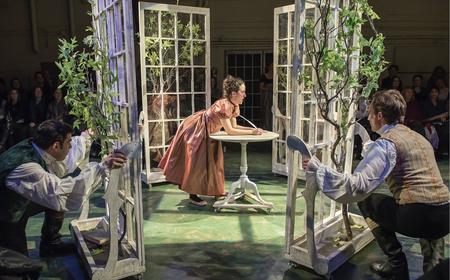
David Zinn’s atmospheric, enveloping set, notable for an optical illusion that fits this material like a glove, is lit with suitable moodiness by Stephen Strawbridge. Ilona Somogyi’s costumes complete the period picture admirably, though Merricat’s final dress, a vestige of something in the novel that Bock has removed, only confuses.
Bock and Almond may be searching for a new form for the musical, but they are not going to find it until they better understand why the old form works.
Presented by Yale Repertory Theatre at Yale University Theatre, 222 York St., New Haven, Conn. Sept. 23–Oct. 9. Tue.–Fri., 8 p.m.; Sat., 2 and 8 p.m. (Additional performance Wed., Sept. 29, 2 p.m.) (203) 432-1234 or www.yalerep.org. Casting by Tara Rubin and Laura Schutzel.